

The 'Rational' Trap: Why You Need to Unpack Decision-Making Flaws.
Golden Hook & Introduction
SECTION
Nova: Alright, Atlas, quick question for you: Do you trust your gut? Because a Nobel Prize-winning psychologist might tell you that your gut, while brilliant, is also a master of self-deception.
Atlas: Oh man, Nova, that's a bit of a curveball! I'd like to think I trust my gut, especially after years of… well, existing. But 'master of self-deception' is a pretty strong accusation. What are you getting at?
Nova: I'm getting at the 'Rational' Trap, Atlas. That pervasive, often unconscious belief that our decisions are purely logical, purely rational. It's a common blind spot, especially when we're trying to analyze complex systems or even just understand human behavior.
Atlas: That resonates. I imagine a lot of our listeners, especially those who pride themselves on being analytical, might feel a slight prickle of discomfort right now. We to believe we're rational.
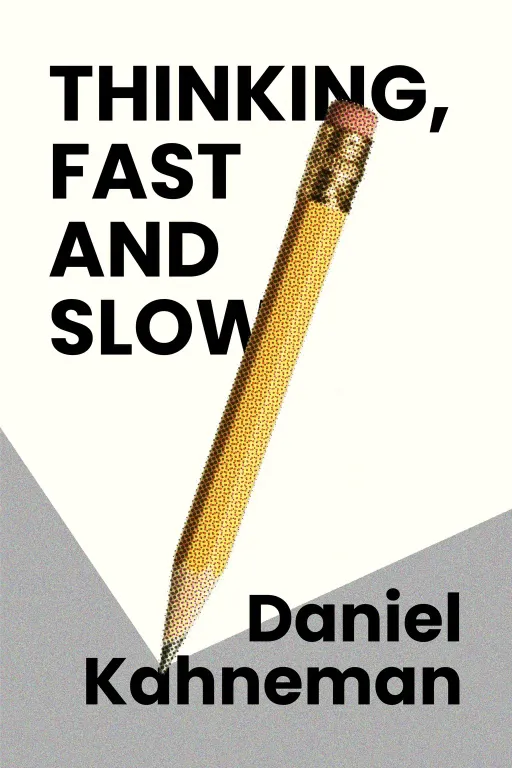
Nova: Exactly. And that's why today we're diving into some truly groundbreaking work that unpacks these decision-making flaws. We're talking about the insights from Daniel Kahneman's seminal book, "Thinking, Fast and Slow," and Richard Thaler and Cass Sunstein's equally impactful work, "Nudge." Both Kahneman and Thaler were awarded the Nobel Memorial Prize in Economic Sciences for their pioneering work, essentially proving that psychology and economics are far more intertwined than we ever thought.
Atlas: Wow, so this isn't just some pop psychology; this is Nobel-level science telling us our brains are playing tricks on us. I can see why understanding this 'blind spot' would be crucial for making better judgments.
The Hidden Architects: Intuition vs. Deliberation in Decision-Making
SECTION
Nova: It absolutely is. And the first step to understanding it is Kahneman's revolutionary concept of two systems of thought: System 1 and System 2. Think of System 1 as your fast, intuitive, emotional, almost autopilot brain. It's what allows you to instantly recognize a face, understand simple sentences, or slam on the brakes in an emergency. It's incredibly efficient, but it's also prone to predictable biases.
Atlas: So, my gut feeling, my first impression, is usually System 1 at work. That makes sense, but why is it a 'master of self-deception'?
Nova: Because System 1 loves shortcuts. It prioritizes speed and coherence over accuracy. Then there's System 2: your slow, deliberative, logical, effortful brain. This is what you engage when you're solving a complex math problem, learning a new skill, or carefully weighing the pros and cons of a major decision. It requires concentration, and frankly, it's lazy. It prefers to let System 1 handle things whenever possible.
Atlas: I know that feeling. My System 2 definitely tries to delegate to System 1 on Monday mornings. But how does this play out in a concrete scenario where System 1 leads us astray? Can you give an example?
Nova: Absolutely. It's famously illustrated by what's called "The Bat and Ball Problem." It goes like this: A bat and a ball together cost $1.10. The bat costs $1.00 more than the ball. How much does the ball cost?
Atlas: Oh, I've heard this one! My System 1 immediately screams out "10 cents!"
Nova: Exactly! And that's the classic System 1 response. It's fast, intuitive, and feels right. But it's wrong. If the ball costs 10 cents, and the bat costs a dollar more, the bat would be $1.10, making the total $1.20. The correct answer, if you engage your System 2 and do the math, is that the ball costs 5 cents, and the bat costs $1.05.
Atlas: Wow. That's a perfect example. I can feel my System 1 trying to justify its answer, even though my System 2 just did the math. That's actually really unsettling, because it shows how easily we can be confident in an incorrect answer. For someone constantly analyzing information or making strategic calls, how does this manifest in more professional settings?
Nova: It's everywhere. Think about confirmation bias, where we seek out information that confirms our existing beliefs. Or the availability heuristic, where we overestimate the likelihood of events that are easily recalled, perhaps because they were recent or vivid. System 1 drives these biases. It's making decisions you'd prefer System 2 to handle, often when you're under pressure, tired, or simply not paying enough attention. It means our initial interpretations of data, our first impressions of a new market, or even our assessment of a team's performance can be skewed by these invisible forces.
The Gentle Push: How Context Shapes Our 'Free' Choices
SECTION
Nova: Once we understand these internal mechanisms, we can then see how the world around us is constantly interacting with them. This is where Thaler and Sunstein's "Nudge" comes in. If System 1 is prone to shortcuts, can we design our environment to gently steer those shortcuts towards better outcomes?
Atlas: So, if our internal systems are flawed, are we just pawns of our environment? Or is this about something more constructive?
Nova: It's definitely more constructive. Thaler and Sunstein introduce the concept of "choice architecture." This isn't about manipulation or restricting freedom. It's about recognizing that choices are never made in a vacuum. The way options are presented, the default settings, the physical layout of a room—all of these are "nudges" that can predictably influence our decisions without taking away our freedom to choose otherwise.
Atlas: That sounds a bit out there. Can you give an example of a nudge in action? Like how does this actually work?
Nova: Imagine a school cafeteria. If the chocolate milk is placed right at the front, easy to grab, and the plain milk is at the back, guess which one kids will choose more often? That's a nudge. A more impactful example is organ donation. In some countries, you have to actively opt-in to be an organ donor, and participation rates are low. In others, you are automatically an organ donor unless you actively opt-out. The opt-out countries have significantly higher donation rates. The choice is still yours, but the default option, the 'nudge,' makes a huge difference.
Atlas: Wow, that's incredibly powerful. So this isn't just about individual psychology; it's about how societies and systems can be designed to help us make better choices without forcing us. It's like we're always being influenced, whether we realize it or not. I've been thinking about this from a cultural perspective—how might different cultural contexts 'nudge' people towards different decisions without them even realizing it?
Nova: Exactly! Cultures build their own choice architectures through norms, traditions, and even the design of public spaces. And for us, as individuals, understanding nudges means we can both be aware of when we're being nudged, and even design our own 'personal nudges.' Want to eat healthier? Don't rely on willpower. Nudge yourself by putting healthy snacks at eye level and hiding the junk food. Want to save more? Set up an automatic transfer to your savings account – an opt-out for your future self.
Atlas: That's a great way to put it. It's about designing your environment to work with your System 1, rather than constantly battling against it with a tired System 2.
Synthesis & Takeaways
SECTION
Nova: Precisely. The journey from Kahneman to Thaler and Sunstein shows us that our minds are full of fascinating, efficient, but sometimes error-prone shortcuts. And the world around us is constantly interacting with those shortcuts, whether intentionally or not. The power comes from recognizing these 'rational traps' and understanding the subtle forces at play.
Atlas: So, to bring it back to that deep question: Where in our daily analysis might System 1 be making decisions we'd prefer System 2 to handle? How do we even begin to spot those moments?
Nova: The first step is awareness, Atlas. When a decision feels too easy, or you have an incredibly strong gut reaction, especially in a complex situation, pause. Ask yourself: Is this System 1 trying to take a shortcut? Force yourself to articulate the logic, to consider alternative perspectives, to look for disconfirming evidence. It's about cultivating a habit of intentional reflection, particularly in high-stakes situations.
Atlas: That's actually really inspiring. It’s not about beating ourselves up for being irrational, but about understanding our own cognitive architecture so we can work it, not against it. It's a continuous journey of self-discovery and better decision-making for anyone who wants to deepen their understanding of themselves and the world.
Nova: Absolutely. It's about becoming a better decision architect of your own life and understanding the unseen forces that shape our world.
Atlas: Powerful stuff, Nova.
Nova: This is Aibrary. Congratulations on your growth!









