The 'Rational' Trap: Why Understanding Biases is Your Biggest Business Advantage.
Golden Hook & Introduction
SECTION
Nova: I was today years old when I realized my brain, the very thing I rely on for 'smart' decisions, is actually a master of self-deception, especially when it comes to money.
Atlas: Oh, I love that. I feel like I have those 'today years old' moments almost daily, particularly when I look back at some of my past financial choices. It's like, 'What was I even thinking?' But then, was I really 'thinking' at all?
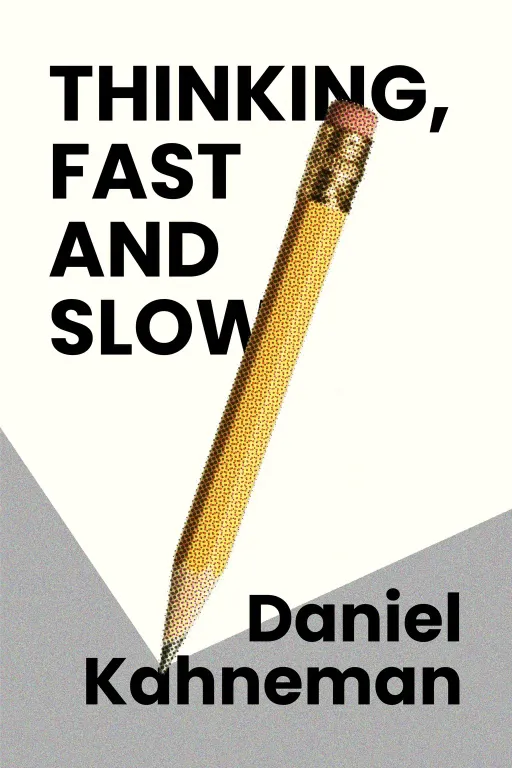
Nova: Exactly! And that's precisely what we're diving into today. Our guides for this fascinating journey are two absolute titans in the field of behavioral economics: Daniel Kahneman's seminal work, "Thinking, Fast and Slow," and Richard H. Thaler's equally impactful "Nudge." What’s so striking is that Kahneman, a psychologist by training, actually won the Nobel Memorial Prize in Economic Sciences for his groundbreaking work. He wasn't an economist, but he completely reshaped how we understand economic decision-making, proving that psychology is inseparable from our financial lives.
Atlas: That’s a great way to put it. It really highlights how interdisciplinary these insights are. For so long, we've been told that business and finance are purely rational domains, driven by logic and numbers. But you're telling me that even in the boardroom, or when analyzing complex market trends, our 'rational' decisions might be secretly swayed by something else entirely?
Nova: Absolutely. And that leads us directly to what I call 'The Blind Spot.'
Atlas: The Blind Spot. Sounds ominous.
The Blind Spot - Unmasking Our 'Rational' Illusion
SECTION
Nova: It is, in a way. We operate under this powerful illusion that our decisions, especially professional ones, are purely rational. We crunch numbers, we analyze data, we build spreadsheets. We we're objective. But human behavior is deeply, profoundly influenced by hidden biases and mental shortcuts. These are the 'irrationalities' that, when overlooked, lead to costly mistakes and missed opportunities in everything from budget allocation to market analysis.
Atlas: Okay, but how does that manifest? I mean, for our listeners who are navigating high-stakes financial regulations or trying to optimize their internal processes, 'irrationality' sounds a bit… soft. Isn't business all about cold, hard logic? Where's the 'irrationality' in a spreadsheet?
Nova: That’s a perfect question, because it’s often invisible until you know what to look for. Let’s take the 'Anchoring Effect' as a prime example. This is a cognitive bias where an individual's first exposure to a number or a piece of information serves as a 'starting point' and subsequently influences their later judgments and decisions, even if that initial information is completely arbitrary or irrelevant.
Atlas: Wait, so you're saying if someone just throws out a random number, it can actually warp my perception of value? That sounds a bit out there.
Nova: It sounds ridiculous, doesn't it? But it's incredibly powerful. Imagine a company trying to sell a product or even an entire business. If the initial asking price is set very high – say, $10 million for a small startup that might realistically be worth $5 million – that $10 million figure becomes the 'anchor.' Even if the buyer knows it's inflated, their subsequent counter-offers and negotiations will often be unconsciously drawn upwards towards that initial anchor. They might end up agreeing to $7 million, feeling like they got a 'deal,' when they would have initially valued it much lower if no anchor had been present.
Atlas: That's incredible. So the cause is System 1, our fast, intuitive thinking, just latching onto that easy-to-recall number. The process is this unconscious adjustment from that starting point, and the outcome is potentially overpaying or missing a truly fair valuation. So, if a budget was initially set high years ago, are you saying we're 'anchored' to that, even if market conditions have changed dramatically?
Nova: Exactly! Or consider market trend analysis. If analysts initially anchor onto a particular growth projection from a competitor's report, even if their own data suggests something different, they might unconsciously filter new information to confirm that initial anchor. This leads to inefficient resource deployment, missed opportunities, and decisions based on outdated or biased starting points rather than a truly fresh analysis. It's System 1 making a snap judgment based on what's 'available' as an initial reference, and then System 2 not fully correcting it. That's a costly blind spot.
The Shift - Harnessing System 1 & System 2 for Business Advantage
SECTION
Nova: Understanding that blind spot, that the brain can be its own worst enemy, is just the beginning. The real power, the true business advantage, comes from understanding our minds work, thanks to thinkers like Kahneman and Thaler. They don't just point out the problems; they give us the tools to navigate them.
Atlas: Okay, so how do we move from 'blind spot' to 'business advantage'? What's the practical application here for someone who needs to make impactful decisions every day?
Nova: This is where Kahneman's distinction between System 1 and System 2 thinking becomes incredibly useful. System 1 is our fast, intuitive, emotional, and often unconscious mode of thought. It's what tells you to hit the brakes when a car swerves. System 2 is slow, deliberate, logical, and requires effort. It's what you use to solve a complex math problem. We need both, but we often let System 1 drive even when System 2 should be in charge.
Atlas: I can see that. It's like my gut reaction versus sitting down and really thinking something through. But how does that play out in a business context?
Nova: Let's look at another System 1 bias: the 'Availability Heuristic.' This is our tendency to judge the likelihood of events by how easily examples come to mind. If something is vivid, recent, or emotionally charged, System 1 makes us think it's more common or more probable than it actually is.
Atlas: Can you give an example? Like how would that affect a business decision?
Nova: Imagine a company considering investing in a new, emerging market. Suppose a competitor recently had a highly publicized, spectacular success in a similar niche. That vivid story, perhaps featured in a business magazine, becomes incredibly 'available' in the minds of the decision-makers. Their System 1 might jump to the conclusion: "This market is booming! We need to get in now!"
Atlas: So they're over-indexing on that one flashy success story, ignoring broader, perhaps less exciting, market data?
Nova: Exactly. They might overlook the dozens of other companies that failed in that market, or the specific, non-replicable factors that led to that one success. Their System 1 is saying, "I have a clear example, so it must be common." A conscious leader, as you mentioned, would engage System 2. They would pause, actively seek out contradictory evidence, look at comprehensive market research, and not just rely on the most easily recalled success story.
Atlas: That makes perfect sense. So if a leader hears one really compelling story about a new initiative, their System 1 might jump to 'let's do that everywhere!' But a conscious leader would engage System 2 to look at the data and see if it's truly scalable or just a one-off success, right? This is crucial for anyone trying to build better futures and align impact with values.
Nova: Precisely. And this is where Richard Thaler's work on 'Nudge' comes in. If we understand these predictable 'irrationalities' and how Systems 1 and 2 interact, we can design environments and choices that subtly guide people toward better decisions without restricting their freedom. It’s about leveraging human psychology for positive outcomes.
Atlas: So it's not about forcing people, but about understanding how their System 1 works and gently guiding them towards better decisions? Like designing the environment to make the right choice the easiest one?
Nova: Yes, think about default options. Many companies now automatically enroll employees in 401 plans or health insurance, with an option to opt out. Most people, thanks to System 1's inertia and tendency to stick with the default, stay enrolled. This seemingly small 'nudge' has a massive positive impact on retirement savings and health outcomes, without anyone feeling coerced. It's incredibly powerful for optimizing internal processes, as the main content suggests, like within school business or any organization. It transforms how you approach leadership and market analysis, turning human foibles into strategic opportunities.
Synthesis & Takeaways
SECTION
Nova: So, what we've really explored today is that the idea of a purely 'rational actor' in business is a myth. Our brains are efficient, but also prone to predictable errors. The true strategic advantage, the real differentiator for a 'Strategic Integrator' or a 'Conscious Leader,' isn't about eliminating emotion or intuition. It's about understanding to trust your gut and to engage in deliberate, analytical thought. It's about designing decision environments that work human nature, not against it.
Atlas: That’s a really profound shift in thinking. It makes me reflect on the deep question posed in the original content: Consider a recent decision you made. How might System 1 or a cognitive bias have influenced your initial assessment, and what would a System 2 analysis reveal now? That's a powerful challenge for our listeners. It's like asking them to truly become their own behavioral economists.
Nova: Exactly. And for anyone out there wrestling with a critical budget allocation, or trying to make sense of volatile market trends, here's a concrete action: Next time you're facing a significant decision, pause. Take a breath. Ask yourself: 'What's my gut telling me right now? And what data or perspectives am I actively seeking out, perhaps because of a recent, vivid success story, or an initial number that's anchored my thinking?'
Atlas: That’s such a valuable exercise. It’s about cultivating that 'Entrepreneurial Mindset' and 'Ethical Leadership' by understanding the very mechanisms of decision-making. It aligns perfectly with the growth recommendation of embracing the journey of learning from others.
Nova: How might understanding these deep human patterns transform your approach to leadership and market analysis? The answers, I believe, are where your next breakthrough lies.
Atlas: Absolutely.
Nova: This is Aibrary. Congratulations on your growth!