

The 'Rational Actor' Illusion: Why We Need Behavioral Economics
Golden Hook & Introduction
SECTION
Nova: Atlas, I have a quick challenge for you. Give me a five-word review of the idea that humans always make rational decisions. Go!
Atlas: Oh, man, okay. "Utterly, hilariously, tragically, demonstrably false."
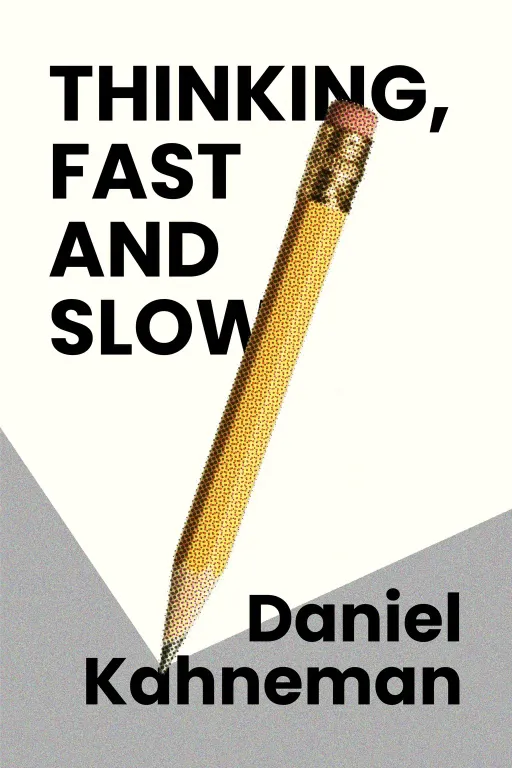
Nova: That's six words, but I'll allow it because it perfectly sets the stage for our deep dive today. We are talking about the 'rational actor' illusion, why it's a blind spot, and why we desperately need behavioral economics. And at the heart of this discussion are two seminal works: "Thinking, Fast and Slow" by Daniel Kahneman and "Nudge" by Richard H. Thaler and Cass R. Sunstein.
Atlas: A psychologist winning the Nobel Memorial Prize in Economic Sciences? That sounds like a plot twist in a spy novel! What was the committee thinking?
Nova: They were thinking about how Kahneman, a psychologist, fundamentally changed our understanding of economic behavior with his work on prospect theory. It's a testament to how human psychology isn't just fluffy stuff; it's the bedrock of how our markets and societies actually function. And then, years later, Thaler, an economist, also won the Nobel for his contributions to behavioral economics, particularly his work on nudge theory, showing how these seemingly disparate fields converged to revolutionize decision-making.
Atlas: So, it's not just theory, it's practical application. "Nudge" really brought these ideas into the mainstream, didn't it? It felt like suddenly everyone was talking about how small changes could have huge impacts.
Nova: Absolutely. It sparked a global conversation about how governments and organizations could use these insights for good. So, today, we're not just dismantling a charming but fictional character—the perfectly rational human. We're also going to explore how understanding our inherent irrationality can actually be our superpower for designing a better world and making smarter personal choices.
The Illusion of the Rational Actor and Cognitive Biases
SECTION
Nova: So, let's start with this foundational assumption: for a long time, economic theory, and even just common sense, assumed people were these perfectly logical beings. They'd weigh all the options, calculate the best outcome for themselves, and then act. Pure self-interest, pure logic.
Atlas: But wait, isn't that how we we operate? Like, we're constantly weighing pros and cons, trying to make the 'smart' choice? I imagine a lot of our listeners would say, "I'm a logical person!"
Nova: That's the illusion, isn't it? Kahneman, through decades of groundbreaking research with Amos Tversky, revealed that we actually have two systems of thinking. He calls them System 1 and System 2. System 1 is fast, intuitive, emotional, and automatic. Think about recognizing a friend's face or understanding a simple sentence. It's effortless.
Atlas: Okay, so System 1 is like autopilot. That makes sense. We can't consciously process all the time.
Nova: Exactly. But then there's System 2: slow, deliberate, effortful, logical. This is what we use when we're solving a complex math problem, learning a new language, or carefully comparing mortgage rates. The problem is, System 1 often jumps to conclusions, takes shortcuts, and is prone to a whole host of cognitive biases. And it does this System 2 often believes it's in charge.
Atlas: So, System 1 is secretly running the show when we think System 2 is calling the shots? That’s going to resonate with anyone who's ever made an impulse purchase they later regretted. Or maybe even a big decision at work that felt completely rational at the time, but looking back, was clearly driven by something else. Can you give an example of how System 1 leads us astray?
Nova: Think about the framing effect. Imagine a surgeon tells you there's a procedure with a 90% survival rate. Sounds pretty good, right? Now, what if they told you it had a 10% mortality rate? It's the exact same information, but the second framing makes it sound much riskier, even though the objective facts are identical. Your System 1 reacts to the words "survival" versus "mortality" in very different ways, guiding your perception.
Atlas: Wow, that's incredible. You mean I'm not even aware my perception is being twisted by the language? That's kind of unsettling. It makes me wonder about all the daily decisions where this might be happening. For our listeners who are managing high-stakes projects or making big financial calls, how does this kind of bias play out in a real-world scenario?
Nova: Consider the anchoring effect. Let's say you're negotiating a salary. If the employer throws out a low number first, even if it's completely unreasonable, it 'anchors' your perception of what's fair. You might end up negotiating for a higher salary than their initial offer, but still lower than what you would have asked for if no anchor had been set. Your System 1 latches onto that first number, influencing all subsequent evaluations, even if your System 2 it's arbitrary.
Atlas: Honestly, that sounds like my Monday mornings trying to decide what to prioritize. It feels like my brain is actively working against me sometimes, making me focus on the most visible task rather than the most important. So, if our own brains are such unreliable narrators, how do we ever make good decisions, or trust ourselves at all?
Leveraging Behavioral Economics for Better Decisions (Nudge Theory)
SECTION
Nova: That's exactly where the genius of books like "Nudge" comes in. It's not about fixing our brains or making us perfectly rational; it's about designing our world to work our human nature, rather than against it. It's about accepting that we're predictably irrational. And Thaler's work, which earned him his own Nobel, showed us how to apply this.
Atlas: Okay, so if we can't completely trust ourselves, we need a better system. But "nudges"—that sounds a bit manipulative, doesn't it? Like, who decides what's "better" for me? As an ethical explorer, I'm always wary of anything that feels like it's taking away agency.
Nova: That's a crucial distinction, and the authors of "Nudge" are very clear about it. A true nudge is a subtle intervention that alters people's behavior in a predictable way without forbidding any options or significantly changing their economic incentives. It preserves freedom of choice. Think of it as "choice architecture."
Atlas: Ah, so it's not about forcing me, it's about making the "good" choice easier or more obvious. Like putting the fruit at eye-level in the cafeteria instead of the candy. That's actually really clever. It’s about making the path of least resistance the path to a better outcome. Can you give another example of a nudge that had a really big, measurable impact?
Nova: Absolutely. Consider organ donation. In some countries, you have to actively opt-in to be an organ donor. In others, you're automatically opted-in unless you choose to opt-out. The default option, which is a classic nudge, dramatically increases participation rates. It's not forcing anyone, but it leverages our System 1's tendency to stick with the default, especially for complex or emotionally charged decisions. Another famous one is the "Save More Tomorrow" program, where people commit to increasing their savings rate automatically with future pay raises. It leverages present bias and inertia for long-term benefit.
Atlas: That gives me chills, how something so small can have such a ripple effect. It's like understanding the hidden levers of human behavior. For someone who wants to make an impact, this really changes everything about how you approach problem-solving, whether it's in public policy or even just within your own family. Are there any areas where nudges have been less successful or even controversial?
Nova: Definitely. The ethical debate around nudges is ongoing. Critics sometimes argue that even if they preserve choice, they can still be paternalistic, or that they might be used by entities with less benevolent intentions. There's also the question of transparency: should people always be aware when they're being nudged? It's a powerful tool, and like any powerful tool, it demands careful and ethical consideration in its application.
Synthesis & Takeaways
SECTION
Nova: So, what we've learned today is that embracing the fact that we're not perfectly rational isn't a weakness; it's actually a profound strength. It’s the first step towards designing better systems, making more intentional choices, and understanding ourselves and others on a deeper level.
Atlas: Exactly. The 'rational actor' is a myth, but that doesn't mean we're doomed to make bad decisions. It means we have to be smarter about our environments and how choices are presented to us. It’s about building guardrails, not just hoping we stay on the road. It makes me think about that deep question from the book: where in your daily life do you see System 1 making decisions, even when you think System 2 is in charge?
Nova: It's a fantastic question for self-reflection. I'd encourage all our listeners to spend this week observing their own System 1 in action. Notice those quick judgments, those automatic reactions, those choices that feel effortless.
Atlas: And share your insights! We'd love to hear where you spot your own automatic thinking taking over. Your curiosity is a powerful guide, and others can benefit from your deep dives.
Nova: It's about being a practical scholar, right? Taking these profound insights and applying them to make a tangible difference.
Atlas: Absolutely. Recognizing the illusion is the first step to true clarity and, ultimately, to wiser decisions.
Nova: This is Aibrary. Congratulations on your growth!









