The Overthinking Trap: Why You Need Clear Decision Frameworks.
Golden Hook & Introduction
SECTION
Nova: Think of the last time you were absolutely certain about something, only to find out you were completely, spectacularly wrong.
Atlas: Oh, man, that's like... every Tuesday. Especially when I'm trying to figure out if I left the stove on after rushing out the door. My brain just I did, even if I vividly remember turning it off.
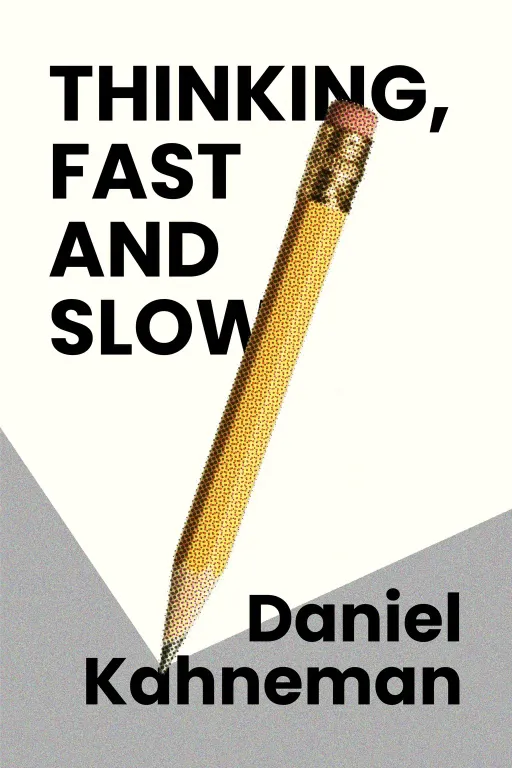
Nova: Exactly! That nagging doubt, that absolute conviction that flies in the face of evidence. It's a perfect example of our minds playing tricks on us, and it’s the heart of what we’re exploring today. We’re diving into a fascinating intellectual landscape shaped by Daniel Kahneman's groundbreaking work, particularly his highly rated book, Thinking, Fast and Slow, which has earned widespread acclaim for its insights into human judgment and decision-making.
Atlas: Ah, Kahneman. The Nobel laureate who basically told us our brains are both brilliant and incredibly lazy at the same time. He's a legend in the world of behavioral economics, and his work has profoundly influenced how we understand everything from personal finance to public policy.
Nova: Absolutely. And when you pair that with the insights from Nudge by Richard H. Thaler and Cass R. Sunstein—another book that's been lauded for its practical applications and has sparked a global conversation about choice architecture—you get a potent cocktail for understanding why we make the choices we do. Thaler, who also won the Nobel Prize, is known for his witty, accessible style, making complex ideas about human behavior incredibly engaging.
Atlas: So, basically, we're talking about the invisible strings pulling our decisions, even when we think we're fully in control. That makes me wonder, how much of my daily thinking is actually, and how much is just... my brain on autopilot?
The Blind Spot: Unmasking Cognitive Biases
SECTION
Nova: That's the deep question, isn't it? And it's where we start our journey. Kahneman, in Thinking, Fast and Slow, introduces us to two systems of thought. He calls them System 1 and System 2. Imagine System 1 as the lightning-fast, intuitive, emotional part of your brain. It’s the one that instantly recognizes a angry face or completes the phrase 'bread and…'
Atlas: Oh, I know that feeling. It's like when you're driving and suddenly you're at your destination but you don't remember the last five minutes of the drive. Pure autopilot.
Nova: Precisely. System 1 is brilliant for efficiency, for quick judgments. It’s a survival mechanism. But its speed comes at a cost: it's prone to biases. It loves shortcuts. And it often operates beneath our conscious awareness.
Atlas: So, if System 1 is the intuitive, gut-feeling part, what's System 2 doing?
Nova: System 2 is your slow, deliberate, logical, calculating self. It's the one you use to solve a complex math problem, compare two vacation packages, or consciously choose what to say in a difficult conversation. It’s effortful, and it's what we is in charge most of the time.
Atlas: But wait, if System 2 is the rational one, why do we still make so many irrational choices? Isn't it supposed to correct System 1's mistakes?
Nova: That’s the core tension, isn't it? System 2 is powerful, but it's also. It prefers to let System 1 handle things whenever possible. And System 1, with its biases, often presents a compelling, coherent story that System 2 is happy to accept without much scrutiny. It’s like having a brilliant but overworked CEO who trusts their incredibly quick but sometimes error-prone assistant.
Atlas: So you're saying my brain's CEO is just chilling in the corner while the assistant makes all the snap decisions? That sounds a bit out there. Can you give an example? Like how does this play out in real life?
Nova: Think about the 'anchoring effect.' Let's say you're buying a used car. The salesperson mentions a ridiculously high initial price, say, $30,000. Even if you negotiate down to $20,000, that initial $30,000 'anchor' makes $20,000 feel like a steal, even if the car is only worth $15,000. Your System 1 latches onto that first number, and your System 2 struggles to fully shake its influence.
Atlas: Oh, I've fallen for that! Or when you see something 'on sale' for 50% off, but the original price was clearly inflated just to make the current price look good. My System 1 shouts, 'Bargain!'
Nova: Exactly! Another classic is the 'confirmation bias.' We tend to seek out, interpret, and remember information that confirms our existing beliefs. If you believe a certain politician is corrupt, you’ll naturally notice every news story that supports that, while dismissing or ignoring anything that contradicts it.
Atlas: That’s actually really inspiring, in a slightly terrifying way. It means we're all walking around with these invisible filters on our perception. It makes me wonder about how much of the 'truth' I think I know is just my System 1 confirming what it already believes.
Nova: And it goes deeper. Consider the 'availability heuristic.' This is where we overestimate the likelihood of events that are easily recallable or vivid in our minds. After a plane crash is heavily reported in the news, people often become more afraid of flying, even though statistically, driving is far more dangerous. The vivid image of the crash makes flying feel riskier.
Atlas: So basically, if it's dramatic and sticks in my head, my brain thinks it's more common or more likely. That explains why I'm more worried about shark attacks than car accidents, even though I drive every day.
Nova: It's a powerful mechanism. Kahneman's work, which earned him the Nobel Prize in Economic Sciences, fundamentally changed how we understand human rationality. He showed us that our irrationality isn't random; it's. And that predictability is the key to both understanding our blind spots and, as we'll discuss next, designing better choices.
Atlas: Wow, that's a lot to unpack. So, if our brains are so prone to these shortcuts, what hope do we have for making truly good decisions, especially when things are complex?
The Nudge Effect: Designing Better Choices
SECTION
Nova: That's where the insights from Thaler and Sunstein's Nudge become incredibly powerful. If Kahneman revealed our predictable irrationality, Nudge shows us how to work it, not against it. The core idea is 'libertarian paternalism.' It sounds like a contradiction, but it means designing choices in a way that 'nudges' people towards better outcomes, without taking away their freedom of choice.
Atlas: Libertarian paternalism. That's a mouthful. So, you're saying we can subtly manipulate people into doing what's good for them, but they still they're making their own choice? It sounds a bit like mind control, but for good.
Nova: Not mind control, but 'choice architecture.' Think of it like this: if you walk into a cafeteria, the way the food is arranged influences what you choose. If the healthy options are at eye level and easily accessible, you're more likely to pick them, even if the unhealthy options are still available. You still have the freedom to choose the donut, but the environment 'nudged' you towards the salad.
Atlas: Okay, so it’s like putting the fruit bowl on the kitchen counter instead of hiding it in the back of the fridge. Small changes in the environment can have a big impact. Can you give another example of how this plays out on a larger scale?
Nova: A classic example is the default option for organ donation. In many countries, you have to actively opt-in to be an organ donor. The default is 'no.' In countries where the default is 'yes', organ donation rates are significantly higher. People often stick with the default because it's easier, or they assume it's the recommended choice.
Atlas: Oh, I see. So the default setting for almost anything can act as a powerful nudge. That's actually really inspiring. It means we don't have to be perfect rational beings to make better choices; we just need smarter systems around us.
Nova: Exactly. Thaler and Sunstein argue that since we're predictably irrational, we can design environments that lead to better outcomes in areas like saving for retirement, making healthier food choices, or even conserving energy. They highlight how governments and organizations can use these insights to improve public welfare without coercion. The book itself received a largely positive reception for its innovative approach, though some critics have raised concerns about the ethical implications of 'nudging' people.
Atlas: That makes me wonder, how can I apply this to my own life? How can I 'nudge' myself away from my System 1 biases?
Nova: Great question. One simple way is to create 'pre-commitments.' If you want to exercise more, lay out your workout clothes the night before. If you want to eat healthier, pre-chop vegetables on Sunday. You're essentially designing your environment to make the desired behavior the easiest default.
Atlas: So it's about anticipating my lazy System 1 and setting up guardrails in advance. Like, if I know I'm going to be tempted by snacks while working, I just don't buy them in the first place.
Nova: Precisely. You're using your System 2 to design an environment that helps your System 1 make better choices. It's about being a conscious architect of your own decisions. It's a profound shift from merely trying to differently to differently by shaping your context.
Atlas: That gives me chills. It's not just about willpower; it's about smart design. The books really complement each other, showing us the problem and then offering a potential solution.
Synthesis & Takeaways
SECTION
Nova: When you put Thinking, Fast and Slow and Nudge together, you get this incredibly comprehensive picture of human decision-making. Kahneman lays bare the intricate, often flawed machinery of our minds, revealing the biases that subtly steer us. He challenges the very notion of our rationality, showing us the 'blind spots' we all possess.
Atlas: And then Thaler and Sunstein step in and say, 'Okay, so our brains are quirky. Now what? Let's use that knowledge to our advantage.' They offer practical, elegant solutions for how we can design our world—and our personal habits—to account for those quirks, helping us make better choices almost effortlessly.
Nova: It's the difference between merely understanding you keep hitting snooze, and actually setting your alarm across the room so you have to get out of bed. One is insight, the other is applied behavior. And the power lies in that application. These books aren't just academic exercises; they are profound blueprints for personal growth and societal improvement.
Atlas: So, the big takeaway for me is that self-awareness isn't just about introspection. It's also about understanding the forces that shape our decisions and then actively designing our lives to support our best intentions. It reminds me of the idea that your environment is stronger than your willpower.
Nova: Absolutely. And for our contemplative, exploring listeners who seek understanding and inner growth, recognizing where System 1 might be leading them astray is the first step towards more deliberate, effective decisions. It's about moving beyond intuition to intentionality. It's about taking control by understanding how control is often subtly lost. This is Aibrary. Congratulations on your growth!