The Invisible Strings: How Cognitive Biases Shape Decisions and Influence
Golden Hook & Introduction
SECTION
Nova: What if I told you that the most important decisions you make aren't actually yours? That your brain is playing a subtle, constant game of trickery, and you're often not even aware you're a player?
Atlas: Whoa. That’s a bold claim, Nova. My brain, tricking me? I like to think I’m pretty rational, especially when it comes to big decisions. How exactly is it pulling off this masterful deception?
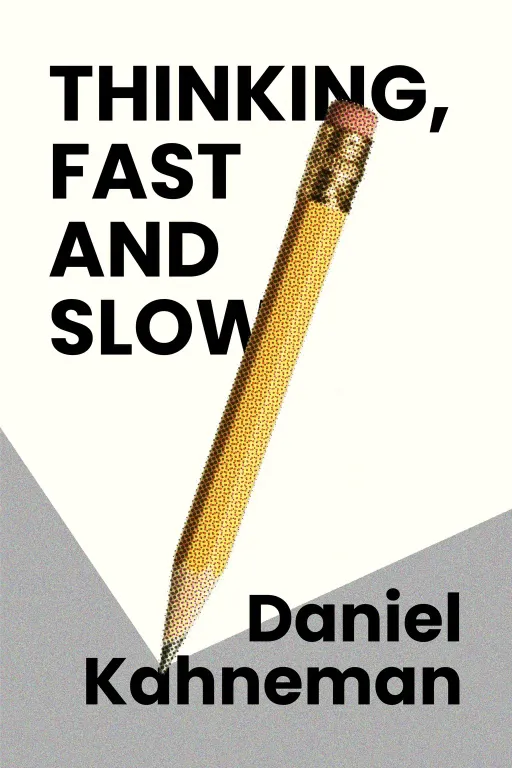
Nova: Oh, it’s masterful indeed, Atlas. And it’s happening right under our noses, influencing everything from what we buy to how we perceive others. Today, we’re unmasking these invisible forces, drawing heavily from two monumental works: Daniel Kahneman's, which literally reshaped our understanding of the human mind and earned him a Nobel Prize in economics for his psychological insights, and Richard Thaler's, which took those insights and showed us how to apply them for good.
Atlas: That’s fascinating. It makes me wonder about all the hidden patterns in human behavior that we just accept as 'the way things are.' So, we're talking about the invisible strings that pull our decisions?
Nova: Exactly. And once you see them, you can’t unsee them.
The Blind Spot Revealed: System 1 vs. System 2 Thinking
SECTION
Nova: So, let's start with Kahneman. His big revelation, the one that earned him that Nobel, was that our minds operate with two distinct systems. He called them System 1 and System 2. System 1 is our fast, intuitive, emotional, almost automatic thinking. It's what tells you to slam on the brakes, or gives you a gut feeling about someone. It's incredibly efficient, but it's also prone to making quick, often biased judgments.
Atlas: Okay, so System 1 is the quick-draw cowboy of our brain, and System 2 is the thoughtful, strategic chess player? But if System 1 is so prone to error, why do we rely on it so much? And can you give me a real-world example where this 'quick-draw' thinking leads us astray? Because I imagine a lot of our listeners, especially those in leadership roles, believe they're always operating from System 2.
Nova: That’s a perfect way to put it, Atlas. And we rely on System 1 because it's effortless. Imagine trying to logically analyze every single decision you make in a day, from what to wear to what to eat. You'd be paralyzed! System 1 is vital for survival, but it has these built-in shortcuts, these biases, that lead to predictable mistakes. Take, for instance, the "framing effect." It’s a classic.
Atlas: Framing effect? Tell me more.
Nova: Alright, imagine a doctor telling you about a new surgical procedure. Option A: "This surgery has a 90% success rate." Option B: "This surgery has a 10% failure rate." Statistically, they’re identical, right? Both mean that out of 100 patients, 90 will live and 10 will die.
Atlas: Yeah, same numbers. Just phrased differently.
Nova: Precisely. But studies overwhelmingly show that people are far more likely to choose Option A, the one framed positively. System 1 hears "90% success" and feels optimistic, safe. It hears "10% failure" and immediately triggers fear and aversion, even though the objective outcome is the same. It's not about the facts; it's about how the facts are presented.
Atlas: Wow, that's kind of heartbreaking, actually. So, our intuitive brain, that quick-draw cowboy, doesn't just process information; it interprets it through an emotional lens, leading us to different conclusions based purely on how something is worded. That must be incredibly frustrating for anyone trying to communicate clearly or make purely objective decisions. How can leaders even begin to recognize these subtle manipulations, not just in others, but in their own judgments?
Nova: It's a constant battle, Atlas, and it starts with awareness. Kahneman’s work shows us that our rationality is often an illusion. System 2, our logical self, is lazy. It prefers to endorse System 1’s quick answers rather than doing the hard work of critical thinking. So, recognizing these blind spots in ourselves is the first step towards ethical leadership and more influential, honest communication. We need to actively pause and engage System 2, especially for important decisions.
The Art of the Nudge: Guiding Choices Ethically
SECTION
Nova: Once we understand these blind spots, the next question is, what do we with that knowledge? And that's where Richard Thaler's work in becomes incredibly powerful. Thaler, who also won a Nobel Prize, took Kahneman's insights and showed how we can design environments and choices to 'nudge' people towards better outcomes without restricting their freedom.
Atlas: Okay, so if our brains are wired for these biases, Thaler figured out how to use that wiring to our advantage, but for good? That sounds almost too simple. Can you give an example of one of these 'nudges' in action? Something that actually works in the real world?
Nova: Absolutely. Think about organ donation. In many countries, you have to actively opt-in to be an organ donor. The default is 'no.' The result? Low donation rates. But in countries where the default is 'yes,' and you have to actively opt-out if you don't want to donate, the donation rates skyrocket. Germany, for example, has an opt-in system, with low donation rates. Austria has an opt-out system, and nearly everyone is a donor. It's the same choice, but the default option, the 'nudge,' makes a monumental difference.
Atlas: But wait, looking at this from a strategic leadership perspective, isn't that just manipulation? Where's the line between guiding people to 'better choices' and just... controlling them? Especially for leaders trying to foster independent thought and agency within their teams, this concept might feel impossible to implement ethically.
Nova: That's a critical question, Atlas, and it's at the heart of ethical leadership. Thaler and Sunstein, his co-author, coined the term "libertarian paternalism." The "paternalism" part means we're trying to guide people towards choices that improve their welfare, but the "libertarian" part is crucial: we must always preserve people's freedom to choose otherwise. A nudge isn't a mandate. It's about changing the choice architecture, the environment in which decisions are made, to make the 'better' choice the easier, more attractive, or default option.
Atlas: So basically you’re saying, it’s not about forcing people, but making the path of least resistance lead to a good place? That’s actually really inspiring for anyone who wants to positively influence a team or a group without resorting to authoritarian tactics. It’s about understanding human nature and designing for it.
Nova: Exactly. It's about understanding that people are busy, fallible, and influenced by context. Instead of blaming them for 'bad' choices, we can design systems that gently steer them towards outcomes they would likely prefer anyway, if they had infinite time and perfect rationality. It’s about turning the invisible strings from arbitrary influences into intentional, positive guides.
Synthesis & Takeaways
SECTION
Nova: So, bringing it all together, Kahneman unmasked the invisible strings of our biases, showing us how our minds trick us. Thaler then showed us how we can consciously, ethically, and strategically re-tie those strings, not to manipulate, but to towards better outcomes. It's a powerful one-two punch for anyone looking to understand human behavior and influence it positively.
Atlas: That makes me wonder, how do we start to untangle these invisible strings in our own decisions, and in how we communicate with those we lead? It sounds like the first step is just acknowledging that they’re there, silently pulling at us.
Nova: It absolutely is. The journey of ethical leadership and influential communication begins with self-awareness – recognizing your own System 1 at play, and then consciously designing for better outcomes, both for yourself and for those you aim to serve. It's a profound shift from merely reacting to actively shaping.
Atlas: That’s such a hopeful way to look at it. It gives us a sense of agency over something that feels so automatic.
Nova: And that agency is what allows us to truly grow.
Atlas: This is Aibrary. Congratulations on your growth!