The Invisible Hand: Decoding Human Behavior for Product Success
Golden Hook & Introduction
SECTION
Nova: Alright, Atlas, quick challenge for you. Five words. 'Predictably Irrational' by Dan Ariely. Go.
Atlas: Mind-blown, user-decoded, product-revolution, wow.
Nova: Okay, that was six, but I'll allow it for the sheer, unadulterated enthusiasm! Because honestly, that book, and the insights within it, really do make you rethink everything you thought you knew about human decision-making.
Atlas: I mean, it’s not every day a book completely reframes how you look at, well,. Especially as someone trying to build products that people actually want to use. You start by assuming rationality, right?
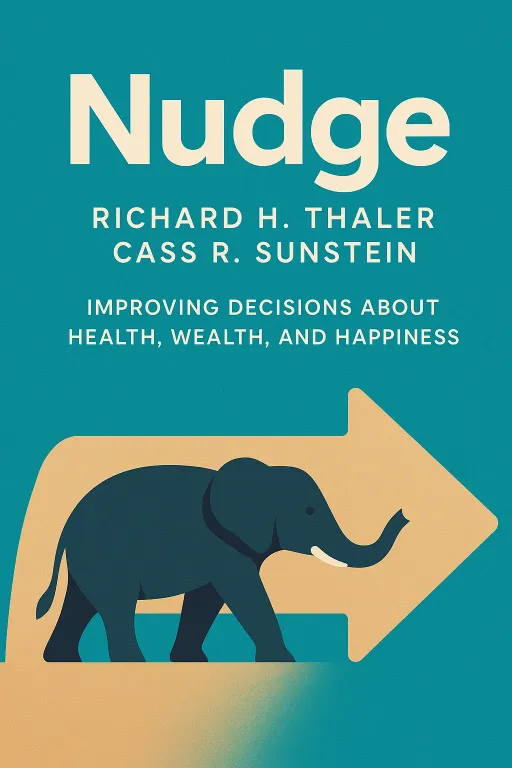
Nova: Exactly! And that's the big myth we're tackling today, drawing primarily from Dan Ariely's groundbreaking work in 'Predictably Irrational,' and then we'll pivot to how we can leverage these insights with 'Nudge' by Richard H. Thaler and Cass R. Sunstein. What's fascinating about Ariely, actually, is that his entire journey into understanding irrationality began from a deeply personal place.
Atlas: Really? I’m curious.
Nova: Absolutely. He suffered severe burns over much of his body in an accident when he was 18. During his long and painful recovery, he observed how his treatment, and how he experienced pain, was often managed in ways that seemed… well, irrational. His nurses would rip off bandages quickly, assuming it was better to get the pain over with, but for him, a slower, more controlled removal was actually less agonizing. That experience, that profound disconnect between assumed logic and actual human experience, sparked his lifelong quest to understand why we humans so often deviate from what seems like the most logical path.
Atlas: Wow, that’s actually really inspiring. So his own suffering led him to decode human behavior for all of us. That’s a powerful origin story. So, he’s saying we’re not just irrational, but… predictably so?
The Myth of Rationality: Unpacking Predictably Irrational Decisions
SECTION
Nova: Precisely. That's the core insight. We often assume people, especially users interacting with our products, are rational actors. They weigh pros and cons, they optimize for their best interests. But Ariely, through a series of ingenious experiments, shows that our irrationality isn't random; it's systematic, it's predictable, and it's deeply ingrained in how our brains are wired.
Atlas: So you're saying our users aren't even making choices based on pure value or logic? That sounds almost… counterintuitive for a product architect trying to create truly valuable solutions. Like, how does that even manifest in a real-world scenario? Give me an example.
Nova: Let's talk about the "decoy effect," which is a brilliant illustration. Imagine you're selling a subscription to, say, a tech magazine. Ariely once famously recreated an experiment involving The Economist. They had three subscription options.
Atlas: Okay, lay them out for me.
Nova: Option one: web-only subscription for $59. Option two: print-only subscription for $125. And option three: print-and-web subscription, also for $125.
Atlas: Hold on. Print-only for $125, and print-and-web for $125? That print-only option seems… kind of pointless. Who would pick that?
Nova: Exactly! In the experiment, almost no one chose the print-only option. It seemed like a throwaway. But here's the kicker: when they that seemingly useless print-only option, the preferences of the students they surveyed completely flipped.
Atlas: What? So, without the decoy, people chose differently?
Nova: Dramatically so. When all three options were present, the vast majority chose the print-and-web option for $125. It looked like a fantastic deal compared to the print-only at the same price. But when the print-only option was removed, most students suddenly opted for the cheaper, web-only subscription.
Atlas: That’s wild! So, that useless middle option, the "decoy," it wasn't useless at all. It was actually guiding people to pick the more expensive bundle.
Nova: It was a powerful anchor. Our brains don't always evaluate things in absolute terms. We often compare things relatively. The print-only $125 option made the print-and-web $125 option seem like a steal. It created a clear point of comparison that made one choice look superior, even if the absolute value wasn't necessarily changing. It's not about being illogical; it's about our cognitive shortcuts, our mental models for making quick judgments.
Atlas: That makes me wonder about every pricing page I’ve ever seen. It means that what we present to users, even if it seems like a benign choice, can subtly, and predictably, influence what they pick. For product managers, that's not just a fascinating psychological quirk; it's a fundamental design principle.
Designing for Human Nature: The Art of the Nudge in Product Development
SECTION
Nova: And that deep dive into we behave this way naturally leads us to the second key idea: if irrationality is predictable, how can we use that understanding to design better choices? This is where Thaler and Sunstein's 'Nudge' comes in. Their work explores how subtle changes in "choice architecture"—the way choices are presented—can gently steer people toward beneficial decisions without restricting their freedom.
Atlas: So it's not about forcing users, but about gently steering them? For a product architect, that's incredibly powerful. It sounds like designing for human nature rather than against it.
Nova: Precisely. Think about it: every product, every service, every environment has a choice architecture. There are defaults, there are ways information is presented, there are various options. Whether we consciously design it or not, we are constantly influencing people's decisions. The idea of a 'nudge' is to consciously design that architecture to help people make choices that are good for them, or for the collective.
Atlas: Okay, so how does that look in practice? Give me another concrete example. Like, how can a subtle 'nudge' have a huge impact?
Nova: One of the most compelling examples comes from organ donation rates. Consider two types of countries: "opt-in" countries, where you have to actively check a box to become an organ donor, and "opt-out" countries, where you are automatically an organ donor unless you actively uncheck a box.
Atlas: I can already see where this is going. People are lazy.
Nova: Not necessarily lazy, but prone to inertia, and also influenced by what they perceive as the "norm" or the "recommended" option. In "opt-in" countries, organ donation rates are typically very low, sometimes as low as 5-10%. But in "opt-out" countries, where the default is to be a donor, the rates skyrocket to over 90%.
Atlas: That’s a staggering difference for something as simple as a default setting. It's the same choice, but presented differently. That’s insane.
Nova: It is. The choice itself isn't removed; you can still opt out. But the default, the "nudge," dramatically changes behavior. This isn't about manipulation; it's about understanding that most people are busy, they have many decisions to make, and they often stick with the path of least resistance, especially for complex or emotionally charged decisions. When the default aligns with a generally beneficial outcome, you see a massive positive shift.
Atlas: That’s a profound insight for anyone building a product. It means that the default settings, the pre-selected options, the order in which things appear – these aren’t just minor UI decisions. They are powerful levers that shape user behavior and, ultimately, the success of the product. But how do you identify those 'friction points' or 'choice architecture' elements in a complex product journey? Like, where do you even start looking for these 'nudge opportunities'?
Nova: That's a brilliant question, and it's where the art of choice architecture truly begins. It starts with deep empathy for your user journey. Where do users get stuck? Where do they abandon a process? Where do they make choices that they later regret, or that lead to suboptimal outcomes? Those points of friction, those moments of decision, are your canvases. You look at the existing defaults, the cognitive load involved, how information is framed. It’s about being a detective of human behavior within your own product.
Synthesis & Takeaways
SECTION
Nova: So, bringing these two powerful ideas together: understanding users are predictably irrational from Ariely's work allows us to then design environments that 'nudge' them towards better outcomes, as Thaler and Sunstein describe. It's about building products that align with real human psychology, not just our assumptions of ideal, rational behavior.
Atlas: For leaders committed to long-term growth and sustainable solutions, this isn't just about clever tricks or dark patterns. This sounds like building a product with integrity, respecting human nature rather than fighting it. It's about truly creating impact by understanding your users at a deeper, more fundamental level. It's about designing systems where the easiest path is also the best path for them.
Nova: Exactly. It's about moving beyond just asking users what they want, because often, what they they want and what they are two different things. It’s about observing, understanding the underlying cognitive biases, and then designing with that knowledge. It’s an incredibly powerful way to foster sustainable product engagement and deliver genuine value.
Atlas: So, for our visionary listeners out there, what’s one tangible step they can take this week to apply this?
Nova: This week, I want you to identify one small friction point in your product's user journey. Think about a place where users struggle, or where they consistently make a less-than-ideal choice. Then, brainstorm a 'nudge' – a subtle change in the choice architecture, perhaps a default setting, a reordering of options, or a reframing of information – to simplify or improve that interaction. Align it with how people behave, not how you assume they.
Atlas: And observe what happens. Because that's where the real learning, and the real impact, begins. It's about making those invisible forces visible, and then using them for good.
Nova: This is Aibrary. Congratulations on your growth!