The Human Element: Designing Tech for Real-World Impact
Golden Hook & Introduction
SECTION
Nova: What if I told you that most of the decisions you make every single day, from what you eat for breakfast to how you interact with your latest tech, aren't actually decisions? They're often ghostwritten.
Atlas: Ghostwritten decisions, Nova? That sounds like a sci-fi thriller, not a guide to everyday life. What kind of spooky authorship are we talking about here?
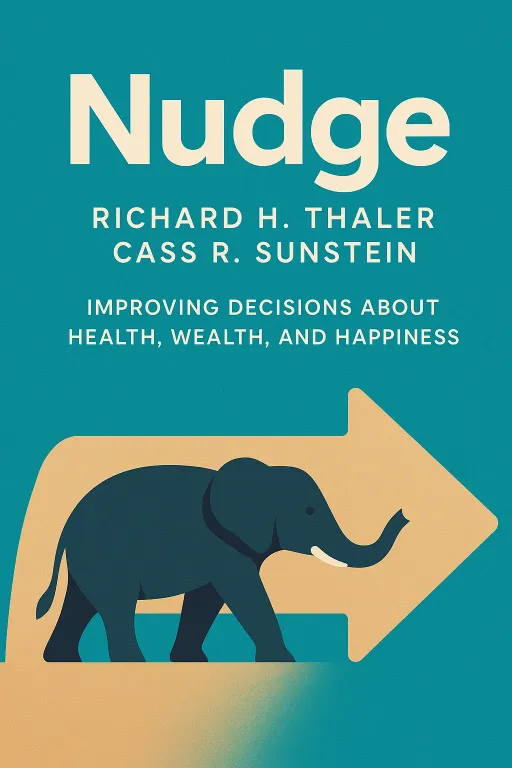
Nova: Oh, it's far spookier because these authors are often invisible, embedded in our environment and even within our own minds. Today we're pulling back the curtain on those invisible forces, diving into two groundbreaking books: "Nudge" by Richard H. Thaler and Cass R. Sunstein, and Daniel Kahneman's seminal work, "Thinking, Fast and Slow."
Atlas: What makes these books so groundbreaking that we're talking about them now? Aren't they about, you know, economics and psychology? How do they connect to the cutting edge of AI?
Nova: They are the absolute bedrock! "Nudge," for instance, didn't just popularize the concept of behavioral economics; it literally reshaped public policy globally, showing how subtle interventions can guide people towards better choices without restricting their freedom. It's had a profound, tangible impact on everything from retirement savings to organ donation. And Kahneman's "Thinking, Fast and Slow" isn't just a psychology book; it's a synthesis of decades of research that won him a Nobel Prize, fundamentally changing how we understand how our own minds work. It's a masterclass in why we often act against our own best interests.
Atlas: So, we're talking about the hidden operators behind our everyday choices, and how understanding them is key to designing technology that actually works us, not just for us? That's a pretty big promise.
Nova: Exactly! And that promise is particularly potent when we talk about AI, especially in critical areas like healthcare. It's about designing AI that doesn't just process data but understands the human at the other end of the screen.
The Invisible Architects of Choice: How Nudges and Biases Shape Our Tech Experience
SECTION
Nova: Let's start with Kahneman. He gives us this brilliant framework for understanding how our brains operate, dividing our thought processes into two systems: System 1 and System 2. System 1 is our fast, intuitive, emotional, almost automatic thinking. It's what makes you swerve to avoid an obstacle without consciously thinking about it.
Atlas: Oh, I like that. So, like when I see a plate of cookies and my hand just… moves? That's System 1?
Nova: Precisely. It's efficient, it's quick, but it's also prone to biases and shortcuts. System 2, on the other hand, is our slow, deliberate, logical, and effortful thinking. It's what you engage when you're solving a complex math problem or carefully weighing the pros and cons of a major life decision.
Atlas: So, the part of my brain that's trying to figure out if I need that second cookie versus the part that just grabbed it. I get it. But how does this play out in the digital world, especially for someone who's building AI?
Nova: It's everywhere. Think about user interfaces. Many apps are designed to appeal to your System 1—quick rewards, instant notifications, infinite scrolls. They tap into our desire for immediate gratification, our fear of missing out, our tendency to follow the path of least resistance. Thaler and Sunstein call these "nudges." A nudge is any aspect of the choice architecture that alters people's behavior in a predictable way without forbidding any options or significantly changing their economic incentives.
Atlas: So, are you saying we're all just pre-programmed robots, easily led by digital breadcrumbs? That sounds a bit unsettling for anyone who prides themselves on being an innovator and a critical thinker.
Nova: Not robots, Atlas, but profoundly human. Consider the classic example from "Nudge": putting healthy food at eye level in a cafeteria, or even the image of a fly in a urinal that dramatically reduces spillage. No one is forced to eat the salad or aim for the fly, but the environmental design subtly guides behavior. In AI, this could be the default settings, the order in which options are presented, or even the framing of a question. It's about recognizing that humans aren't purely rational actors, and then designing AI to account for that.
Atlas: That makes me wonder, though. That sounds a bit like manipulation. Where's the line for an innovator who wants to do good, who cares about the ethical application of science for the greater good, but is also trying to get users to engage with their product?
Nova: That's the crux of it, and it's a brilliant question. The key distinction, as Thaler and Sunstein emphasize, is whether the nudge is transparent and aimed at improving the user's well-being, or if it's opaque and designed to exploit a bias for profit at the user's expense. The ethical innovator uses these insights to help people, not to trick them. It's about understanding human psychology to design AI that supports positive behaviors, not just maximizes clicks.
Designing Trust and Positive Behavior: Crafting Ethical AI for Human Well-being
SECTION
Nova: That's exactly the tightrope we walk, Atlas, and it brings us to the core challenge for anyone building AI, especially in healthcare. If we understand that people are making decisions with System 1 and influenced by nudges, how do we design AI that not only respects that but actively guides them towards beneficial outcomes?
Atlas: Okay, so if I'm building an AI for healthcare, say an app that helps people manage a chronic condition, I can't just expect them to make perfectly rational choices about medication or diet. Their System 1 is going to kick in. So what then?
Nova: Precisely. You recognize biases like "present bias," where we prioritize immediate gratification over future benefits – like skipping today's exercise for instant comfort, even if it harms long-term health. An ethical AI won't shame you for it. Instead, it might use a gentle nudge: perhaps a timely, personalized reminder that highlights a positive outcome of adherence, rather than a distant, abstract one. Or it could make the healthy choice the default, requiring less System 2 effort.
Atlas: So it's not about forcing people, it's about making the healthier, more ethical choice the choice? Like pre-filling a form with the most privacy-preserving settings, instead of making me hunt for them?
Nova: Exactly! It's what we call "choice architecture" in the digital realm. An AI-powered health coach could, for instance, be designed to gently remind users about their medication at the optimal time, or suggest a five-minute stretch break when it detects prolonged sedentary behavior. It's not dictating; it's facilitating. And the "Communicator" in you would appreciate that it's about framing these options in a way that resonates, that speaks to that System 1 intuition in a positive way.
Atlas: But how do you build into an AI that's essentially 'nudging' me? Especially when dealing with sensitive health data. For someone building AI for healthcare, that's crucial. Transparency is so important when we're talking about personal well-being.
Nova: Trust is paramount. And it's built on transparency and control. An ethical AI, especially in healthcare, needs to be clear about it's making a suggestion. It shouldn't feel like a black box. It could say, "Based on your activity patterns and our goal to help you stay active, we suggest a five-minute walk now. You can always dismiss this." It gives the user agency. It respects their autonomy while still offering guidance. The "Ethicist" in you knows that true impact comes from empowering, not just optimizing.
Atlas: So, it's about designing AI that its nudges, that provides context, and most importantly, offers an easy off-ramp if the user doesn't want to be nudged?
Nova: That's it. It’s about creating systems where the user feels respected and understood, not manipulated. It moves AI from being just a tool for efficiency to a partner in well-being. It’s about ensuring that the data usage is ethical, clear, and always in the user's best interest, fostering a long-term relationship built on reliability and respect. When you understand the cognitive biases, you can design around them to create an experience that feels intuitive trustworthy. It's bridging the gap between lab and life, as you mentioned, but with a profound ethical foundation.
Synthesis & Takeaways
SECTION
Nova: So, what we've really been talking about today is this profound insight: AI's true potential, particularly in high-stakes fields like healthcare, is unlocked when it's meticulously designed with a deep understanding of human psychology, guiding users respectfully towards beneficial outcomes. It's not just about algorithms; it's about empathy coded into the system.
Atlas: For anyone working on AI right now, how crucial is it to step back and ask: "Am I understanding the ghost in the machine, the human decision-maker, before I even write a line of code?" It sounds like ignoring these psychological principles is like building a house without understanding gravity.
Nova: It absolutely is. It's the difference between building tech that's merely functional and building tech that genuinely serves humanity. The "Innovator" thrives on what's next, but the "Ethicist" ensures that "what's next" is also "what's right." These books provide the blueprint for creating AI that doesn't just predict behavior but shapes it for good, always with transparency and respect at its core.
Atlas: It sounds like a call to action for innovators to become behavioral scientists, too. To connect those dots between the lab, the code, and the human experience.
Nova: Absolutely. It’s about impact. It’s about building technology with a soul.
Atlas: That’s a powerful idea.
Nova: This is Aibrary. Congratulations on your growth!