

The Hidden Wires: How Unseen Biases Shape Every Decision
Golden Hook & Introduction
SECTION
Nova: What if I told you that most of your 'rational' daily decisions are actually made by an impulsive, often error-prone autopilot? And that your conscious, logical self is often just playing catch-up, making excuses?
Atlas: Oh, I resonate with that. My 'autopilot' often lands me in the cereal aisle when I meant to grab, you know, kale. But seriously, Nova, are you saying our brains are just… lazy?
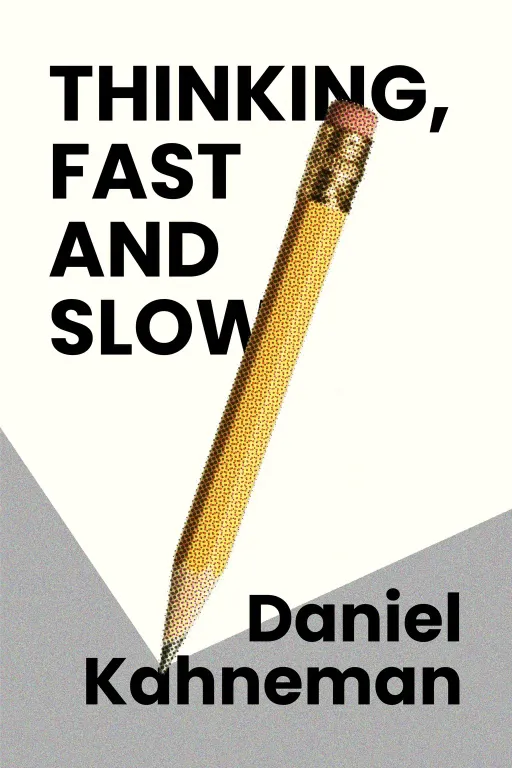
Nova: Not lazy, Atlas, but incredibly efficient in ways we often don't fully appreciate. Or, sometimes, fully. Today, we’re diving into the brilliant minds behind two seminal books: Daniel Kahneman’s “Thinking, Fast and Slow” and Richard H. Thaler and Cass R. Sunstein’s “Nudge.” Kahneman, a psychologist, actually won the Nobel Memorial Prize in Economic Sciences for his groundbreaking work, bridging psychology and economics. He fundamentally changed how we see decision-making.
Atlas: Wow. A psychologist winning an economics Nobel. That’s a powerful statement right there about how deeply human our 'economic' decisions truly are.
Nova: Absolutely. And what these books collectively reveal is that beneath the surface of every choice we make, there are these hidden mental shortcuts – biases – profoundly shaping our judgment. Understanding these invisible forces isn't just academic; it's key to making better choices ourselves and, crucially, to designing environments that help others do the same.
The Architecture of Bias: Our Mental Shortcuts
SECTION
Atlas: So, if our brains aren't lazy, what exactly is going on? What are these 'hidden wires' Kahneman talks about?
Nova: He breaks it down into two fundamental systems of thought: System 1 and System 2. Think of System 1 as your intuition, your gut reaction. It’s fast, automatic, emotional, and always on. It's what tells you a face is angry or that two plus two equals four.
Atlas: Oh, I like that. So, it’s the instant recognition. The immediate 'I know this!' feeling.
Nova: Exactly. But it’s also prone to shortcuts and biases. System 2, on the other hand, is your more deliberate, logical, effortful thinking. It's what you use to solve a complex math problem, fill out a tax form, or carefully weigh the pros and cons of a major life decision. It’s slow, conscious, and requires energy.
Atlas: Okay, so System 1 is the quick-draw cowboy, and System 2 is the thoughtful chess master. But how does the cowboy lead us astray?
Nova: Let me give you a classic example. It’s called the 'bat and ball' problem. I want you to give me the first answer that comes to mind, without overthinking it.
Atlas: Alright, I’m ready.
Nova: A bat and a ball cost $1.10 in total. The bat costs $1 more than the ball. How much does the ball cost?
Atlas: Oh, I know that feeling! Ten cents. Definitely ten cents.
Nova: That's your System 1 speaking! And it's the wrong answer.
Atlas: Wait, hold on. It feels so right! Ten cents plus a dollar for the bat is $1.10.
Nova: See? System 1 offers an intuitive, coherent, but incorrect solution. Now, let your System 2 kick in. If the ball cost ten cents, and the bat cost a dollar more, the bat would be $1.10. And together, they’d be $1.20, not $1.10.
Atlas: Oh, I see. So the bat costs $1.05 and the ball costs $0.05. Five cents! That took actual effort to figure out. I can feel my brain cells working.
Nova: Precisely. Your System 1 quickly generated a plausible answer, and your System 2 had to override it, which requires mental energy. This simple problem beautifully illustrates how often our fast, intuitive thinking provides us with a ready-made answer, and we often accept it without engaging the more effortful System 2. For strategists and leaders, who often deal with complex, high-stakes decisions, this is a critical blind spot.
Atlas: That’s a great way to put it. I imagine a lot of our listeners, especially those in high-pressure roles, feel like they're constantly trying to engage System 2, but System 1 is just so… persuasive.
Nova: It is! And Kahneman shows us that these biases aren't just quirks; they're systematic. They’re part of our cognitive architecture. They lead to overconfidence, confirmation bias, anchoring effects, and countless other ways our perception of reality can be subtly skewed.
Designing Better Choices: The Power of Nudges
SECTION
Atlas: So, if our brains are so prone to these shortcuts, what can we actually about it? Is it just a matter of trying harder to engage System 2 all the time? Because honestly, that sounds exhausting.
Nova: It is exhausting! And often impractical. This is where Thaler and Sunstein's "Nudge" comes in. Instead of constantly fighting our System 1 biases, what if we could design our environments to work them?
Atlas: Okay, so you’re saying we can trick our System 1 into making better choices?
Nova: Not trick, but gently guide. A "nudge" is any aspect of the choice architecture that alters people's behavior in a predictable way without forbidding any options or significantly changing their economic incentives. It’s about making the desired choice easier, more obvious, or the default. It's about subtle interventions.
Atlas: Can you give an example? Because for someone who's trying to foster genuine human connection and effective collaboration, the idea of 'nudging' sounds a bit… manipulative.
Nova: That’s a fair question, and it's a critical distinction. Think about organ donation. In many countries, you have to actively opt-in to be an organ donor. The default is 'no.' In other countries, the default is 'yes,' and you have to actively opt-out.
Atlas: Oh, I see. So, in the opt-out countries, donation rates are much, much higher. Because people tend to stick with the default.
Nova: Exactly! It’s the very same human tendency to follow the path of least resistance that System 1 loves. The choice isn't removed; you can still opt out. But by changing the default, you leverage that cognitive inertia for a positive outcome. Another powerful example is automatic enrollment in retirement savings plans. Companies found that when employees had to actively, participation was low. When they were but could opt-out, participation soared.
Atlas: That’s fascinating. So, for leaders, this isn't about micromanaging or forcing decisions. It's about structuring the environment. Like, if I want my team to collaborate more, I could default our meetings to include a five-minute brainstorming session, rather than hoping someone initiates it.
Nova: That’s a perfect example! Or if you want to encourage healthier eating in the office, you make the fruit bowl more prominent than the candy dish, or place it closer to the entrance. It’s about understanding the subtle cues and defaults that influence behavior, and then deliberately designing them to promote better choices, both for individuals and for the collective. It’s human-centered design at its finest.
Atlas: So basically you’re saying that while our brains have these inherent 'flaws,' we can actually use that understanding to build better systems and foster better habits, both for ourselves and for those we lead.
Nova: Absolutely. It empowers us to move beyond simply wishing for rationality and towards intelligently architecting a world where good choices are the easy choices.
Synthesis & Takeaways
SECTION
Nova: So, what we've really explored today is this incredible duality: our minds are brilliant but biased, quick but often misguided. Yet, that very understanding gives us immense power. It's not about being flawless, but about being aware and intentional.
Atlas: That’s actually really inspiring. It frames our biases not as a weakness to be ashamed of, but as a design feature we can learn to work with. It means we can be more empathetic communicators, understanding why people make the choices they do, even when they seem irrational.
Nova: And it gives the resilient builder in all of us a powerful toolkit. By recognizing our own System 1 at play, we can pause, engage System 2, and make more deliberate choices. For others, it means we can design those 'nudges' – those subtle environmental cues – that gently steer towards better outcomes without dictating. It’s about creating systems where the 'right' choice is the easiest choice.
Atlas: Honestly, that gives me chills. It transforms decision-making from a mysterious, often frustrating process into something we can actually understand and influence. It's about being strategic not just in we decide, but in we decide.
Nova: Exactly. And the profound insight here is that when we understand these 'hidden wires,' we don't just improve our own judgment; we gain the ability to foster genuine human connection and effective collaboration by creating environments where everyone is subtly guided towards their best selves. So, think about a recent decision you made. Can you identify any hidden biases that might have influenced your choice? And how might you approach designing that choice differently next time, for yourself or for those around you?
Atlas: That’s a powerful challenge. I’m definitely going to be looking at my daily decisions with a new lens.
Nova: This is Aibrary. Congratulations on your growth!









