The Framing Trap: Why Your Assumptions Shape Your Reality (and How to Break Free)
Golden Hook & Introduction
SECTION
Nova: Okay, Atlas, give me your five-word review of 'The Framing Trap' before we even start.
Atlas: Reality is a highly subjective construct. Yours?
Nova: Hidden influences shape everything you know.
Atlas: Oh, I like that. It’s concise and a little ominous.
Nova: Well, it’s meant to be! Today, we're diving deep into a book that really pulls back the curtain on those hidden influences: 'The Framing Trap: Why Your Assumptions Shape Your Reality '. This isn't just another self-help book. It's a powerful synthesis, a distillation of decades of groundbreaking work in cognitive psychology and behavioral economics. It draws heavily from the Nobel Prize-winning insights of Daniel Kahneman and Richard Thaler.
Atlas: So, it's taking these academic giants and making their theories relevant to our lives? That sounds like exactly what many of us need. I mean, we all think we're rational, right?
Nova: Exactly! It brings these complex ideas down to earth, showing how Kahneman and Thaler's work directly impacts our daily lives, from personal choices to those really complex ethical dilemmas. It challenges the very notion of our 'rational' self.
Atlas: Oh, I know that feeling. It makes me wonder, if our reality is shaped by these hidden influences, how much of our 'free will' is truly free?
Nova: That's a fantastic question, and it's precisely where we start. The book really forces us to confront this idea that we often believe we see the world clearly, but our minds are playing tricks on us all the time. It's about 'the blind spot' – those unconscious biases in perception.
The Blind Spot – Unconscious Biases in Perception
SECTION
Atlas: Okay, 'blind spots.' That sounds a bit scary. Are you saying we're all just walking around making predictable errors without even knowing it?
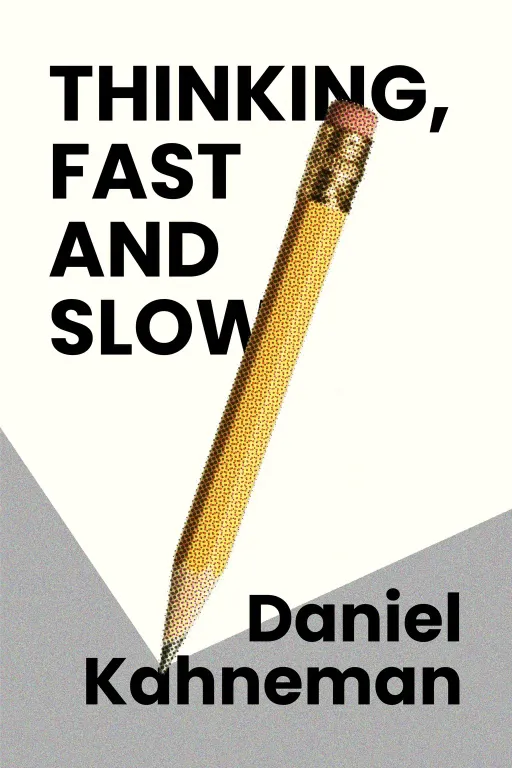
Nova: Pretty much! Daniel Kahneman, in his seminal work 'Thinking, Fast and Slow,' introduced us to two systems of thinking. System 1 is fast, intuitive, and emotional. It's what lets you recognize a friend's face or react quickly to a sudden noise. System 2 is slow, deliberate, and logical. It's what you use to solve a complex math problem or plan a strategy.
Atlas: So, System 1 is our gut reaction, and System 2 is our careful thought.
Nova: Exactly. System 1 is incredibly efficient, but its shortcuts, what Kahneman calls heuristics, are prone to biases. Let's take anchoring bias as an example. Imagine you're negotiating for a new project budget at work. Your colleague throws out an initial figure—let's say, an astronomically high $5 million—for a project that should realistically cost $1 million. Even if you know it's absurd, that $5 million figure, that 'anchor,' subtly shifts your perception.
Atlas: Wait, you're saying even if I consciously dismiss it, that initial, ridiculous number still affects my thinking?
Nova: Absolutely. Your System 1 has already latched onto it. So, when you counter with $1.5 million, it feels like a 'reasonable' reduction from $5 million, when your original, truly rational assessment might have been closer to $800,000. That initial, seemingly irrelevant anchor has 'pulled' your judgment upwards.
Atlas: That’s going to resonate with anyone who struggles with high-stakes negotiations. But how does that play into ethical decisions? For someone who prides themselves on dissecting complex situations and seeking clarity in ethics, this is a bit of a bombshell. Are we saying our ethical compass can be subtly guided by an arbitrary initial number?
Nova: It can, and it does. Imagine a company setting a new policy on employee conduct. If the initial draft of the policy is overly restrictive, even if later revisions soften it, that initial 'anchor' of strictness might lead to a final policy that's still more punitive than it would have been if the first draft had been more balanced. Or consider a jury: if the prosecution asks for an unusually harsh sentence, it might inadvertently anchor the jury’s perception of a 'just' punishment, even if they aim for fairness.
Atlas: That’s actually really inspiring, because it means true objectivity isn't a default state, it's an active practice. This fundamentally challenges our belief in purely rational thought, doesn't it? It makes me wonder, if our internal system is so easily swayed, what about external influences?
Choice Architecture – The Subtle Art of Influence
SECTION
Nova: That’s a perfect segue, Atlas. If our minds are prone to these internal biases, how easily can others—or even ourselves—manipulate our choices? This brings us to Richard Thaler's work, particularly from his book 'Nudge,' and the concept of 'choice architecture.'
Atlas: Okay, 'choice architecture.' That sounds like something an architect designs, but for decisions.
Nova: It's exactly that! Thaler demonstrates how 'choice architecture' subtly influences decisions. He shows that even minor changes in how choices are presented can significantly alter outcomes, proving that our rationality is easily swayed, often without us even realizing it.
Atlas: Give me an example. Something vivid.
Nova: The classic example is organ donation. In some countries, you have to actively 'opt-in' to be an organ donor. You check a box to say, 'Yes, I want to donate.' In others, you're automatically an organ donor unless you actively 'opt-out.' You have to check a box to say, 'No, I don't want to donate.'
Atlas: Oh, I see where this is going. People are lazy.
Nova: Exactly! The default option has an enormous impact. Countries with 'opt-out' systems have significantly higher organ donation rates, sometimes over 90%, compared to 'opt-in' countries, which might be in the single digits. It's the same choice, but the way it's framed—the architecture of the choice—completely changes the outcome.
Atlas: That’s incredible. So, it's not about forcing anyone, it's about making one path easier or the default. How would a persuasive analyst, someone who wants to influence with integrity, use this? Because it sounds like it could be manipulative.
Nova: That's the ethical tightrope. Thaler himself emphasizes that 'nudges' should be transparent and easily avoidable. The goal isn't manipulation; it's about helping people make better decisions for themselves, given their inherent biases. For an analyst, it might mean designing a presentation where the most ethical or sustainable option is the default one, or structuring a meeting agenda to gently guide the team towards a more comprehensive discussion rather than a rushed decision.
Atlas: So, if I'm structuring a new company policy, instead of just presenting options A, B, and C, I could frame them in a way that highlights the long-term benefits of option C, making it the 'default' or the most easily accessible choice, without removing the others. That's a bit like a hidden superpower.
Nova: It absolutely is. It's about understanding how human psychology works and using that knowledge responsibly. The book really highlights that whether it's our internal biases or external choice architecture, we're constantly being shaped. The key is to become aware of it.
Synthesis & Takeaways
SECTION
Nova: So, what we've really explored today is how our inherent cognitive biases and the subtle framing of choices profoundly shape our perception and ethical decision-making, often without us even realizing it. It's a powerful idea to grasp.
Atlas: It really is. It makes me question every 'rational' decision I thought I was making. It's not just about what we choose, but how that choice is presented, and how our own minds are wired to interpret it.
Nova: Precisely. True objectivity, then, isn't a default state; it's an ongoing practice of self-awareness and critical analysis. The deep question from 'The Framing Trap' becomes a powerful tool for self-reflection: 'Where in your daily decisions might an unconscious bias be subtly guiding your ethical compass without your awareness?'
Atlas: That's a question that sticks with you. For listeners who dissect complex situations and seek clarity in ethics, this isn't just theory; it's a call to action. It's about sharpening those deconstruction skills and exploring new ethical frameworks.
Nova: Absolutely. It's about embracing your unique perspective, your 'niche,' as your superpower, and applying these ethical frameworks starting with small, daily decisions.
Atlas: So, as our listeners go about their day, think about a decision you made recently. Was there an initial 'anchor' that influenced you? Or was there a way the options were presented that subtly nudged you in one direction over another?
Nova: And remember, being aware of these traps is the first step to breaking free.
Nova: This is Aibrary. Congratulations on your growth!