The Decoy Effect: How Subtle Choices Shape Your Customer's Mind
Golden Hook & Introduction
SECTION
Nova: What if I told you that the choices you make every single day, the ones you proudly declare as 'rational' and 'logical,' are actually being subtly manipulated, not by some shadowy conspiracy, but by the very way the options are presented to you?
Atlas: Whoa. Hold on, Nova. Manipulated? That sounds a bit out there. I mean, I like to think I’m pretty in control of my decisions. Are you saying I’m not?
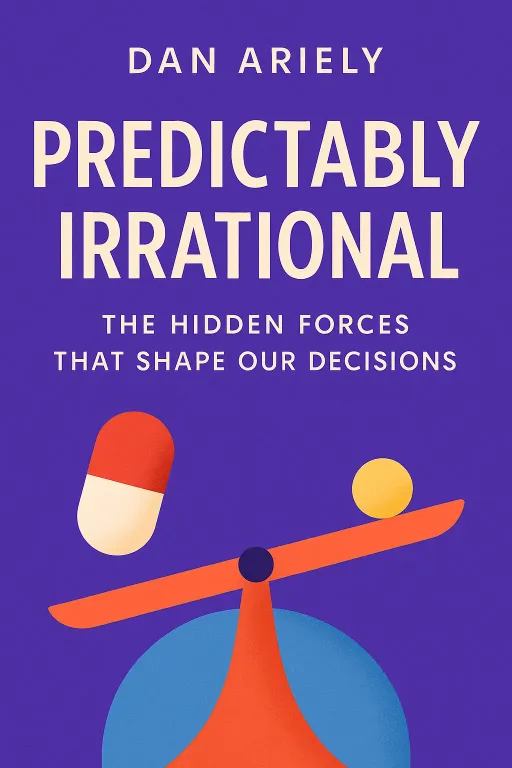
Nova: Well, Atlas, that's exactly what "Predictably Irrational" by Dan Ariely dives into. It's a groundbreaking book, and what's fascinating is that Ariely's deep dive into irrational decision-making actually stemmed from a deeply personal experience. He suffered severe burns as a young man, enduring a prolonged hospitalization that forced him to observe human behavior, including his own, under extreme conditions. That unique vantage point fueled his lifelong quest to understand why we often act against our own best interests.
Atlas: That makes me wonder about all those times I thought I was being logical, but maybe I was just... following a script I didn't even know existed. So, this book is basically saying we all have a blind spot when it comes to our own choices?
The Illusion of Rationality & The Decoy Effect
SECTION
Nova: Precisely. Ariely's work reveals that our minds are easily swayed by context, and our seemingly rational choices are actually predictably irrational. One of the most compelling illustrations of this is something called the "decoy effect." Have you ever seen a subscription offer that looks something like this?
Atlas: Oh, I love a good example. Lay it on me.
Nova: Imagine you're looking at a magazine subscription. Option A: Online-only for $59. Option B: Print-only for $125. And then, Option C: Print and Online for $125.
Atlas: Wait, so the print-only and the print-and-online are the same price? That seems... redundant. Why would anyone pick print-only?
Nova: Exactly! And that's the decoy. In Ariely's famous experiment with The Economist, when presented with just Option A and Option C, most people chose the online-only for $59. But when the seemingly useless Option B was introduced as a decoy, suddenly the "Print and Online for $125" option became wildly popular.
Atlas: That’s incredible. So, the decoy option, which nobody would logically choose, isn't there to be chosen. It's there to make the, more expensive option look like an amazing deal by comparison. It's like a psychological lever.
Nova: It absolutely is. The decoy creates a clear, easy comparison. Suddenly, $125 for print-only looks terrible next to $125 for print online. It makes the print-and-online option seem like a no-brainer, a steal. Our brains aren't always good at evaluating absolute value, but they're excellent at relative comparisons. The decoy provides that relative anchor.
Atlas: That gives me chills, honestly. For anyone building products or designing experiences, it means people aren't just evaluating features; they're evaluating based on how you frame the options. It's not about what something, but what it next to something else.
Nudge Theory: Designing Choices for Desired Outcomes
SECTION
Nova: And that naturally leads us to the second key idea we need to talk about: how we can use this understanding to better choices, not just passively observe our irrationality. This is where "Nudge: Improving Decisions About Health, Wealth, and Happiness" by Richard H. Thaler and Cass R. Sunstein comes in. They introduced the concept of "choice architecture."
Atlas: Choice architecture. That sounds like you're building a house, but for decisions. What does that actually mean?
Nova: It’s about how small changes in the way options are presented can "nudge" people toward better choices, without restricting their freedom. Think of it like a gentle push, not a shove. For instance, consider organ donation. In some countries, you have to actively opt-in to be an organ donor, and rates are low. In others, you're automatically opted-in, but you can choose to opt-out, and donation rates are significantly higher.
Atlas: So, it's the default setting that makes all the difference. That's a powerful and subtle influence. But isn't there a fine line between nudging and outright manipulation? I mean, for strategists and architects listening, how do they ensure they're using this ethically, especially when thinking about monetization?
Nova: That’s a crucial question, Atlas. Thaler and Sunstein emphasize that a true nudge preserves freedom of choice. You can always opt-out, or choose differently. It’s not about coercion. The ethical consideration comes down to intent: are you nudging people towards outcomes that genuinely benefit them, or just towards your own profit at their expense?
Atlas: And for the strategists, the architects, the visionaries listening, who are grappling with their monetization models, how can they apply this to unlock more perceived value for their customers? Because that's where the rubber meets the road.
Nova: Absolutely. Think about how you present your pricing tiers. Instead of just showing a basic and a premium, can you introduce an intermediate option that acts as a decoy, making your premium offering look like much better value? Or, if you have a product with an optional add-on, how do you frame it? Making the default option include a popular add-on, with an easy way to remove it, can significantly increase adoption. It’s about understanding the psychological friction points and making the desired path the path of least resistance.
Atlas: So it's not just about adding features, but about those features or pricing options are presented. It’s about designing the decision-making journey itself to highlight value, to make the optimal choice feel intuitive and obvious to the customer. That’s a game-changer for anyone looking to optimize product value and growth.
Synthesis & Takeaways
SECTION
Nova: Exactly. We started by challenging the illusion of our own rationality, uncovering how easily our choices are swayed by context and the subtle power of the decoy effect. Then, we moved into the proactive application of those insights with nudge theory, learning how to design choice architecture that guides users towards better outcomes, and crucially, towards recognizing the true value in what we offer.
Atlas: And it all boils down to trust. Trusting your insights, as a strategist, to understand these underlying psychological triggers. It's about being intentional with your design, rather than leaving perceived value to chance. It makes me wonder, where in our own daily lives, or in our current monetization models, are we unknowingly creating decoys or missing opportunities for a positive nudge?
Nova: That's the powerful question, isn't it? Even the smallest, most seemingly insignificant change in presentation can have a profound impact on how users perceive value and ultimately, on their decisions. It’s about turning those blind spots into strategic advantages for mutual benefit.
Atlas: That’s actually really inspiring. It’s not about tricking people, but about understanding human behavior so deeply that you can help them make choices that are truly better for everyone.
Nova: And that's a skill worth cultivating.
Atlas: This is Aibrary. Congratulations on your growth!