The Decision Trap: Why Your Brain Bets Against Your Best Interests
Golden Hook & Introduction
SECTION
Nova: You think you're in control of your decisions, right? Every choice, a product of careful thought? What if I told you your brain is constantly betting against your best interests, and you don't even know it?
Atlas: Whoa, that sounds a bit out there. My brain is supposed to be greatest asset, not some internal saboteur. Are you saying we're all just… walking contradictions?
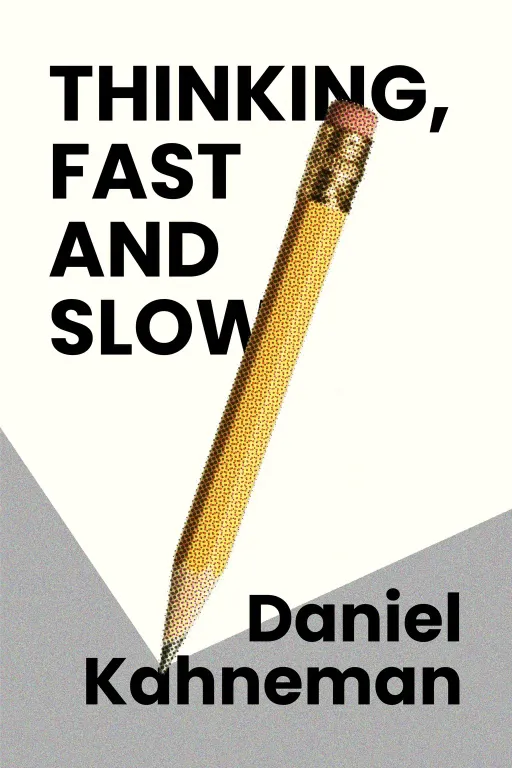
Nova: In a way, yes! Today we're cracking open "The Decision Trap," a book that distills decades of groundbreaking work on exactly this. It's built on the shoulders of giants like Daniel Kahneman, a Nobel laureate who completely reshaped our understanding of the human mind, and Richard Thaler, another Nobel winner, who showed us how subtle environmental cues can sway our choices. The book essentially pulls back the curtain on the decision-making process.
Atlas: Okay, so it's not just about willpower then, it's about understanding the mechanics of our own minds. That really resonates with anyone who’s ever wondered why they keep making the same mistakes.
Nova: Exactly. And the first step to escaping this "decision trap" is recognizing that we all have these internal blind spots.
The Illusion of Rationality: System 1 vs. System 2 Thinking
SECTION
Nova: Kahneman, particularly in "Thinking, Fast and Slow," introduced this brilliant framework of two systems of thought. System 1 is our fast, intuitive, emotional brain. It's the one that instantly recognizes a familiar face or slams on the brakes when a car swerves. It’s efficient, but prone to error.
Atlas: So basically you’re saying, it's the part of my brain that sees a flashy ad and thinks, "I need that!" without really thinking it through.
Nova: Pretty much! And then there's System 2. That's your slow, deliberate, logical, and effortful thinking. It's what you use to solve a complex math problem or plan a strategic business move. The problem? We vastly over-rely on System 1, even for decisions that demand System 2.
Atlas: I can see how that would be a problem for a future-focused leader, who needs to make critical, long-term decisions. Can you give an example? Like how does System 1 lead someone astray in a high-stakes professional context?
Nova: Absolutely. Imagine a CEO, let's call her Sarah, who needs to hire a new Head of Innovation. During the interview, one candidate, Mark, is incredibly charismatic, tells compelling stories, and reminds Sarah of a younger version of herself. Sarah's System 1 lights up – "This guy's a winner! I have a great gut feeling about him." She ignores some inconsistencies in his resume and lukewarm references, pushing them aside because of that strong initial impression.
Atlas: Wait, hold on. But isn't gut feeling sometimes good? I mean, we're often told to trust our instincts, especially in leadership. How do you know when to trust it, and when it’s just System 1 leading you down the garden path?
Nova: That’s a great question, Atlas, and it's where the "trap" lies. Sarah's gut feeling was a System 1 response – fast, associative, and based on superficial cues like charisma and personal resemblance. Her System 2 have been engaged to carefully vet the resume, cross-reference references, and analyze the candidate’s actual track record. The cause of the error was her System 1 overriding System 2. The process involved rationalizing away the red flags. The outcome? Mark turned out to be a brilliant storyteller but lacked the execution skills, leading to a year of stalled projects and team frustration. Sarah's initial "great feeling" cost the company significantly.
Atlas: Wow, that’s kind of heartbreaking. So the "blind spot" isn't a lack of information, but a failure to it deliberately.
The Power of Context: How Nudges Shape Our Choices
SECTION
Nova: Precisely. And while our brains have these internal quirks, the external world is also subtly manipulating us, often without us even noticing. This brings us to the concept of "nudges," popularized by Thaler and Sunstein.
Atlas: Okay, so if we're designing a strategy or even just a team meeting, we're not just thinking about the logical steps, but how we those steps, how we the choices?
Nova: Exactly! A nudge is any aspect of the choice architecture that alters people's behavior in a predictable way without forbidding any options or significantly changing their economic incentives. It's about making the desired decision the easiest, most obvious one.
Atlas: Can you give an example? Like how does a "nudge" play out in a real-world scenario, maybe something from a strategic planning or leadership perspective?
Nova: Certainly. Think about employee retirement savings. Many companies struggle to get their employees to contribute enough. Instead of launching a massive, complex financial literacy campaign – which is a System 2 approach – they introduce a nudge. They make enrollment in the 401k program the option, with employees having to actively if they don't want to participate.
Atlas: Oh, I see. So the default setting itself becomes the nudge. It’s like, instead of asking "Do you want to save?", it's "Unless you tell us no, you're saving." That makes sense, but what about the ethics of that? Isn't that manipulative? Where's the line between nudging for good and just tricking people into doing something they might not want?
Nova: That's a crucial point, Atlas. Thaler argues that nudges should be transparent and easily avoidable. The goal isn't coercion, but to help people make choices that are generally in their best long-term interest, especially when System 1 might lead them astray. In the retirement example, people can still opt-out, but the default leverages inertia and makes the positive choice the path of least resistance. The cause is the default setting. The process is bypassing the effortful decision. The outcome is significantly higher savings rates, benefiting both employees and the company.
Atlas: So it's about designing environments that support better decisions, rather than just hoping people will use their System 2 all the time. That's a powerful idea for leaders, especially when trying to influence team behavior or client choices.
Synthesis & Takeaways
SECTION
Nova: Absolutely. Understanding both our internal System 1 biases and the external nudges around us is incredibly empowering. It moves us from simply reacting to our decisions to actively our decision-making processes. Strategic planning becomes less about pure logic and more about understanding human psychology.
Atlas: That's actually really inspiring. So for someone who's a curious explorer, who wants to be a more future-focused leader, what's one immediate, practical action they can take based on this?
Nova: For every significant decision, force yourself to articulate your System 2 reasoning. Don't just go with your gut. Actively question your first impulse. Ask: "Is my initial reaction based on a quick association, or have I truly analyzed this?"
Atlas: And for leaders, how can they 'nudge' their teams towards better decisions without being paternalistic or feeling like they're tricking people?
Nova: Design processes that make the desired decision the easiest one, the default one. Whether it’s meeting prep, project management, or even just healthy eating in the office, make the 'good' choice the path of least resistance. It's about smart design, not coercion.
Atlas: So, it's about being aware of the decision traps, both internal and external, so we can finally start betting our best interests. That's a profound shift in perspective.
Nova: Indeed. It's about taking back control by understanding the forces that shape us.
Atlas: This is Aibrary. Congratulations on your growth!