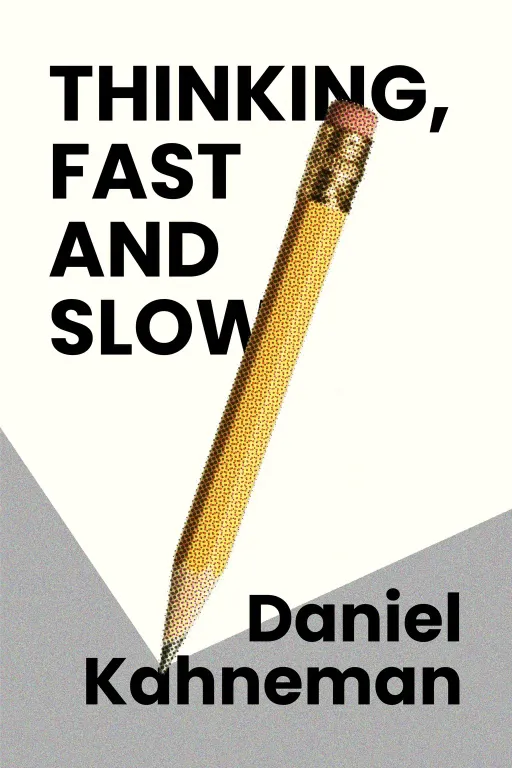
The Cognitive Bias Trap: Why Your Brain Tricks You in Tech Decisions.
Golden Hook & Introduction
SECTION
Nova: What if I told you that being incredibly smart, highly analytical, and deeply philosophical actually makes you more susceptible to certain decision-making traps? Not less.
Atlas: Whoa, Nova. That sounds like a bold claim, especially for our listeners who pride themselves on their logical approach. Are you saying our brilliant minds are actually working against us sometimes?
Nova: Absolutely. It’s a fascinating paradox, isn't it? The very intellect we rely on can sometimes be a blind spot. Today, we're diving into "The Cognitive Bias Trap: Why Your Brain Tricks You in Tech Decisions." We're going to unpack some profound insights from two giants in this field: Daniel Kahneman's groundbreaking work, "Thinking, Fast and Slow," and Richard H. Thaler's immensely practical "Nudge."
Atlas: Oh, I see. So we're talking about those invisible forces that influence every choice we make, especially in those high-stakes, fast-paced tech environments where quick decisions are the norm. It's like our brains have these built-in shortcuts, but sometimes they lead us down the wrong path.
Nova: Precisely. And what's truly remarkable about Kahneman's work, which earned him a Nobel Memorial Prize in Economic Sciences—a huge feat for a psychologist—is how he bridged the gap between our understanding of the human mind and economic theory. He showed us that our decision-making isn't always rational, far from it. It changed everything.
Atlas: That's a great way to put it. It’s like discovering there's an operating system running in the background of your mind that you didn't even know existed, and it has some quirks.
The Dual Engines of Your Mind: System 1 and System 2 Thinking
SECTION
Nova: Exactly! And Kahneman brilliantly breaks this operating system down into two core "systems." There's System 1, which is fast, intuitive, emotional, and largely unconscious. It's what allows you to instantly recognize a face or react to a sudden noise. Then there's System 2, which is slow, deliberate, logical, and requires effort. That's the part of your brain you use for complex calculations or deep analytical thought.
Atlas: Okay, so System 1 is our gut reaction, and System 2 is our careful consideration. Can you give me a vivid scenario where my 'fast brain'—my System 1—would actively trick me, even if I consider myself a logical person who tries to use my System 2? I imagine a lot of our listeners in demanding roles face this daily.
Nova: Absolutely. Imagine a tech lead, let's call her Sarah, working on a major new feature for a product. Early on, a few enthusiastic users give positive feedback. Sarah, using her System 1, quickly latches onto this. She starts seeing every subsequent piece of data, every user interview, through the lens of that initial positive impression. She's subconsciously looking for confirmation that her initial idea was brilliant, rather than objectively evaluating the feature's true performance.
Atlas: So, she's falling into confirmation bias. She's filtering out anything that contradicts her initial belief, even if it's glaringly obvious to an outsider.
Nova: Exactly. Her System 1 is shouting, "This is great! Keep going!" It's efficient, it saves mental energy, but it leads her to ignore warning signs—like declining engagement metrics or frustrated support tickets—because her brain is biased towards confirming her original intuition. The outcome? A suboptimal feature, wasted engineering resources, and a missed opportunity to truly innovate. The cause was the brain's shortcut, the process was biased interpretation, and the outcome was a less effective product.
Atlas: That sounds rough, but isn't System 1 what makes us efficient in the first place? We can't engage System 2 for every single decision, especially in a fast-paced environment. How do we balance speed with accuracy without getting bogged down?
Nova: That's the core challenge. The point isn't to eliminate System 1; it's indispensable. The breakthrough moment comes when you recognize System 1 is likely to mislead you, and then consciously engage System 2. It’s about building awareness of these traps, so you can pause and ask, "What data am I missing? Am I truly being objective here?" It's not about being slow all the time, but about being smart about to be slow.
From Awareness to Action: Nudging Better Decisions in Tech and Beyond
SECTION
Nova: Understanding our brains work, and where they often trip us up, is one thing. But what do we with that knowledge? This is where Richard Thaler's work on "Nudge" becomes incredibly powerful, taking Kahneman's insights from theory to practical application.
Atlas: That makes sense. We know we're wired for these biases. So, how does 'nudging' help us make better choices, especially in product design or user experience, where the ethical implications of guiding user behavior are huge? I'm curious about the line between helpful guidance and outright manipulation.
Nova: That's a crucial distinction, and it's central to Thaler's work. A "nudge" isn't about coercion or restricting choices. It's about subtly altering the "choice architecture" to guide people towards decisions that are demonstrably better for them, without taking away their freedom to choose otherwise. Think about it like a well-designed road. It guides you safely to your destination without forcing your steering wheel.
Atlas: Can you give me an example of a good nudge in the tech world? Something that makes a positive difference without feeling manipulative.
Nova: Certainly. Consider a privacy setting in a new app. If the default setting is "share all data," most users, driven by System 1's inertia and desire for ease, will just accept it. They might not even read the fine print. That's exploiting a bias. But if the default setting is "share minimal data," and the user has to to share more, that's a nudge. It leverages the same inertia, but towards a more privacy-preserving outcome, which most users would prefer if they thought about it deliberately.
Atlas: Oh, I like that. So it's about making the "better" choice the path of least resistance. But wait, isn't that still a form of manipulation? It's still influencing behavior. Where's the ethical line?
Nova: That's a very important question, and one that resonates deeply with anyone driven by meaning and ethics, like our listeners who are thinking about AI ethics and governance. Thaler argues that nudges are ethical when they are transparent, easy to avoid, and demonstrably improve people's welfare as judged by the people themselves. The line is crossed when you're obscuring information, making it difficult to opt out, or guiding people towards outcomes that benefit the "nudger" at the expense of the "nudgee." It's about designing systems that respect autonomy while still helping people overcome their inherent biases to achieve their own stated goals.
Atlas: That's a powerful distinction. It shifts the focus from simply identifying biases to actively designing environments that mitigate their negative effects, especially for those of us building the digital world. It’s about shaping the future responsibly.
Synthesis & Takeaways
SECTION
Nova: Exactly. So, while Kahneman gives us the profound understanding of our brains trick us, Thaler offers us the practical playbook for to design around those tricks. Recognizing these mental models fundamentally changes how you approach problem-solving and decision-making in any complex system, from product development to team management.
Atlas: It really does. It makes me think about that deep question from the book: "Where in your current work might a quick, intuitive decision have led to a less optimal outcome? What bias might have been at play?" For our listeners, I’d encourage you to reflect on that. What single decision are you making this week where pausing to ask 'What bias might be at play here?' could change everything?
Nova: That's a perfect challenge. This isn't just theory; it's a call to action for deeper understanding and more thoughtful creation. It’s about moving from being a passenger in your own mind to being a more conscious architect of your decisions.
Atlas: Powerful stuff.
Nova: This is Aibrary. Congratulations on your growth!