The Blind Spot: Why Understanding Psychology Unlocks Better Product Strategy.
Golden Hook & Introduction
SECTION
Nova: Atlas, five words. Describe the average product strategy you see out there. Go.
Atlas: Features, features, features, no, soul.
Nova: Oh, that's brutal, but I think you've just perfectly encapsulated the central argument of the book we're dissecting today: The Blind Spot: Why Understanding Psychology Unlocks Better Product Strategy.
Atlas: Soul-less features. I like that. So, we're talking about products that are technically brilliant, but… emotionally tone-deaf?
Nova: Precisely. And it’s a blind spot that costs companies billions. This book, while not naming specific authors, draws heavily from the groundbreaking work of pioneers like Richard Thaler and Daniel Kahneman. Thaler, in particular, actually won a Nobel Prize for his contributions to behavioral economics – essentially, bridging the gap between psychology and economic decision-making. He showed us that humans aren't rational robots.
Atlas: Oh, I like that. So, it’s about acknowledging the beautiful mess that is human decision-making, which, let's be honest, is rarely purely logical.
The Psychological Blind Spot in Product Strategy
SECTION
Nova: Exactly! Most product strategies are built on the faulty assumption that users are rational actors. We think about what features they want, what logical steps they take. But the reality is, human behavior is driven by a complex interplay of emotions, biases, and unconscious processes. That's the blind spot. We focus on the 'what' and 'how' of the product, but miss the 'why' of the human using it.
Atlas: But isn't it rational to want more features? I mean, from a strategic innovator's perspective, we're always pushing for more capability, more options. Where does the 'feeling' part come in when you're deep in the weeds of technical specs, trying to outperform the competition?
Nova: That's the trap. Let me paint a picture. Imagine a team, brilliant engineers, who built the most robust, secure, feature-rich budgeting app ever conceived. It had every financial tool you could dream of: advanced forecasting, integration with every bank, real-time analytics. On paper, it was perfect. But it failed spectacularly.
Atlas: Failed? How? Was it too expensive?
Nova: Not at all. It was free, even! The problem was, it assumed users wanted to meticulously track every single penny, categorize every latte, and analyze their spending patterns for hours. It assumed perfect financial rationality. But for real people, budgeting is often emotionally charged. It’s overwhelming, it brings up guilt, or anxiety. This app felt like a chore, a constant reminder of financial shortcomings, not a helpful tool. It lacked any emotional scaffolding to support the user through that difficult process.
Atlas: Oh man. So, even though it offered every logical solution, it ignored the very human, very illogical emotional resistance to engaging with those solutions. For a strategic innovator navigating complex product roadmaps, that's a huge blind spot. You're building for an idealized user, not the actual, messy human.
Nova: Precisely. It was designed for a spreadsheet, not a human heart. And the result? Users downloaded it, got overwhelmed, felt bad, and abandoned it. The technical brilliance was wasted because it didn't connect with the actual human experience of managing money. This blind spot manifests as feature creep, products designed for ideal users rather than real, messy humans, and a constant chasing of the next big thing without understanding the underlying behavioral drivers.
Designing for Human Behavior: Nudges and Dual-System Thinking
SECTION
Nova: That's where understanding our actual decision-making comes in, and that's where the insights from books like 'Nudge' and 'Thinking, Fast and Slow' become game-changers. It’s about shifting from expecting rationality to designing for reality.
Atlas: So you’re saying we need to stop trying to force users to be rational and instead design for how they actually behave? Like, gently guiding them?
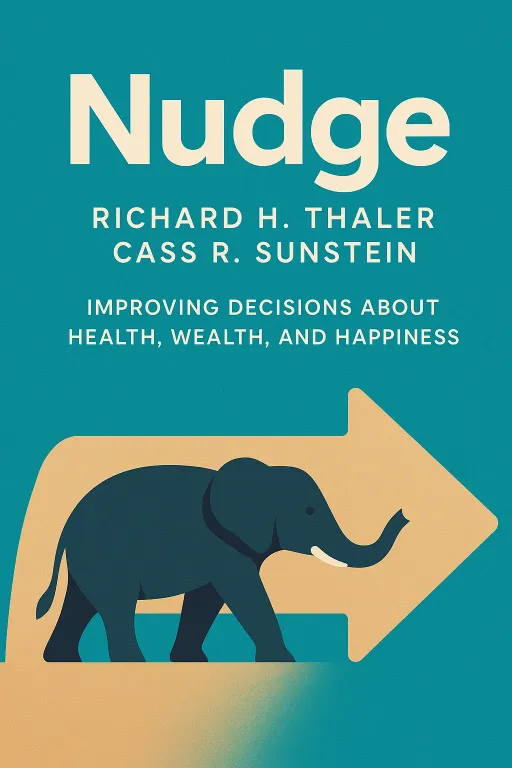
Nova: Exactly. That's the essence of the 'nudge' concept from Thaler and Sunstein – 'libertarian paternalism,' as they call it. It's about structuring choices in a way that subtly guides people toward better decisions without restricting their freedom of choice. It’s not about manipulation, but about thoughtful environmental design.
Atlas: But for a product leader, where's the line between a helpful nudge and… manipulation? Especially when you're trying to drive specific metrics, there's always that pressure.
Nova: It’s a critical distinction. A nudge is transparent and easy to opt-out of. Think about retirement savings: if the default is 'opt-in,' participation is low. Change the default to 'opt-out,' and suddenly, participation skyrockets. People are still free to opt-out, but the default provides a gentle push in a beneficial direction. It's about designing for our intuitive, fast thinking – what Daniel Kahneman calls System 1.
Atlas: What do you mean by System 1? I’m curious, how does Kahneman's 'Thinking, Fast and Slow' play into this?
Nova: Kahneman describes two systems that drive our thinking. System 1 is fast, intuitive, emotional, and largely unconscious. It's what makes you swerve to avoid an obstacle or understand a simple sentence. System 2 is slow, deliberate, logical, and effortful. It's what you use to solve a complex math problem or fill out a tax form. Most product design implicitly targets System 2, assuming users will thoughtfully analyze every option. But in reality, most of our daily decisions are System 1.
Atlas: Oh, I see. So nudges work because they cater to that fast, intuitive System 1, rather than demanding complex thought from System 2? That makes sense. My brain is always looking for the easy button. So, how can a small design change in our product 'nudge' users towards a more beneficial action? Can you give me a tangible example that a product team could implement next week?
Nova: Absolutely. Think about an online shopping cart. If a user adds items but doesn't complete the purchase, there's often a 'blind spot' around commitment. A simple nudge could be this: instead of just showing the total at checkout, before they even click "Pay," a small, discreet message pops up saying, "You're just one step away from." Or, even more subtly, a progress bar that clearly shows "Almost There!" with a gentle animation.
Atlas: That’s a great example. It’s like a quiet cheerleading section for your brain. It feels supportive, not pushy. It’s not taking away my choice to abandon the cart, but it’s making me feel good about proceeding.
Nova: Exactly. Or consider a simple onboarding flow for a new app. Instead of a long form with a hundred fields, a nudge might be to break it into tiny, single-question steps, celebrating each completion with a small animation or confirmation. It reduces cognitive load, caters to System 1’s desire for quick wins, and gently guides the user through a potentially tedious process. It’s a shift from 'making them think' to 'making it feel right.'
Synthesis & Takeaways
SECTION
Nova: So, ultimately, the book argues that product strategy isn't just about what a product, but how it and how it users through their choices. It's about recognizing that our users are human, with all their quirks and cognitive shortcuts.
Atlas: And it’s about shifting from just building features to building experiences that truly resonate with how humans think and feel? It's about empathy at scale, isn’t it? For innovators, that means moving beyond the technical specifications and truly understanding the human psychology behind user choices.
Nova: Precisely, Atlas. Understanding psychology unlocks a deeper, more effective level of product strategy, leading to products that aren't just technically sound, but emotionally engaging and truly impactful. It’s about building futures by driving meaningful outcomes, as you said.
Atlas: That’s actually really inspiring. It makes me wonder, for all our listeners out there, what’s one 'blind spot' in your current product or project where you might be overlooking the human element? Just take a moment to reflect on that.
Nova: A fantastic question to leave our listeners with. Thank you for joining us today.
Atlas: Always a pleasure, Nova.
Nova: This is Aibrary. Congratulations on your growth!