The Behavioral Economics Trap: Why You Need to Master Human Decisions.
Golden Hook & Introduction
SECTION
Nova: What if I told you that even with perfect data, the most brilliant strategy could still fail, not because of the numbers, but because of a single, often invisible, variable?
Atlas: Oh man, that sounds like a riddle wrapped in a paradox. Most of the leaders and builders I know are obsessed with data, with optimizing every single metric. Are you saying we're missing something fundamental?
Nova: Absolutely, Atlas. We're talking about the ultimate variable: human behavior. Ignoring the subtle biases that drive decisions can derail even the most meticulously crafted plans. Today, we're diving deep into what we call "The Behavioral Economics Trap: Why You Need to Master Human Decisions."
Atlas: Master human decisions? That feels like trying to herd cats, or maybe, trying to predict the stock market on a Tuesday. How do we even begin to approach that?
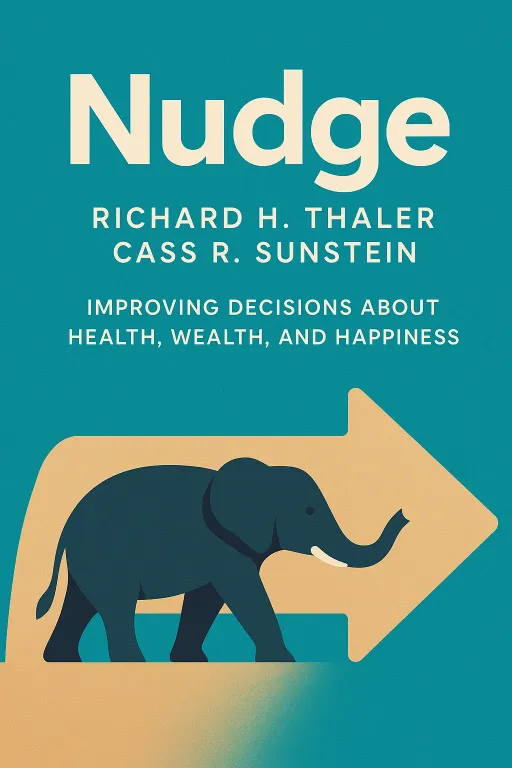
Nova: We start by understanding the 'why' behind user choices, and for that, we turn to two monumental works. We're drawing insights from "Nudge: Improving Decisions About Health, Wealth, and Happiness" by Richard H. Thaler and Cass R. Sunstein, and the profoundly influential "Thinking, Fast and Slow" by Daniel Kahneman.
Atlas: Kahneman... now that name rings a bell. Didn't he, a psychologist, win a Nobel Prize in Economics? That always struck me as fascinating, a psychologist in a field of economists.
Nova: You're spot on! It highlights just how groundbreaking his work was. Kahneman, a psychologist, shattered the traditional economic assumption of rational actors by demonstrating how psychological insights could fundamentally reshape our understanding of judgment and decision-making, particularly under uncertainty. It’s a powerful testament to the interdisciplinary nature of true insight.
Atlas: That’s incredible. So, we're talking about going beyond the spreadsheets and into the human psyche to really understand what's going on.
Nova: Exactly. Today, we'll dive deep into this from two perspectives. First, we'll explore the hidden biases that make us all predictably irrational, then we'll discuss how we can use that understanding to design powerful 'nudges' that guide better outcomes.
The Unseen Architects: Unmasking Cognitive Biases in Decision Making
SECTION
Nova: So, let's kick off with Daniel Kahneman's revolutionary insights, particularly his framework of System 1 and System 2 thinking from "Thinking, Fast and Slow." He essentially describes our minds as having two operating modes. System 1 is fast, intuitive, emotional, and largely unconscious. It's what lets you recognize a friend's face instantly or slam on the brakes without thinking.
Atlas: Okay, so like instinct. That makes sense. We all rely on that quick judgment, especially when things are moving fast.
Nova: Precisely. But System 1, for all its efficiency, is also the birthplace of most of our cognitive biases. It's prone to shortcuts, heuristics, and often jumps to conclusions. System 2, on the other hand, is slow, deliberate, analytical, and effortful. It's what you engage when solving a complex math problem or carefully weighing pros and cons.
Atlas: I see. So, System 1 is the autopilot, and System 2 is when you actually take the wheel. But how does this actually manifest in a strategic decision-making context? For leaders, for builders, we're taught to be rational, to look at the data. How do these 'blind spots' sneak in?
Nova: Let me give you a classic example that often trips up even the sharpest minds: the availability heuristic. Imagine you're a product manager deciding whether to invest heavily in a new, high-risk feature. A colleague just told you a vivid, dramatic story about a competitor's similar feature failing spectacularly and costing millions.
Atlas: Oh, I know that feeling. That story would be echoing in my head.
Nova: Exactly. Because that vivid, easily recalled story is so "available" in your memory, System 1 overweights its probability. You might then significantly overestimate the risk of your own feature failing, even if the objective data—market research, technical feasibility, user testing—suggests a much lower probability. System 1 latches onto the emotional impact of the story, making you predictably irrational.
Atlas: Wow. So, System 1 isn't just about small, everyday decisions. It can actively skew our perception of risk and reward in high-stakes strategic choices. That's actually really unsettling. It sounds like our brains are actively working against our best intentions sometimes.
Nova: They're working efficiently, but not always rationally. Kahneman’s insight is that recognizing this isn't about blaming ourselves, but understanding the machinery of our minds. It's about acknowledging that even with perfect data, our inherent biases can lead us to suboptimal choices. That's the blind spot.
Atlas: But if we're all susceptible, how can we trust any of our 'gut feelings' then? This sounds like it could paralyze decision-making if we're constantly second-guessing every instinct.
Nova: That's a great point, and it's not about eliminating intuition. It's about understanding its limitations and designing checks and balances. It's about knowing when to pause, engage System 2, and ask, "Is there a bias at play here? What objective data am I overlooking because of a vivid story or a recent experience?" The goal is to be aware, not to be paralyzed.
Designing for Better Outcomes: The Art of the Nudge
SECTION
Nova: And that naturally leads us to the second key idea we need to talk about, which often acts as a counterpoint to what we just discussed: the concept of the 'nudge' from Richard Thaler and Cass Sunstein. If Kahneman showed us how predictably irrational we are, Thaler and Sunstein show us how to use that predictability for good.
Atlas: So, if we understand these biases, how do we actually use that knowledge to something? Give me a concrete example. For someone trying to guide their users to make better choices in a product or a process, how does this 'nudge' actually work?
Nova: Think about the classic cafeteria example. When healthy food options are placed at eye level and at the beginning of the serving line, people choose them more often. Unhealthy options are still available, no one is forced to eat salad, but the environment is subtly designed to guide them towards a healthier outcome. That's a nudge. It's a small, subtle intervention that predictably influences human behavior without restricting choices, leveraging our inherent biases towards convenience or what's immediately visible.
Atlas: That's a great example. So, it's not about banning candy, it's about making the fruit easier to grab. I can see how that applies to product design, too. Like making the 'opt-in' for a privacy setting the default, rather than making users actively choose it.
Nova: Exactly! Default options are powerful nudges. Thaler and Sunstein’s work emphasizes that there's no such thing as a neutral design. Every environment, every choice architecture, nudges people in some direction, whether intentionally or unintentionally. The brilliance is in making those nudges intentional and beneficial. Another powerful example is in organ donation. In countries where the default is 'opt-out', donation rates are significantly higher than in 'opt-in' countries.
Atlas: Whoa. That's a huge impact from such a simple change in wording. It addresses that System 1 inertia, making the path of least resistance the one that leads to a better societal outcome. But isn't there a fine line here between guidance and manipulation? How do we ensure we're nudging for 'better outcomes' and not just our own gain, or subtly coercing people?
Nova: That's a critical question, and it's one Thaler and Sunstein address directly. A true nudge should improve the welfare of the people being nudged, as judged by those people themselves. It should be transparent and easily avoidable. The goal isn't to trick people, but to help them make choices they would rationally prefer, if they weren't prone to biases or inertia. It's about ethically designing environments that guide desired behaviors, aligning with what people truly want for themselves. It’s about empowering choice, not removing it.
Atlas: That’s a massive distinction. So, it’s about strategically designing the environment to align with people's long-term best interests, even when their System 1 might lead them astray in the short term. It's foresight in action.
Synthesis & Takeaways
SECTION
Nova: Precisely. The synthesis of Kahneman and Thaler is incredibly powerful. First, recognize that we are all predictably irrational, constantly navigating blind spots created by our own cognitive biases. Second, instead of fighting human nature, we can strategically design 'choice architectures'—environments and processes—that gently 'nudge' individuals towards better outcomes, whether that's healthier eating, saving more for retirement, or making optimal product choices.
Atlas: That gives me chills, in a good way. For the leaders, for the builders, for the strategic architects listening, what's the one actionable insight they can take from this today to immediately impact their decisions or their team's outcomes?
Nova: My challenge for everyone listening is this: Think about your current product, your service, or even an internal team process. Where are users or team members currently making suboptimal choices? Where do you see a 'blind spot' causing friction or inefficiency? Then, brainstorm one subtle 'nudge' – a default setting, a reordering of options, a different framing – that could gently guide them to a better outcome without restricting their freedom. It’s about leveraging foresight to shape tomorrow, one smart decision at a time.
Atlas: That’s a clear call to action, and it really drives home the idea that mastering human decisions isn't about controlling people, it's about understanding and enabling them. It's about being the architect of better choices.
Nova: Absolutely. And that, Atlas, is the profound power of behavioral economics. This is Aibrary. Congratulations on your growth!