Decoding Human Decisions: The Behavioral Economics Edge
Golden Hook & Introduction
SECTION
Nova: Imagine, for a moment, that you are the most logical, analytical person you know. You dissect complexity, you seek hidden truths, you pride yourself on rational decisions.
Atlas: Oh, I'm imagining it. Sounds like a Tuesday morning. What's the catch?
Nova: The catch, Atlas, is that even for the most strategic minds among us, our brains are constantly playing tricks. We like to think our decisions are purely rational, a product of careful deliberation. But what if I told you that much of the time, that's just a comforting illusion?
Atlas: Whoa, that's a bold claim. Are you telling me my highly refined decision-making process, honed through years of strategic thinking, is actually just a puppet show put on by my subconscious?
Nova: In many cases, yes! And today, we're pulling back the curtain on this fascinating reality. Welcome to Aibrary, the podcast dedicated to decoding the knowledge that helps you grow. I'm Nova.
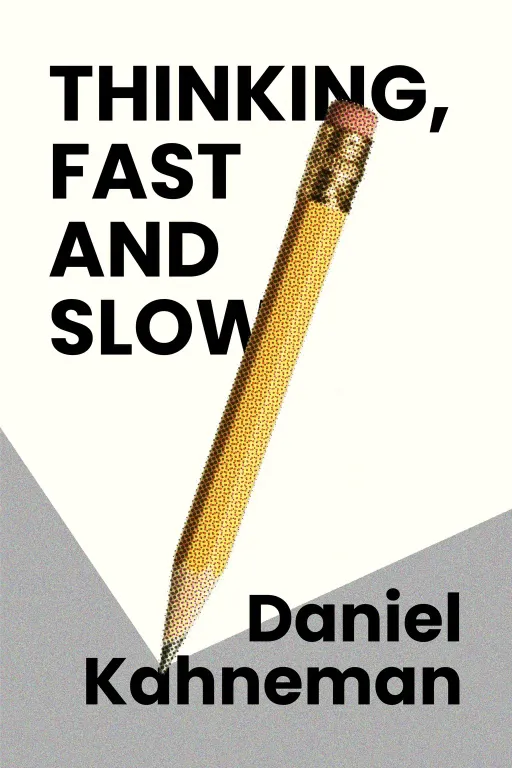
Atlas: And I'm Atlas. Today, we're diving into the brilliant world of behavioral economics, specifically two foundational texts that have reshaped our understanding of human choice: "Thinking, Fast and Slow" by the Nobel laureate Daniel Kahneman, and "Nudge" by another Nobel Prize winner, Richard H. Thaler, co-authored with Cass R. Sunstein.
Nova: It’s incredible how Kahneman, a psychologist, won the Nobel in Economics for his groundbreaking work, proving just how intertwined our psychology is with our financial and life choices. And Thaler, building on that, showed us how we can ethically use these insights. These aren't just academic theories; they're blueprints for understanding ourselves and designing better systems.
Atlas: That makes me wonder, for someone who thrives on dissecting complexity and applying theories to the real world, how do these ideas actually translate into tangible impact?
The Dual Systems of Thought & Cognitive Biases
SECTION
Nova: That's precisely where we start, Atlas. Kahneman's core insight, the one that truly changed the game, is the idea that our minds operate with two distinct systems. He calls them System 1 and System 2.
Atlas: Okay, System 1 and System 2. Sounds a bit like a computer's operating system. What's the difference?
Nova: Exactly! Think of System 1 as your intuition. It's fast, automatic, emotional, and operates with little to no effort. It's what allows you to understand a simple sentence, recognizes a friend's face, or react instantly to a sudden noise. It’s your gut feeling.
Atlas: So, it's the part of my brain that screams "danger!" before I've even consciously registered the car swerving?
Nova: Precisely. And System 2? That's your conscious, deliberative self. It's slow, effortful, logical, and handles complex calculations, focused attention, and self-control. This is the system you engage when you're solving a complicated math problem, learning a new skill, or carefully weighing the pros and cons of a major investment.
Atlas: I guess that makes sense. We can't be deliberating over every single decision all day, or we'd never get anything done.
Nova: Right. And here's where it gets really interesting, and often problematic: System 1 is incredibly efficient, but it's also prone to systematic errors, what Kahneman calls cognitive biases. It often jumps to conclusions, relies on mental shortcuts, and is heavily influenced by emotions or how information is presented.
Atlas: So you're saying our "gut feelings," which we often valorize, can actually lead us astray? Especially for someone who's constantly evaluating risks and opportunities in, say, financial markets?
Nova: Absolutely. Take the concept of "framing," for example. Imagine a new medical treatment for a serious illness. If a doctor tells patients, "There's a 90% chance you'll survive this procedure," most patients will opt for it. System 1 kicks in, "90% survival! Good odds!"
Atlas: That sounds like a pretty good outcome to me.
Nova: But what if the doctor frames it differently, saying, "There's a 10% chance you will not survive this procedure"? The statistical outcome is identical, but suddenly, for many, System 1 screams "10% chance of death! That's too risky!" The perception shifts dramatically, solely based on how the information is presented.
Atlas: Wow. That's kind of heartbreaking, actually. It's the same information, but the emotional response completely flips. So, our interpretation of data isn't always objective, even if we pride ourselves on being data-driven?
Nova: Exactly. And this isn't just about medical decisions. Think about financial products. How a return is "framed"—as gains or avoided losses—can profoundly impact investment decisions. Or "anchoring," where an initial, often irrelevant, piece of information influences subsequent judgments. A high initial asking price for a stock or a house can anchor our perception of its true value, even if we know it's inflated.
Atlas: That makes me wonder about all the times I thought I was making a purely rational choice, but was actually just reacting to how the information was presented to me. It's like my brain was pre-programmed to respond in a certain way. This is crucial for an Analytical Architect, someone who’s predicting market movements. If you don't understand these psychological undercurrents, you're missing a huge piece of the puzzle.
Nova: You've hit on exactly what Kahneman and Thaler highlight. For someone like you, who dissects complexity and designs financial strategies, understanding these biases isn't just academic; it's a competitive edge. It’s about predicting where the irrationality might emerge and how it could sway market behavior. It allows you to design more robust strategies that account for human nature, not just idealized rational actors.
Choice Architecture & Ethical Nudging
SECTION
Atlas: So, if our brains are wired for these biases, and System 1 often takes the wheel, can someone actually an environment to influence our choices? Like, can the way choices are presented actually "nudge" us in a particular direction?
Nova: That's the brilliant leap made by Thaler and Sunstein in "Nudge." They introduce the concept of "choice architecture." Essentially, every decision we make exists within a particular context, and that context is designed by someone. Whether it's the layout of a supermarket, the default options on a website, or the way benefits packages are presented, these are all forms of choice architecture.
Atlas: Okay, so someone is always designing the menu, so to speak. But where does the "nudge" come in?
Nova: A "nudge" is any aspect of the choice architecture that alters people's behavior in a predictable way without forbidding any options or significantly changing their economic incentives. It's about guiding choices without restricting freedom. This is where "libertarian paternalism" comes in.
Atlas: Libertarian paternalism. That sounds like a contradiction in terms. "Libertarian" implies freedom, "paternalism" implies guidance, even control. How do those two coexist?
Nova: It’s a fascinating balance. The "libertarian" part means that people are always free to choose differently; no options are removed. The "paternalism" part means that the choice architect is trying to steer people towards choices that will make their lives better, as judged by themselves.
Atlas: Can you give an example? Because for someone who values autonomy, this sounds a bit... manipulative if not handled carefully.
Nova: Absolutely. One of the most famous examples is the default setting for retirement savings plans. In many companies, employees used to have to actively "opt-in" to a 401k. Most people, thanks to System 1's inertia and procrastination, wouldn't get around to it.
Atlas: Yeah, I totally know that feeling. paperwork, forms... it's easy to put off.
Nova: Exactly. But when companies switched to an "opt-out" system—where employees were automatically enrolled unless they actively chose to leave the plan—participation rates skyrocketed. People were still free to opt-out, but the default setting, the choice architecture, nudged them towards a better outcome for their future.
Atlas: That’s a perfect example. The freedom is still there, but the default option leverages our tendency to stick with the path of least resistance. But wait, looking at this from a strategic perspective, for an Analytical Architect designing financial products or even public policy, how do you ethically apply these insights without infringing on individual autonomy? Isn't there a risk of manipulation here?
Nova: This is the deep question, Atlas, and it's one Thaler and Sunstein grapple with. The key is transparency and the intent behind the nudge. A truly ethical nudge is one that helps people achieve their own stated goals, goals they would rationally choose for themselves if System 2 were always fully engaged. It's not about tricking people into doing what want, but helping them do what want, more easily.
Atlas: So, it's about making the healthy or financially sound choice the easier, more convenient default, rather than forcing it or making it difficult to choose the alternative. It's about designing systems that work with human nature, not against it.
Nova: Precisely. For an Analytical Architect, this means moving beyond just offering choices to designing the of those choices. It's about understanding that every system, every product, every policy implicitly has a choice architecture, and we have the power—and the responsibility—to design it consciously for better outcomes.
Synthesis & Takeaways
SECTION
Nova: So, what we've really explored today is this incredible dance between our internal psychology and the external world. On one hand, we have Kahneman showing us the dual nature of our minds and the biases that can trip us up. On the other, Thaler and Sunstein demonstrate how cleverly designed environments can leverage those very same psychological tendencies to guide us towards decisions that are ultimately better for us.
Atlas: It’s fascinating how these two ideas connect. It’s not just about understanding our own internal quirks, but realizing that the world around us is constantly, subtly influencing those quirks. For someone dissecting complexity to predict market movements or design effective financial strategies, this isn't just theory; it's a critical lens through which to view every decision point.
Nova: Exactly. It empowers you to not only understand your own decision-making better but also to anticipate the behavior of others, whether they’re clients, consumers, or even entire markets. It’s about building strategies that are robust to human irrationality.
Atlas: That’s actually really inspiring. So, for our listeners, that 'Analytical Architect' who's always dissecting complexity and seeking tangible impact, what's one immediate, small step they can take to start applying this?
Nova: A tiny step, but a powerful one, is to simply observe your own decision-making process for one day. Note instances where your System 1, your intuition, might have overridden your System 2, your deliberation. What was the outcome? Just becoming aware of these patterns is the first step to mastering them.
Atlas: That’s a great piece of advice. And it makes me wonder: if we become more aware of these influences, how does that shift our fundamental understanding of personal responsibility and the role of free will in a world designed to nudge us? Something to ponder during some unstructured thinking time.
Nova: Indeed.
Nova: This is Aibrary. Congratulations on your growth!