Decoding Decisions: The Psychology of Markets & Consumers
Golden Hook & Introduction
SECTION
Nova: Alright Atlas, rapid-fire word association for you today. Ready?
Atlas: Oh, I like that! Always. Lay it on me, Nova.
Nova: Okay. "Choice."
Atlas: Freedom! Or... regret. Depending on the day.
Nova: Ha! Good one. "Market."
Atlas: Jungle. Or... opportunity, if you’ve got a machete.
Nova: Excellent. And finally, "Decision."
Atlas: Oh, that's a big one. Trap. Or... triumph. Again, depends on the outcome.
Nova: Definitely depends on the outcome. And those outcomes, Atlas, are what we're decoding today, because they're often shaped by forces far beyond our conscious awareness.
Atlas: That makes me wonder, how much of our 'freedom' or 'regret' is actually, well, ours?
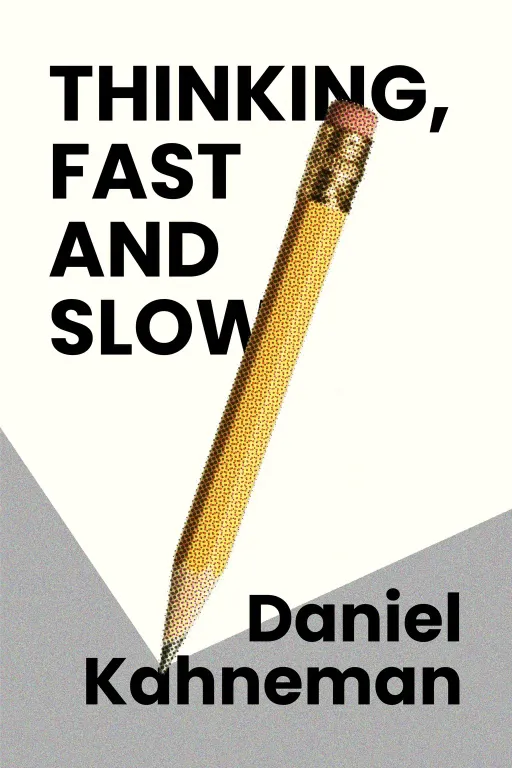
Nova: Exactly. And that's the core question we're tackling, drawing heavily from the insights of two groundbreaking books: Daniel Kahneman's "Thinking, Fast and Slow" and "Nudge" by Richard H. Thaler and Cass R. Sunstein. What’s fascinating about 'Thinking, Fast and Slow' is that Kahneman, a psychologist, actually won the Nobel Memorial Prize in Economic Sciences for his work, showing just how deeply psychological insights impact our understanding of markets and human behavior.
Atlas: That's actually really inspiring. A psychologist shaking up economics—that’s a serious interdisciplinary feat. So, if these books are about decoding decisions, where do we even begin to unpack something that feels so... internal?
The Dual Systems of Thinking: System 1 vs. System 2
SECTION
Nova: We begin with the hidden architecture of our own minds, Atlas. Kahneman introduces us to two systems that drive our thinking: System 1 and System 2. Think of System 1 as the fast, intuitive, emotional part of your brain. It's what makes you instantly recognize a face, or flinch at a loud noise. It operates automatically, with little to no effort.
Atlas: So you're saying, like, my gut reaction? That immediate 'yes' or 'no' feeling before I've even thought it through?
Nova: Precisely. System 2, on the other hand, is the slow, deliberate, logical thinker. It’s what you engage when you're solving a complex math problem, or carefully weighing the pros and cons of a major investment. It requires effort, attention, and conscious control.
Atlas: Okay, so one's a reflex, the other's a spreadsheet. I can see that. But how do these two systems get us into trouble, especially in a market context? I imagine a lot of our listeners, the strategic entrepreneurs, pride themselves on being logical.
Nova: Well, that's where the predictable irrationalities come in. System 1 is brilliant for survival, but it's prone to biases. Take the "anchoring effect." Imagine you're negotiating a price for a new product. If the very first number mentioned is high—even if it's completely arbitrary—it can 'anchor' the subsequent discussion, making even a slightly lower final price seem reasonable, even if it's still too high.
Atlas: Wait, so just hearing a number, even if I know it's a ridiculous starting point, can subtly shift my perception of value? That sounds like a sophisticated trap.
Nova: It absolutely is. Your System 1 latches onto that anchor, and your System 2 then works to rationalize around it, rather than independently evaluating the true value. It’s a powerful force in everything from salary negotiations to how we perceive discounts. Or think about "confirmation bias." System 1 loves to find information that confirms what it already believes.
Atlas: Oh, I've been there. You have an idea for a new feature, and suddenly every piece of customer feedback, every market trend, seems to scream 'validation,' even if there are contradictory signals you're just not seeing.
Nova: Exactly! I've seen startups pour millions into products because the founders, driven by their initial passion—a very System 1 emotion—only sought out data that confirmed their vision. They ignored the red flags, the dissenting voices, because System 1 was already convinced. The outcome? Often, a spectacular failure that could have been avoided if System 2 had been given more airtime.
Atlas: That makes me wonder, how do you even begin to fight against something so ingrained in how our brains work? It feels like we're constantly battling our own operating system.
Nudging Choices: Guiding Behavior Ethically
SECTION
Nova: It’s a battle, but also an opportunity. And that's where our second book, "Nudge," comes into play. Thaler and Sunstein show us that while we might be predictably irrational, we can also be predictably guided. A 'nudge' is a subtle intervention that steers human choices towards better outcomes without restricting anyone's freedom of choice. It's about designing the 'choice architecture.'
Atlas: So it's not like banning unhealthy food, but maybe putting the fruit at eye level in the cafeteria?
Nova: Precisely! It's a gentle push, not a shove. Think about default options. When you sign up for a new software, or even a retirement savings plan, there's often a pre-selected default. Studies show that simply making 'opt-in' the default, rather than 'opt-out,' dramatically increases participation. People just stick with the path of least resistance, which is System 1 at work.
Atlas: So, for our listeners building products or services, this means the way they present options, the order they put them in, or even what they pre-select, can have a massive impact on user behavior? That's a huge lever.
Nova: It's a massive lever, and one that ethically minded entrepreneurs can use for good. Consider 'loss aversion.' People are generally more motivated to avoid a loss than to achieve an equivalent gain. If you frame a healthy eating program as helping people 'avoid losing their vitality' rather than 'gaining better health,' you might see higher engagement.
Atlas: Wow, that's kind of heartbreaking, but also incredibly powerful. So, a company could redesign their onboarding process to 'nudge' new employees towards, say, enrolling in a mental health benefits program by making it a default, leading to better well-being and retention?
Nova: Absolutely. It’s about understanding the psychological shortcuts and then designing an environment where the 'best' choice is also the easiest or most obvious. The ethical tightrope, as you mentioned, is crucial here. Thaler and Sunstein call it 'libertarian paternalism.' 'Libertarian' because it preserves freedom of choice—you can always opt out. 'Paternalism' because it's designed to guide you towards what's generally considered a better outcome.
Atlas: That makes me wonder, for a strategic entrepreneur, how do you ensure you’re on the 'libertarian' side of that and not accidentally slipping into manipulation? Because that's a fine line.
Synthesis & Takeaways
SECTION
Nova: That's the deep question, isn't it? The key lies in transparency and genuine user benefit. Understanding these dual systems and the power of nudges isn't about tricking people; it's about helping them make choices that align with their long-term goals, even when their System 1 might lead them astray. If you’re building products that truly benefit your customers, then using these insights to make the 'good' choice the 'easy' choice is ethical design.
Atlas: So, it's about leveraging insights from behavioral economics to build products that not only succeed commercially but also genuinely benefit our customers. That's a powerful integration of psychology, business, and ethics.
Nova: Exactly. For our listeners, the challenge is to identify one area in their business where a small 'nudge' could lead to a significantly better outcome for their users. Think about your user journey: where are people making suboptimal choices, not because they want to, but because the choice architecture is working against them?
Atlas: That's a concrete tiny step, and it really shifts the perspective from 'fixing the user' to 'fixing the system.' It's about designing for human nature, not against it.
Nova: And that's where the profound insights lie. How can you leverage our understanding of human irrationality to build products and experiences that not only meet commercial goals but also uplift and genuinely benefit your customers? It's a question that demands continuous reflection for any ethical leader.
Atlas: Definitely one to chew on. This is Aibrary. Congratulations on your growth!