Beyond the Headlines: The Economic Logic Behind Human Choices
Golden Hook & Introduction
SECTION
Nova: You know, Atlas, for the longest time, the bedrock of economic theory was this idea that humans are these perfectly rational, calculating machines. Every decision, a cold, logical equation.
Atlas: Right? The "Homo Economicus" – always maximizing utility, never making a silly impulse buy because the packaging was shiny. My credit card statements beg to differ with that theory, Nova.
Nova: Exactly! It's a lovely thought, isn't it? That we're all just little Spocks making perfectly logical choices. But the truth is, we are gloriously, wonderfully, often comically irrational. And that, my friend, is the blind spot we're peering into today.
Atlas: Oh, I love that. The glorious irrationality. So, are we talking about the wild world of human nature crashing into the pristine halls of economic models?
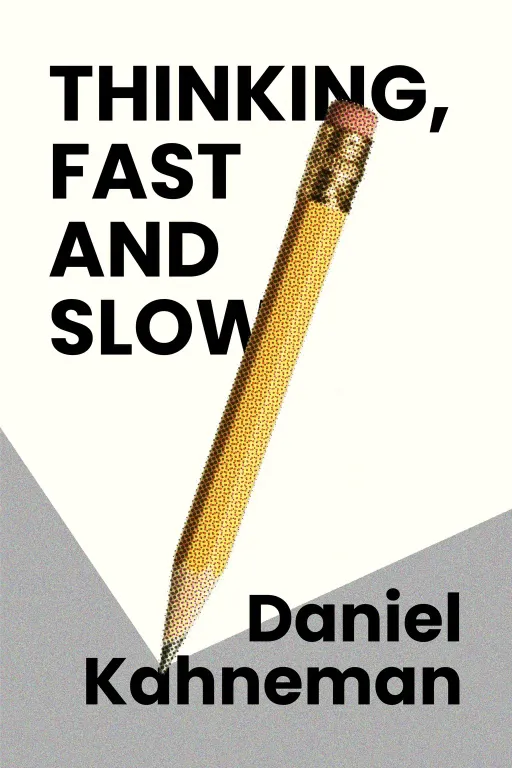
Nova: Precisely. We're diving into two groundbreaking books that fundamentally reshaped our understanding of how we make decisions: Daniel Kahneman's seminal "Thinking, Fast and Slow" and Richard H. Thaler's incredibly influential "Nudge." What’s fascinating about this work is that Kahneman, a psychologist, actually won the Nobel Memorial Prize in Economic Sciences for his pioneering work on prospect theory – essentially showing the world that psychology and economics are inextricably linked.
Atlas: Wow, a psychologist winning an economics Nobel. That's like a chef winning an Olympic medal for synchronized swimming. It really underscores how intertwined these fields are, doesn't it? It’s not just about numbers; it’s about the messy, fascinating human brain behind those numbers.
Nova: It absolutely does. And it sets the stage perfectly for our first dive: understanding this "blind spot" and the two systems that drive our decisions.
Unmasking the 'Rational' Economic Actor & Cognitive Bias
SECTION
Nova: So, Kahneman introduces us to two characters living inside our heads: System 1 and System 2. Think of System 1 as the fast, intuitive, emotional, almost automatic thinker. It’s what tells you to hit the brakes when a car swerves or recognizes a familiar face instantly. It’s brilliant, efficient, and often right.
Atlas: The gut reaction, the snap judgment. That's System 1. I know that guy. He’s usually the one telling me to eat the second slice of pizza.
Nova: Exactly! And then there's System 2. This is your slow, deliberate, analytical, effortful thinking. It's what you use to solve a complex math problem, fill out your taxes, or consciously decide whether to eat that second slice of pizza. System 2 is rational, but it's also lazy.
Atlas: Lazy? So my brain has a built-in procrastinator?
Nova: Pretty much! System 2 requires energy, so System 1 often takes the lead. And here’s the kicker: System 1, for all its brilliance, is prone to predictable errors, what Kahneman calls "cognitive biases." These biases lead us to make decisions that are, from a purely economic standpoint, irrational.
Atlas: Okay, so give me an example. How does System 1 trick us, especially when money is involved? For our listeners who are trying to make sense of market fluctuations or even their own spending habits, this is crucial.
Nova: Alright, let's talk about the "anchoring effect." Imagine you're buying a used car. The salesperson first quotes a ridiculously high price – say, $20,000. You negotiate them down to $15,000. You feel like you got a great deal, right?
Atlas: Absolutely! I saved five grand! High five!
Nova: But what if the car was only ever worth $12,000? That initial high anchor of $20,000 subtly influenced your perception of value, making $15,000 seem reasonable. Your System 1 latched onto that initial number, and System 2 didn't work hard enough to truly re-evaluate from scratch.
Atlas: Oh, I see! So even if my System 2 is trying to be logical, System 1 has already set the playing field. It's like the referee has already taken a bribe before the game even starts. That's insidious.
Nova: It is. Another powerful one is the "framing effect." How a choice is presented drastically changes our perception. Think about a medical treatment. If a doctor says, "There's a 90% chance of survival," most people will choose it. But if they say, "There's a 10% chance of mortality," even though it's the exact same outcome, people are far less likely to opt for it.
Atlas: That’s wild. The same information, just phrased differently, completely flips the decision. It makes me wonder about every single advertisement, every news headline I read. It's like our brains are constantly being subtly steered without us even realizing it.
Nova: Exactly. And these biases aren't just for individuals. They play out in financial markets. Think about the "availability heuristic." If a stock analyst has recently seen a few tech companies skyrocket, they might overestimate the probability of future tech successes, simply because those examples are readily "available" in their memory. This can contribute to market bubbles.
Atlas: That’s a really insightful point. So, the "blind spot" isn't just about not understanding complex economics; it's about not understanding how our own minds work and how that impacts our economic choices. It makes the world seem less chaotic and more, well, human.
Nova: Precisely. And once you understand these biases, you can start to see them everywhere. It's like putting on a new pair of glasses.
The Gentle Hand: How 'Nudges' Reshape Choices and Outcomes
SECTION
Nova: But if our brains are so prone to these biases, always falling for the trick of the framing effect or the anchor, is there anything we can actually about it? Are we just doomed to be irrational economic actors?
Atlas: That's the million-dollar question, isn't it? For our listeners who are constantly battling their own System 1, what hope is there?
Nova: Well, this is where Richard Thaler and Cass Sunstein come in with their brilliant concept of "nudges." A nudge, at its core, is a subtle intervention that guides human choices towards better outcomes without restricting freedom of choice. It's about designing the "choice architecture" in a way that makes the beneficial option the easiest or most obvious one.
Atlas: Wait, so it's not about forcing me to do something, but making it easier for me to choose the good thing? That sounds almost too good to be true. Isn't that a bit manipulative? Where's the line between guiding and controlling?
Nova: That's a crucial distinction, Atlas. A true nudge always preserves freedom of choice. If you can still easily opt out or choose the less desirable option, it's a nudge. If you can't, it's coercion. The classic example is automatic enrollment in retirement plans.
Atlas: Ah, I've heard of that. Instead of having to actively sign up for a 401k, you're automatically enrolled, but you can opt out if you want.
Nova: Exactly. Most people intend to save for retirement, but System 1's inertia, or the sheer effort of System 2 having to fill out forms, often gets in the way. By making automatic enrollment the default, companies leverage that inertia for good. People are much more likely to stay enrolled than to actively opt out, significantly boosting retirement savings rates.
Atlas: That’s actually really inspiring. It's like using our own psychological quirks to our advantage, rather than letting them trip us up. So, it's not about being smarter; it's about designing a smarter environment.
Nova: Precisely. Another powerful example is the "opt-out" versus "opt-in" choice for organ donation. In countries where you have to actively "opt in" to be an organ donor, rates are significantly lower than in countries where you're automatically a donor unless you "opt out." The default setting has a profound impact.
Atlas: That’s a powerful illustration of how these subtle changes can have massive societal implications. I’m starting to think about every form I fill out, every online setting. It's like someone is always nudging us in one direction or another.
Nova: They are! And recognizing it is the first step. For our listeners, especially those who navigate complex decisions daily, understanding nudges means you can identify where you're being nudged and, more importantly, how you can "self-nudge."
Atlas: Self-nudging! I like that. So, instead of relying on willpower, which System 2 often struggles with, I can design my own choices? Like, putting my healthy snacks front and center in the fridge and hiding the cookies?
Nova: Bingo! Or setting up automatic transfers to your savings account, or pre-committing to a workout schedule with a friend. These are all personal nudges that leverage your understanding of your own biases to achieve better outcomes.
Atlas: That completely shifts the conversation from blaming ourselves for being "irrational" to empowering us to design better systems for ourselves. It's about working human nature, not against it. It makes me wonder where else I can identify a nudge or a cognitive bias at play in a recent economic policy decision or market trend. I'm thinking about the recent surge in subscription services—is that a nudge? Or the way certain investment opportunities are framed on social media.
Nova: Absolutely! The power of behavioral economics is precisely in that shift. It's about being aware of the invisible forces at play and then consciously shaping them.
Synthesis & Takeaways
SECTION
Nova: So, what we've really explored today is the profound truth that economic decisions aren't made by abstract, perfectly rational beings. They're made by us, complex humans, driven by a fascinating interplay of fast, intuitive thinking and slower, deliberate reason.
Atlas: And that our System 1, while incredibly efficient, has these predictable blind spots, these cognitive biases, that can lead us astray in everything from our daily spending to major market trends. It's like our brains are running on perfectly optimized, but sometimes buggy, software.
Nova: Exactly. But the truly empowering part, the deep insight here, is that once we understand these bugs, we can start to design better systems. We can create "nudges" – gentle, freedom-preserving interventions – that steer us, and society, towards healthier, wealthier, and wiser choices. It means we're not just passive recipients of economic forces; we can actively shape them.
Atlas: It's about moving beyond the headlines and understanding the human logic beneath, or sometimes, the beneath. It gives us a framework to truly make sense of the world, not just consume facts, but understand implications.
Nova: And it gives us the tools to not only analyze our own decisions but also to critically evaluate the economic policies and market trends around us. What "nudges" are at play in daily life, or in a recent policy decision you’ve observed?
Atlas: That’s a fantastic question to leave our listeners with. It turns the theoretical into the immediately personal.
Nova: Indeed. This is Aibrary. Congratulations on your growth!