Beyond Rhetoric: Crafting Policy That Truly Connects
Golden Hook & Introduction
SECTION
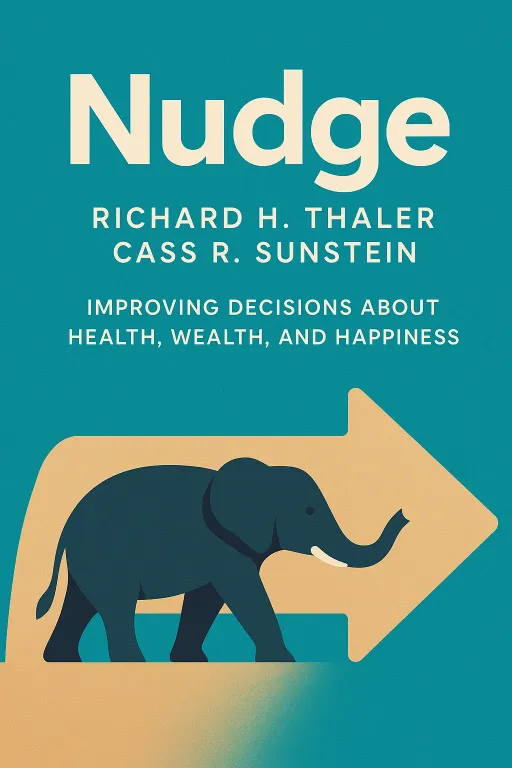
Nova: What if the reason some of the most well-intentioned policies fail isn't because people are stubborn or uncooperative, but because the policies themselves fundamentally misunderstand how human brains actually work?
Atlas: Whoa. That's a bold claim, Nova. Are you really saying it's not us, it's the policy? Because I've seen a lot of great initiatives just… fizzle out, and it always felt like a communication breakdown or a lack of public will.
Nova: Well, Atlas, today we're dissecting two monumental works that completely reshaped our understanding of human decision-making: "Nudge" by the Nobel laureate Richard H. Thaler and Cass R. Sunstein, and Daniel Kahneman’s "Thinking, Fast and Slow," another Nobel Prize-winning masterpiece. Thaler, a behavioral economist, and Kahneman, a psychologist, weren't just academics; they essentially founded the entire field of behavioral economics, bringing psychology into economics and policy in a way that had never been done before.
Atlas: That's a huge claim! So, we're talking about designing policies that actually for messy human beings, not just an ideal, perfectly rational 'Homo Economicus'? Because I imagine a lot of our listeners, especially those working in advocacy or healthcare ethics, are constantly grappling with that gap between ideal policy and messy human reality.
Nova: Exactly. These books argue that understanding human irrationality isn't a flaw to be overcome; it's a powerful lever for effective policy. It's about acknowledging our cognitive quirks and designing systems that work them.
The Power of Choice Architecture: How Nudges Shape Decisions
SECTION
Nova: And the first big idea, coming from Thaler and Sunstein's "Nudge," is this concept of "choice architecture" and "libertarian paternalism." It sounds complex, but it's incredibly simple and profound.
Atlas: Libertarian paternalism. That sounds like an oxymoron, Nova! As an advocate for self-determination, I'm already raising an eyebrow. How can you be both libertarian, meaning freedom-loving, and paternalistic, meaning guiding behavior?
Nova: That's the brilliance of it! It's about organizing the context in which people make decisions – the "choice architecture" – in a way that "nudges" them towards better outcomes, without actually restricting their freedom of choice. You can still choose the "wrong" option; it's just made slightly less convenient or prominent.
Atlas: So, you're not forcing me to eat my vegetables, you're just putting them right at the front of the buffet line?
Nova: Precisely! Think about organ donation. Countries with an "opt-in" system, where you have to actively tick a box to become a donor, often have very low participation rates. But in countries with an "opt-out" system, where you are a donor by default unless you specifically say no, donation rates skyrocket. People still have the freedom to opt-out, but the default choice, the "nudge," guides them towards a socially beneficial outcome.
Atlas: Wow. That's a powerful example. It shows how much our inertia plays a role. It's not about people being inherently against organ donation, but just the friction of having to actively choose it. That's actually really inspiring for anyone trying to drive systemic change. It means small design tweaks can have massive impact.
Nova: And it's everywhere once you start looking. Another classic example is the school cafeteria. Thaler and Sunstein describe how simply rearranging the food – putting the healthy options at eye level and first in line, and less healthy options further back – dramatically increased the consumption of fruits and vegetables, without banning a single cookie. The kids still had the choice, but they were nudged towards healthier eating.
Atlas: Okay, but this makes me wonder about the ethics. Where is the line between guiding people towards a better decision and simply manipulating them, even if it's for their "own good"? As someone who values profound understanding and thoughtful approaches, I’m thinking about the implications for transparency. Should people they're being nudged?
Nova: That's a crucial question, Atlas, and it's central to the "libertarian" part of the concept. The authors argue that nudges should be transparent and easy to avoid. If people feel coerced or manipulated, the nudge loses its effectiveness and its ethical standing. It's about making the 'right' choice easier, not forcing it. The goal is to align choices with people's long-term interests, which they might otherwise overlook due to short-term biases.
Atlas: So, for advocates, this means if I'm trying to improve, say, public health during a flu season, instead of just telling people to get vaccinated, I might focus on making it incredibly easy. Like, having pop-up clinics at grocery stores or making the online sign-up process just one click. It's about reducing friction.
Nova: Exactly! It's about understanding that human beings often take the path of least resistance, and using that insight constructively. This brings us neatly to the behind these nudges, which Daniel Kahneman so brilliantly illuminates in "Thinking, Fast and Slow."
Unmasking the Mind: Understanding Cognitive Biases for Better Policy
SECTION
Nova: The reason these nudges work, Atlas, takes us straight into Daniel Kahneman's brilliant work in "Thinking, Fast and Slow," which unpacks we're so susceptible to these subtle environmental cues. Kahneman, a psychologist, won his Nobel for demonstrating how psychological insights could be integrated into economic science. His book introduces us to two fundamental systems of thought.
Atlas: Oh, I've heard about this! System 1 and System 2. Can you break that down for us? Because I imagine a lot of our listeners have heard the terms, but maybe haven't fully grasped the implications for policy.
Nova: Absolutely. Think of System 1 as your fast, intuitive, emotional, almost automatic thinking. It's what tells you to jump when startled, or what quickly calculates 2+2. System 2 is your slow, deliberate, logical, effortful thinking. It's what you use to solve a complex math problem or analyze a nuanced policy brief. System 1 is constantly running in the background, making snap judgments, and often, it's pretty good. But it's also prone to systematic errors, or cognitive biases.
Atlas: So, System 1 is our gut reaction, and System 2 is our careful, considered thought. And you're saying System 1, which is always on, is where the biases live? That's fascinating, because as someone who seeks profound understanding, I always assumed people just 'think wrong,' not that there are built-in shortcuts that lead us astray.
Nova: Precisely. And these biases are pervasive. For instance, there's the, where we overestimate the likelihood of events that are easily recalled. After a highly publicized plane crash, people might overestimate the risk of flying, even though statistically, driving is far more dangerous. If a policy is designed assuming purely rational risk assessment, it's going to fail.
Atlas: So, if I'm designing a public safety campaign, I shouldn't just present raw statistics. I need to make the behaviors, or the, feel more immediate and available in their minds. That's a powerful insight for communication.
Nova: Exactly. Another huge one is. Kahneman found that people prefer avoiding losses over acquiring equivalent gains. Losing $100 feels worse than gaining $100 feels good. This has massive implications for policy framing. If you frame a new environmental regulation as "preventing future climate disaster," it's often more effective than "gaining a cleaner environment," even if both are true.
Atlas: That's incredible. So, for an advocate trying to convince stakeholders about a new initiative, it's not just about the facts; it's about how those facts are presented, tapping into these fundamental psychological tendencies. Instead of "Here's how much we'll save," it might be "Here's how much we'll if we act."
Nova: You've got it. And then there's, where our decisions are unduly influenced by the first piece of information we encounter. If a charity asks for a donation and suggests $100 as the first option, people tend to give more than if the first option suggested was $10. These biases are why nudges work. Setting a default option for retirement savings, for example, is a nudge that leverages inertia and present bias – a System 1 tendency to prioritize immediate gratification over future benefits. By making automatic enrollment the default, you overcome that bias.
Atlas: That makes me wonder, Nova, how do we, as policymakers or advocates, avoid falling prey to our biases when we're trying to design these policies? Are the experts, the philosophers, the communicators, immune to System 1 thinking? Because if we're trying to design policies that account for human irrationality, we need to make sure we're not being irrational ourselves.
Nova: That's the million-dollar question, Atlas. Kahneman himself would tell you no, no one is immune. The first step is awareness – understanding that System 1 is always at play. Then, it's about deliberately engaging System 2 to check those initial impulses. For policymakers, it means building in processes for critical review, seeking diverse perspectives, and using data to challenge assumptions, rather than just relying on intuition, however experienced.
Synthesis & Takeaways
SECTION
Nova: So, bringing it all together, the profound insight here is that human irrationality isn't a bug; it's a feature that, once understood, becomes the very foundation for crafting policies that resonate and succeed. It's about moving from prescriptive 'shoulds' to descriptive 'hows' – understanding how people actually behave, not just how we wish they would.
Atlas: That's a much more pragmatic and effective approach than simply lecturing people on what's good for them. So, if I'm an advocate looking at a current policy, say around public health or civic engagement, instead of just pushing for the 'right' thing, I should be asking: 'What are the human behaviors involved here? What subtle nudges or framing can I use to make the desired outcome the easiest, most intuitive choice?'
Nova: Exactly! It's about designing a more human-centric world, one tiny step at a time. Identify one policy initiative you care about, and brainstorm three 'nudges' that could improve its adoption or effectiveness. It's about working the grain of human nature, making the better choice the easier choice.
Atlas: That's a practical, impactful challenge for our listeners. It takes these groundbreaking ideas out of the academic ivory tower and puts them right into the hands of those who want to make a difference.
Nova: Indeed. This is Aibrary. Congratulations on your growth!