Beyond Logic: Understanding Human Choices with Behavioral Economics
Golden Hook & Introduction
SECTION
Nova: Atlas, quick! Word association. "Rational choice"!
Atlas: Oh man, "Rational choice"? Spreadsheets! Budgeting! And... oh, wait, actually, that time I bought a gadget just because it was "free shipping" even though I didn't really need it.
Nova: Exactly! Because here's the thing: we often think we're these perfectly logical decision-making machines, operating on pure reason. But the truth is, we're delightfully, predictably irrational.
Atlas: That's a bold statement right out of the gate! "Delightfully, predictably irrational." I like that.
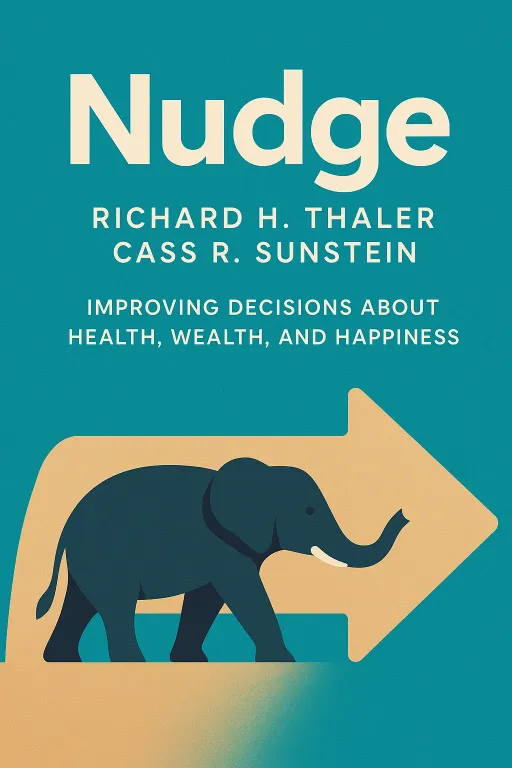
Nova: It’s the core insight of behavioral economics, and today, we're diving into this fascinating world, specifically through two seminal works. First, "Nudge" by Richard H. Thaler and Cass R. Sunstein. It's worth noting here that Thaler actually won the Nobel Memorial Prize in Economic Sciences for his groundbreaking contributions to this field. That’s how significant his work is.
Atlas: Absolutely. And we're also pulling from Dan Ariely's incredible "Predictably Irrational." Ariely's own journey, recovering from severe burns, actually sparked his deep dive into understanding human pain and decision-making, which gives his work such a profound, personal dimension. It's not just theory for him.
Nova: That personal connection truly shines through. And both books fundamentally challenge our assumptions about how we make decisions, and more importantly, how those decisions can be subtly guided.
Atlas: So, we're talking about the hidden forces behind our choices? The stuff we don't even realize is working on us?
The Power of the Nudge: Guiding Choices Without Restricting Freedom
SECTION
Nova: Precisely. Let's start with the concept of the "nudge" from Thaler and Sunstein. A nudge is any aspect of the choice architecture that alters people's behavior in a predictable way without forbidding any options or significantly changing their economic incentives. It's about designing environments.
Atlas: Okay, but how is that different from, say, just really good marketing? Or even, you know, manipulation? As someone who’s always trying to cut through the noise and make informed decisions, I’m instantly wary of anything that feels like it’s trying to steer me covertly.
Nova: That’s a crucial distinction. The key is "without forbidding any options." It's not about forcing you; it's about making a desired choice easier or more attractive. Think of it as "libertarian paternalism"—guiding choices for people's own good, but preserving their freedom to choose otherwise.
Atlas: Libertarian paternalism. That sounds like a contradiction in terms.
Nova: It does, doesn't it? But it's powerful. The classic example comes from Amsterdam's Schiphol Airport. They had a problem with men's urinal "spillage." Instead of putting up signs telling people to be neater or levying fines, they simply etched a small image of a fly into the urinals, right near the drain.
Atlas: A fly? What did that do?
Nova: It dramatically reduced spillage. Men, almost instinctively, would aim for the fly. It was a subtle visual cue, a "nudge," that guided their behavior without them even consciously thinking about it, and certainly without restricting their options. No one was forced to aim at the fly.
Atlas: Wow. So it wasn't about telling people what to do, but creating an environment that made the desired behavior the easiest or most natural option. I'm thinking about so many applications for that, from product design to even how we structure team projects.
Nova: Exactly. Another powerful nudge is the default option. In some countries, organ donation is opt-in, meaning you have to actively sign up. Rates are low. In others, it's opt-out, meaning you're a donor by default unless you specifically say no. Organ donation rates in opt-out countries are dramatically higher.
Atlas: That’s fascinating. It shows how much inertia plays a role in our decisions. So, for a critical explorer, someone who really wants to understand the "why" behind their actions, recognizing these nudges is quite impactful. It's about taking control of the subtle influences around you.
Nova: It empowers you to either design better environments for yourself and others, or to be more aware of how environments are influencing you. It moves beyond simply blaming ourselves for "bad choices" and looks at the system.
Predictably Irrational: Unpacking Our Systematic Biases
SECTION
Atlas: So, nudges work because we're already set up to be influenced, right? Which brings us to Ariely's work in "Predictably Irrational." What insights does he bring to this idea of our inherent, systematic biases?
Nova: Ariely takes it a step further, demonstrating that our irrationality isn't random chaos. It's systematic, consistent, and therefore, predictable. He shows us the specific cognitive shortcuts and emotional responses that lead us astray, again and again.
Atlas: That’s a bit unsettling. So, I'm not just occasionally making a bad decision; I'm actually wired to make certain kinds of "bad" decisions consistently?
Nova: In many cases, yes. He explores how relativity, the power of context, and even emotions like excitement or fear, shape our decisions in surprising ways. Consider the "decoy effect."
Atlas: The decoy effect? Sounds like something out of a spy movie.
Nova: It’s everywhere once you see it. Ariely famously used an old Economist subscription offer as an example. It had three options: a web-only subscription for $59, a print-only subscription for $125, and a print-and-web subscription for $125.
Atlas: Wait, the print-only and the print-and-web were the same price? That makes no sense.
Nova: Precisely! In that scenario, most people chose the print-and-web option. Why? Because the print-only option, priced identically, acted as a "decoy." It made the print-and-web option look like an incredible deal, a clear no-brainer, even though without the decoy, people might have just gone for the cheaper web-only option.
Atlas: That’s incredible. So that print-only option wasn't really meant to be sold; it was there just to make the other one look better. I can totally see that in so many places now, from car dealerships to coffee shop menus.
Nova: Absolutely. It's about understanding how our brains assess value. We often don't have an absolute internal scale; we compare things. And clever designers can exploit that comparative nature. Another great example is the "zero-cost appeal."
Atlas: Ah, free stuff! I'm a sucker for that.
Nova: Most of us are! Ariely shows that the perceived value of "free" isn't just a linear discount; it creates an emotional high that makes us disregard the actual value of the item or the effort required to get it. We'll stand in line for hours for a free ice cream cone that we wouldn't pay a dollar for if we had to.
Atlas: That’s so true! It’s like the "free shipping" example I gave at the start. I’m thinking about how this plays into the "practical mastery" aspect of our listeners. For those who want to apply this, how do you even begin to untangle these biases in your own life or in your work? How do you avoid being predictably irrational?
Nova: It starts with awareness. Recognizing that these biases exist, and that they're systematic, means you can build systems to counteract them. For instance, before making a big purchase, explicitly ask yourself: "Is there a decoy making this look better than it is?" Or, if something is "free," ask: "What am I giving up, or what am I being nudged towards, by accepting this 'free' offer?" It's about slowing down and introducing friction into our automatic decision-making.
Synthesis & Takeaways
SECTION
Nova: So, what "Nudge" and "Predictably Irrational" ultimately reveal is that our choices are not solely products of our logical minds. They are profoundly shaped by the environments we're in, the way options are presented, and the inherent cognitive shortcuts our brains employ. It's a powerful combination of external nudges and internal, predictable biases.
Atlas: It’s almost liberating to realize that our "irrationality" isn't a personal failing, but a fundamental aspect of human psychology that can be understood. It gives us a roadmap to better decision-making, both for ourselves and when we're trying to influence others.
Nova: Exactly. It's about moving beyond simply hoping people will make the "right" choice and instead, designing systems and understanding human nature to make the "right" choice the easiest, most attractive one. It's a profound shift in perspective.
Atlas: For all our critical explorers and practical seekers out there, here’s a tiny step you can take: Over the next few days, observe a recent decision you or someone else made that seemed illogical. Can you identify a 'nudge' or a 'predictable irrationality' at play? Just noticing it is the first powerful step towards making more conscious choices.
Nova: That self-awareness is truly where the impact begins. Understanding these forces means you're no longer just a passive participant in your own decision-making, but an active architect.
Atlas: Incredible insights today. Thank you, Nova.
Nova: Always a pleasure, Atlas.
Nova: This is Aibrary. Congratulations on your growth!