The Engineer's Gambit: FBI Negotiation Secrets for Entrepreneurs
Golden Hook & Introduction
SECTION
Nova: Imagine you're in the final stages of a critical supplier contract. They're pushing back on price, hard. Your gut reaction is to push back harder, to argue your case with data and logic. But what if the most powerful move you could make was to go completely quiet, look them in the eye, and simply repeat the last three words they said?
peris: It sounds completely counterintuitive.
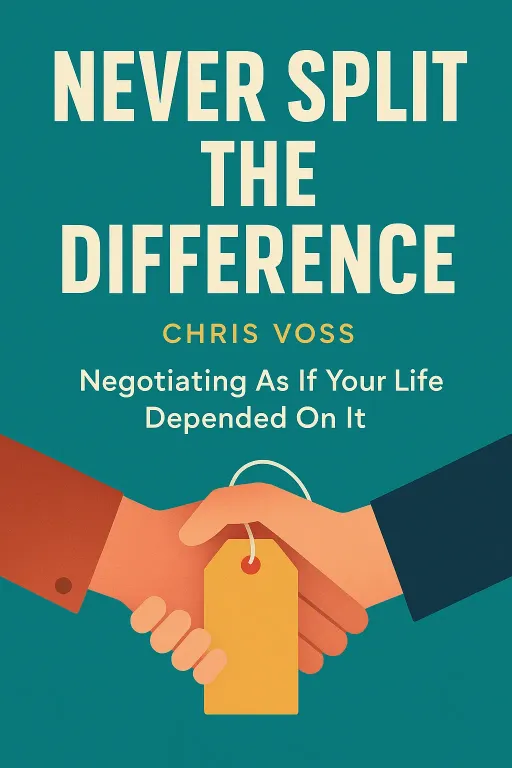
Nova: It sounds crazy, right? But this is a core tactic from a former lead FBI hostage negotiator. It’s a world where the wrong words can cost a life, and the right ones can change everything. Welcome everyone. Today we're diving into Chris Voss's phenomenal book, "Never Split the Difference." And I'm so thrilled to have peris here, an entrepreneur in the engineering and manufacturing space, to help us translate these high-stakes tactics into the business world. Welcome, peris!
peris: Thanks for having me, Nova. I'm excited. The idea of applying FBI psychology to a supply chain negotiation is fascinating.
Nova: It's a game-changer. And that's our goal today. We'll dive deep into this from two perspectives. First, we'll explore how to turn listening into your most powerful offensive weapon. Then, we'll discuss how to proactively disarm conflict by getting ahead of the negative emotions in the room.
Deep Dive into Core Topic 1: Negotiation as Information Warfare
SECTION
Nova: So, peris, let's start with that first idea: listening as a weapon. Most of us think negotiation is about being a great talker, but Voss argues it's really about information gathering. To show just how powerful this is, let's go to a Chase Manhattan Bank in Brooklyn, 1993.
peris: Okay, setting the scene.
Nova: It's a classic bank robbery gone wrong. Two masked robbers, hostages inside, SWAT teams outside. The initial negotiations are going nowhere. The lead robber is agitated, unpredictable. The NYPD negotiator is struggling. So, Chris Voss steps in. And the first thing he does is change his voice. He adopts what he calls the "Late-Night, FM DJ Voice"—calm, slow, and with a downward inflection. It's inherently reassuring.
peris: So he's immediately trying to lower the emotional temperature.
Nova: Exactly. He's calming the situation down. But then he deploys his main weapon. The robber, a guy named Chris Watts, is making all sorts of claims to sound like a big shot. At one point, he says, "I got a getaway driver and I got a co-conspirator." Now, the old-school approach would be to ask, "Who's your co-conspirator? What's their name?" But that's confrontational.
peris: Right, it puts them on the defensive.
Nova: Instead, Voss, in that calm DJ voice, just repeats the last two words. He says, "A co-conspirator?" And then he goes silent. This is a technique Voss calls "Mirroring." And what do you think the robber does?
peris: He... fills the silence?
Nova: He fills the silence! He starts talking, elaborating on his plan, giving Voss crucial intelligence without even realizing it. Voss didn't demand information; he created a space for the robber to volunteer it. By simply mirroring, he kept the guy talking, built a sliver of rapport, and maintained control, all while seeming passive.
peris: That's incredible, Nova. Because in an engineering context, if a supplier says, 'Your specs are impossible to meet,' our training is to immediately counter with data proving they possible. We treat it as a factual dispute.
Nova: You go into battle mode.
peris: Exactly. But mirroring with a calm, 'Impossible to meet?'... it's a non-confrontational prompt. You're not disagreeing. You're inviting them to explain the constraint. Is it a tooling issue? A material tolerance they can't hold? A problem with one of their own suppliers? You get to the root cause without starting a fight.
Nova: You've just turned a confrontation into a data-gathering mission.
peris: It's a tool for root cause analysis, really. You're not conceding anything. You're saying, 'Help me understand the problem behind your statement.' That's actionable intelligence for an entrepreneur. And the 'Late-Night FM DJ Voice'... I can see that being so effective when a client is panicking about a deadline. Instead of matching their frantic energy, you bring it down. It signals that you're in control and the situation is manageable.
Nova: That's the key. Voss says it gives them the illusion of control, which makes them feel safe, but you're the one actually steering the conversation. You're the pilot, even if they think they're flying the plane. It's a fundamental shift from arguing to discovering.
Deep Dive into Core Topic 2: Preemptive De-escalation
SECTION
Nova: And that idea of managing the emotional energy in the room leads us perfectly to our second point: disarming your counterpart before the fight even begins. This is less about listening and more about speaking first, but in a very, very specific way.
peris: Okay, so this is moving from defense to offense, in a sense.
Nova: A psychological offense, yes. The technique is called an "Accusation Audit." It's one of the most powerful tools in the book. The idea is to figure out all the worst things the other person could be thinking or saying about you, and then you say them first.
peris: You lead with your own negatives? That feels... dangerous.
Nova: It feels completely backward, but it's a masterstroke of what Voss calls Tactical Empathy. Let me give you a business example from the book. A student of his named Anna works for a major government contractor. They partnered with a smaller company, ABC Corp, on a project. ABC Corp didn't do their part, and now, to make matters worse, Anna's company has to tell them their pay is being cut.
peris: Oh, that is a nightmare conversation. She's walking into an ambush.
Nova: A total ambush. She knows ABC Corp is going to be furious. They're going to feel bullied, betrayed, and ripped off by the 'Big Bad Prime Contractor.' So, how does she start the meeting? She doesn't start with a defense of her position. She sits down and says something like, "We know you're going to think we are a big, bad prime contractor. You're probably going to feel that we've been unfair, that we haven't been a good partner, and that we're changing the terms on you yet again." She lists every single negative accusation she can think of.
peris: Wow. So she's basically verbalizing their internal monologue for them.
Nova: Precisely. And the effect is stunning. The lead negotiator on the other side, a woman named Angela, is completely disarmed. She's silent for a moment, and then she says, "Wow. This is not a good situation, but we appreciate you acknowledging that... and you are not the 'Big Bad Prime.'" By preemptively addressing all their fears and accusations, Anna took all the venom out of the room. She went on to save her company a million dollars on the contract and, unbelievably, actually the long-term relationship.
peris: That is a Jedi mind trick. As an entrepreneur, you're constantly delivering news that people don't want to hear—project delays, budget cuts, scope changes. The instinct is to brace for impact, to build your fortress of data and logic.
Nova: And wait for the attack.
peris: Yes. But this is like putting up a shield before the arrow is even fired. You're calling out the elephant in the room, which shows you're not afraid of the truth and, more importantly, that you see things from their perspective. It's a profound display of confidence and empathy.
Nova: That's Tactical Empathy in a nutshell! It's not about agreeing with them or saying, "You're right." It's about demonstrating that you their position and their feelings. Voss says labeling someone's fear or anger diffuses its power. Once it's out in the open, it's no longer a monster hiding in the closet.
peris: So, let's make this real. If I have to tell a key client that a shipment of custom-machined parts will be two weeks late, jeopardizing their production schedule...
Nova: A conversation no one wants to have.
peris: No. But instead of just stating the fact and then defending why, I could start the call with, 'Look, I have some news that's going to frustrate you, and you're probably going to feel like we've put your entire production line at risk and haven't managed this project well.'
Nova: Perfect. And what does the client do then? They can't yell at you for something you've already admitted and taken responsibility for. Their anger has nowhere to go.
peris: Right. They might even say, 'Well, it's not bad, but what are we going to do about it?' And just like that, you've shifted the dynamic. They're not fighting you anymore. They're working with you to solve the problem that you've both just acknowledged.
Nova: It's brilliant, isn't it? You've gone from being the source of the problem to being their partner in finding the solution.
Synthesis & Takeaways
SECTION
Nova: So, as we wrap up, we have these two powerful, counterintuitive tools that are really two sides of the same coin. First, using Mirroring to turn listening into a form of information gathering. It's about discovering what's really going on.
peris: And second, using the Accusation Audit to proactively manage the emotional landscape. It's about disarming negativity before it can take root and derail a logical conversation.
Nova: Both techniques are about moving away from a battle of wills and toward a process of collaborative discovery. So, peris, for everyone listening today, what's the one thing they can do to start putting this into practice?
peris: I think it really shifts the whole paradigm of what negotiation is. For anyone listening, especially fellow entrepreneurs, the challenge is this: find one low-stakes opportunity this week to try one of these. Don't do it in a million-dollar deal first. Try mirroring your partner when they talk about their day. Or start a slightly awkward conversation with a team member by labeling their potential hesitation, like 'It seems like you're a bit hesitant about this new design.'
Nova: A small, safe experiment.
peris: Exactly. The goal is just to see how it changes the emotional temperature of the conversation. Think of it as an experiment in emotional engineering. You're just collecting data on a new process.
Nova: Emotional engineering. I love that. A perfect takeaway for our listeners. It frames it in a way that's analytical and results-oriented, which I think will resonate with so many people. Peris, thank you so much for bringing your perspective to this.
peris: It was my pleasure, Nova. This was a lot of fun.