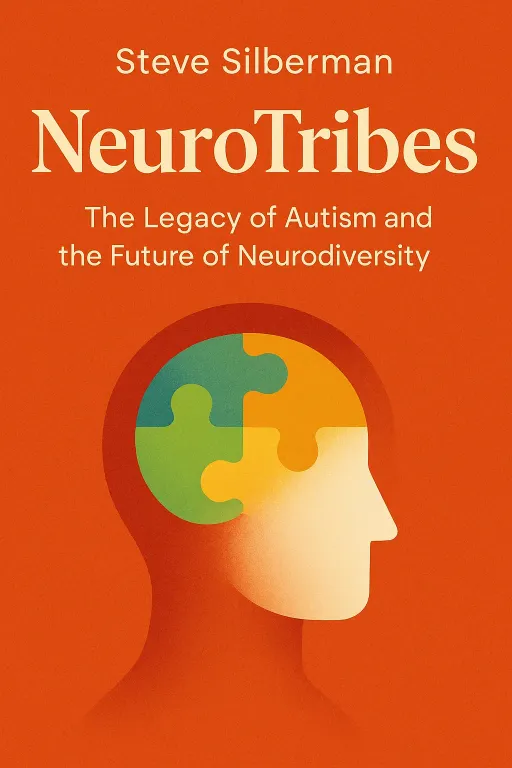
NeuroTribes: The Secret History of Tech's Innovators
Golden Hook & Introduction
SECTION
Orion: Imagine a cruise ship in the year 2000, filled not with tourists, but with the world's top computer programmers—the original 'geeks.' They're not just on vacation; they're upgrading the ship's network for fun and holding lectures on theoretical physics. This isn't just a quirky story; it's a glimpse into a special kind of tribe. What if these tribes of 'different thinkers' are not a modern phenomenon, but the secret engine behind centuries of innovation? That's the provocative idea at the heart of Steve Silberman's.
Aaron: It's a fascinating premise. It flips the whole stereotype of the socially awkward tech person on its head. Instead of seeing it as a deficit, it asks if it's actually part of a pattern of innovation.
Orion: Exactly. And that's why I'm so glad you're here, Aaron. With your background in tech and interest in creativity, you're the perfect person to explore this. Today we'll dive deep into this from two perspectives. First, we'll meet the ultimate 'lone genius,' an 18th-century scientist who might be the blueprint for neurodivergent innovation. Then, we'll jump forward to the 20th century to discover how the very first 'tech tribes'—the ancestors of today's Silicon Valley—were born.
Deep Dive into Core Topic 1: The Archetype of the Lone Genius
SECTION
Orion: So, Aaron, we love stories of innovators like Einstein or, as you're interested in, Neil Armstrong—people who saw the world differently. The book argues this pattern goes way, way back. Let's start with one of the most extreme and brilliant examples: a man named Henry Cavendish.
Aaron: I'm not familiar with him, but the name sounds... historical.
Orion: Oh, he's a legend. We're in late 18th-century London. Henry Cavendish is one of the wealthiest men in England, and also one of its most brilliant scientists. But he is so pathologically shy, so terrified of social interaction, that he's basically a ghost. The book paints this incredible picture of his life. He had a separate staircase built onto the back of his massive London mansion for the sole purpose of avoiding any accidental encounters with his female housekeeper.
Aaron: A whole staircase? That's not just shy, that's... architectural avoidance.
Orion: It's next-level. There's a story where he was taking one of his rigidly scheduled nightly walks and spotted two ladies who, curious to see the famous recluse, were waiting for him. His reaction? He didn't just turn around. He bolted, fleeing through a freshly plowed, muddy field to get away. He communicated with his staff almost exclusively through written notes left on a table.
Aaron: That's unbelievable. It sounds like any form of unplanned human contact was like a system error for him.
Orion: A complete system error. And yet, this is the crucial part. This same man, who couldn't handle a simple greeting, was a scientific powerhouse. He discovered hydrogen. He was one of the first to recognize that water is a compound, H2O, not an element. And his most famous achievement—he conducted an impossibly delicate experiment to measure the force of gravity between lead spheres. From that, he became the first person to accurately calculate the density, and therefore the weight, of the entire planet.
Aaron: Wait, he weighed the world? The guy who couldn't talk to his maid weighed the planet?
Orion: That's why they called him "The Wizard of Clapham Common." He was a walking paradox. And this is the core question the book raises. Was his social difficulty a tragic flaw, or was it somehow connected to his genius?
Aaron: It has to be connected. It sounds like his brain was so hyper-specialized for scientific inquiry, for pattern recognition and intense focus, that the 'social module' was just... turned way down. In tech, we sometimes joke about '10x engineers'—programmers who are ten times more productive than average—but who can have zero social skills. Is the book suggesting this isn't a bug, but a feature of their genius?
Orion: That's precisely the argument. The neurologist Oliver Sacks is quoted in the book saying of Cavendish, "His singularities were inextricable from his genius." You couldn't have one without the other. The same intense, single-minded focus that allowed him to spend months in a shed observing tiny movements to weigh the Earth also made him flee from a simple conversation.
Aaron: That really makes you think. It makes you wonder how many 'Cavendishes' we lose today because they can't navigate a typical 30-minute behavioral job interview or a corporate team-building exercise. We filter for social skills and 'culture fit,' but maybe we're accidentally filtering out a very specific, and very powerful, kind of brilliance.
Deep Dive into Core Topic 2: The Power of the Tribe
SECTION
Orion: That's a perfect transition, Aaron. Because if you're a Cavendish, if you're wired differently in a world that doesn't understand you, how do you survive? How do you find your people? The book argues you form a tribe. And this is where the origin story of modern tech culture really begins.
Aaron: So we're moving from the lone genius to the group.
Orion: Exactly. Fast forward to the early 20th century. The book highlights two new hobbies that exploded: amateur radio and science fiction. And it argues these weren't just pastimes; they were the first real networks for neurodivergent minds. They were meritocracies.
Aaron: How so?
Orion: Think about amateur radio. You had kids, mostly boys, in their basements and attics, building these complex crystal radio sets. They were connecting with people hundreds, even thousands of miles away. In that world, it didn't matter if you were awkward or shy or had a stutter. What mattered was your technical skill. Could you build the circuit? Could you understand Morse code? It was a community built entirely on technical competence, not social grace.
Aaron: It's a different set of rules. The social hierarchy is replaced by a technical one. I get that.
Orion: And then you have science fiction fandom, which is even more fascinating. These were people obsessed with stories of the future, of aliens, of different ways of being. They felt like aliens in their own world. The book tells this amazing story of a movement in the 1940s called "Fans are Slans!"
Aaron: "Fans are Slans?" What does that even mean?
Orion: It was based on a sci-fi novel called, about a race of super-intelligent, telepathic mutants who are hunted and persecuted by normal humans, or 'mundanes.' The fans, who were often bullied and felt like outcasts, adopted this identity. They started to believe, half-jokingly, half-seriously, that they were a superior, misunderstood species. They were Slans. It was this incredible act of turning their outsider status into a badge of honor.
Aaron: That's fascinating. It's the proto-internet. It's Reddit before Reddit, or 4chan. The 'Fans are Slans!' idea sounds a lot like the 'us vs. them' mentality you sometimes see in niche programming communities or crypto circles. It's a powerful way of building an identity by defining yourself against the mainstream.
Orion: Precisely. The author, Steve Silberman, draws a direct, unbroken line from those early radio 'hams' and sci-fi 'Slans' to the Homebrew Computer Club where Steve Wozniak and Steve Jobs showed off the first Apple computer, and right through to the open-source movement today.
Aaron: It makes total sense. Open source is the ultimate meritocracy. Your code is either good or it's not. Your identity, your social skills, your background—they're all secondary to the quality of your contribution. It's a global 'Slan shack,' a place where your technical obsession is your greatest asset. And it's where so much of today's most important technology, from Linux to the frameworks running almost every website, comes from. It's a system designed by and for neurodivergent-style thinking.
Synthesis & Takeaways
SECTION
Orion: So there we have it. These two powerful, connected ideas from. First, the archetype of the lone, hyper-focused innovator, the 'Cavendish,' whose genius is inseparable from his different way of being.
Aaron: And second, the 'tribe'—the community, whether it's a radio club or a sci-fi convention or an open-source project—that creates a safe and productive space for those innovators to connect, collaborate, and create.
Orion: The book's ultimate argument is that you need both for true progress. Innovation isn't just about brilliant ideas popping into someone's head. It's about creating the conditions for those ideas to flourish.
Aaron: Right. And I think the takeaway for me, and for anyone in tech or any creative field, is to be more conscious of this. When you're building a team or a company, you're not just hiring individuals; you're building a culture, a 'tribe.' The question you have to ask is, is your tribe built to include the next Cavendish? Or is it designed to filter them out?
Orion: That's a powerful question. What does that look like in practice?
Aaron: It means rethinking what 'valuable' looks like. It's about valuing the quiet colleague who has deep, niche knowledge but doesn't speak up in meetings. It's about creating different ways for people to contribute, maybe through writing instead of presenting. It's about understanding that the next big breakthrough might come from someone who doesn't fit the smooth, charismatic corporate mold. History, as this book shows, suggests that the people who think differently are the ones who end up changing the world.
Orion: A powerful thought to end on. We need to build a world, and especially a tech world, that has room for its wizards. Aaron, thank you so much for bringing your perspective to this.
Aaron: This was great. It's given me a whole new lens through which to see my own industry. Thanks, Orion.