The Mind's Blueprint: A Healer's Guide to Empathy and Resilience
Golden Hook & Introduction
SECTION
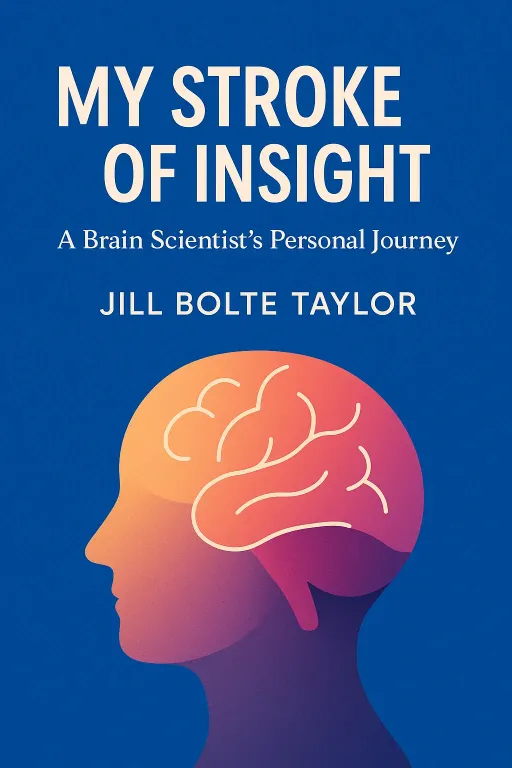
Nova: Imagine you're a Harvard-trained brain scientist. Your life's work is understanding the intricate wiring of the human mind. Then one morning, you wake up with a throbbing pain behind your eye, and over the next four hours, you get a front-row seat to your own brain's destruction. You watch, as a scientist, as you lose the ability to walk, talk, read, and even recognize your own mother. This isn't a horror movie; it's the true story of Dr. Jill Bolte Taylor, and it led to an incredible discovery about the human mind.
Echo : It's a scenario that's almost impossible to comprehend. It’s one thing to study the brain, but another thing entirely to experience its deconstruction from the inside.
Nova: Exactly. And that's why we're so excited to have you here, Echo. As a healthcare professional, you're on the front lines of these kinds of crises. Today, we're going to explore Dr. Taylor’s book,, from two powerful perspectives. First, we'll experience that harrowing minute-by-minute account of the stroke itself, from the unique viewpoint of a brain scientist. Then, we'll uncover the profound insight she gained about the two completely different 'personalities' living inside our heads, and how we can choose which one to listen to. Echo, as someone who works to understand and heal, the idea of truly getting inside a patient's internal world during a crisis… that must be the holy grail.
Echo : It absolutely is. We see the external signs, we run the tests, but the subjective experience—what the person is actually feeling and perceiving—is often a black box. A story like this feels like being handed a key.
Deep Dive into Core Topic 1: The Ultimate Insider's View
SECTION
Nova: Well, let's use that key. Let's go right to that morning. December 10th, 1996. Jill wakes up, and something is very, very wrong. It starts with a sharp, pulsing pain behind her left eye. She's a busy, active person, so she tries to push through it and gets on her cardio-glider exercise machine.
Echo : A classic 'power through it' mentality. I see that all the time.
Nova: Right? But then something truly bizarre happens. She describes feeling a sense of dissociation, as if her consciousness has detached and is observing from afar. She looks down at her own hands on the machine, and they don't look like her hands anymore. She describes her hand as a "primitive claw."
Echo : Wow. That's not just a physical symptom; that's a fundamental break in self-perception. She's losing the connection to her own body.
Nova: Precisely. It gets worse. She stumbles to the bathroom and gets in the shower, and the sensory input—the sound of the water, the feel of it on her skin—becomes a deafening, chaotic roar. Her thoughts are fragmenting. And in that moment, with all her training, she has a chilling realization. She thinks, "Oh my gosh, I'm having a stroke!"
Echo : And her scientist brain kicks in.
Nova: It does! It's this incredible, surreal mix of sheer terror and profound scientific curiosity. She later writes, "Wow, how many scientists have the opportunity to study their own brain function and mental deterioration from the inside out?" She knows she needs help, but her left hemisphere, the part of the brain responsible for linear thought and planning, is hemorrhaging.
Echo : So the very tool she needs to solve the problem is the one that's breaking.
Nova: Exactly. And this is where it becomes a masterclass in empathy for anyone in healthcare. She needs to call her office for help. She has a stack of business cards. A simple task, right? But for her, the numbers and letters on the cards are just meaningless "squiggles." Her brain can no longer decode the symbols. She spends an agonizing 45 minutes trying to match the visual pattern of the phone number on the card to the pattern on her phone's keypad.
Echo : Forty-five minutes to make a phone call. That's just staggering. In a clinical setting, we see the outcome—the patient is confused, they can't follow instructions. We might label it 'altered mental status.' But to hear her describe the experience of numbers becoming squiggles… it completely reframes what's happening. It's not just a malfunction; it's a complete breakdown of reality for that person.
Nova: It's a total reality collapse. And it really makes you think about how we interact with patients in distress.
Echo : It makes me question everything. When a patient is that disoriented, are our rapid-fire questions even making sense to them? Are we just adding to the sensory chaos she described in the shower? We're trying to gather data, but we might just be contributing to the noise. Her story forces us to slow down and consider the patient's reality, not just our own diagnostic checklist.
Nova: That is such a powerful point. We're not just treating a set of symptoms; we're interacting with a consciousness that is actively falling apart and trying to make sense of it all.
Deep Dive into Core Topic 2: The Two Characters in Your Head
SECTION
Nova: And that 'noise' she was experiencing, that chaos, was her left brain—the logical, language-based part—going offline. But as it went quiet, something else emerged. And this, Echo, is the core of her 'stroke of insight.'
Echo : The silver lining, if you can call it that.
Nova: A profound one. She gives us this incredible map of the two hemispheres, not just as functional areas, but as two distinct 'characters' or 'personalities' living in our heads.
Echo : I love that framing. It makes it so much more relatable.
Nova: It really does. So, on one side, you have the Left Brain. This is the 'story-teller.' It's the part that creates language, organizes the world into categories, analyzes details, and judges everything. It's the part that's constantly thinking about the past and worrying about the future. It's our ego, our inner narrator.
Echo : So her left brain is the inner critic, the one making the to-do lists and replaying that awkward thing I said yesterday.
Nova: Precisely! It's the voice that says, "You should have done this," or "What if that happens?" But then, there's the Right Brain. Dr. Taylor describes this as the 'present moment' mind. It thinks in pictures, not words. It's connected to our sensory experience—the feeling of our body, the sights and sounds around us right now. It's creative, intuitive, and doesn't see boundaries. It experiences a feeling of connection to everything and everyone. She calls it "La-La Land."
Echo : A place of 'being' rather than 'doing.'
Nova: You've got it. And during her stroke, as her anxious, chattering left brain went silent, she found herself floating in this right-brain consciousness. She describes the experience as feeling like a "genie liberated from its bottle." She lost the sense of where her body began and the room ended. She felt enormous and expansive, at one with the energy of the universe. And in this state, there was no fear, no stress—only a profound and euphoric peace.
Echo : Even as her physical body was in the middle of a catastrophic medical emergency. That contrast is mind-blowing.
Nova: Isn't it? She was experiencing a state of bliss while simultaneously being unable to perform the simplest logical task. It was the ultimate separation of these two minds.
Echo : You know, this is so incredibly relevant to the issue of burnout in healthcare. We are trained to live almost exclusively in our left brains. We're analyzing charts, planning treatments, documenting every detail, critically evaluating outcomes. It's a constant state of 'doing' and judging.
Nova: And that's exhausting.
Echo : It's utterly draining. It's what leads to compassion fatigue. But the idea that we have this built-in 'peace circuit' in our right brain that we can consciously access… that's not just a nice, fuzzy thought. For someone in my field, that's a powerful, practical tool for self-care. It’s a survival mechanism.
Nova: And she says it's always there, we just have to choose to step into it. We've been so conditioned by society to value the 'doing' of the left brain that we forget the 'being' of the right brain is even an option.
Echo : It's like we have a palace inside us, but we've been living in the broom closet because that's where all the tools are. Her story gives us permission to open the door to the rest of the house.
Synthesis & Takeaways
SECTION
Nova: I love that metaphor. A palace we've forgotten about. So, through this terrifying event, Jill gave us this incredible gift: a map to the two sides of ourselves. The anxious, achieving 'doer' in the left hemisphere, and the peaceful, present 'be-er' in the right.
Echo : And the most powerful part of that map, for me, is the idea of choice. It's not about getting rid of the left brain—we need it to function. It's about realizing we have the power to choose which one is in the driver's seat at any given moment.
Nova: Absolutely. And she gives us a very concrete, science-backed way to practice this. It's something she calls the '90-second rule.'
Echo : I was fascinated by this part.
Nova: It's brilliant. She explains that from a neuroanatomical perspective, when an event triggers an emotional response—like anger, or fear—the chemical cascade that's released in your body, that rush of feeling, runs its course and is flushed out of your bloodstream in about 90 seconds.
Echo : Only 90 seconds. That's it.
Nova: That's the automatic, physiological response. She argues that if you remain in that emotional state for longer than 90 seconds, it's because you have made a conscious choice to stay there. Your left brain has decided to re-run the thought loop that keeps re-triggering the emotion.
Echo : So after that first minute and a half, the suffering is optional. That is a radical idea. It puts the responsibility, and the power, right back in our hands.
Nova: It's total empowerment. So the takeaway is simple but profound. The next time you feel overwhelmed, or anxious, or stuck in a negative thought loop—that's your left brain running its program.
Echo : And you can choose to switch programs.
Nova: Exactly. You can make a conscious choice to 'step to the right.' And the way you do that is through your senses. Try to consciously shift your focus. Notice one sensory detail around you—the deep, rich color of the wall, the hum of the air conditioner, the feeling of your feet flat on the floor.
Echo : You're essentially using a real, present-moment sensation to interrupt the left brain's story about the past or future.
Nova: You are. That simple act is you, taking a deliberate step out of your chattering left brain and into the quiet, peaceful presence of your right. It's a small act of rebellion against the noise. And as Dr. Jill Bolte Taylor's incredible journey shows us, it can be the first step back to yourself.