The Human Hard Drive: Engineering Your Memory with Moonwalking with Einstein
Golden Hook & Introduction
SECTION
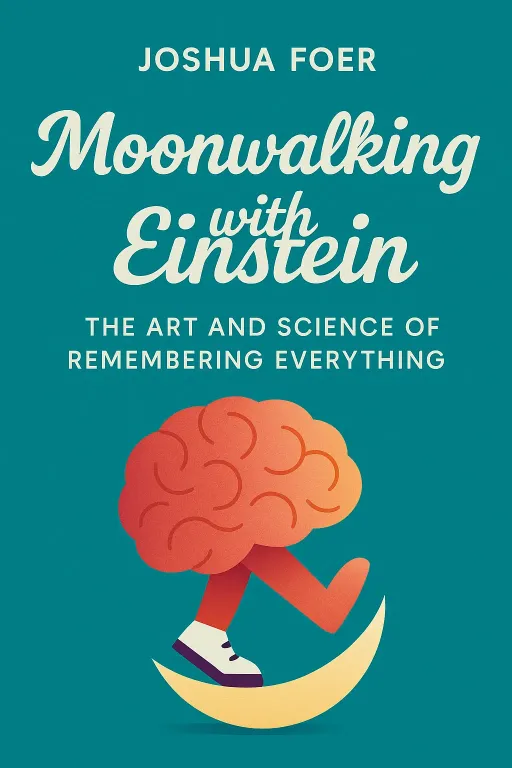
Nova: Imagine your brain is a factory floor. Every single day, raw data pours in, but the assembly line of your working memory can only process about seven pieces of information at a time. It is a massive cognitive bottleneck! But what if you could upgrade your mental hardware to store entire databases in the blink of an eye? Today, we are diving into Joshua Foer's fascinating book, Moonwalking with Einstein: The Art and Science of Remembering Everything, to explore how we can reverse-engineer our own minds. We are joined by engineer Madhabilata to tackle this from three distinct angles. First, we will look at chunking as a way to bypass our mental RAM limits. Second, we will map out the Memory Palace as a highly efficient spatial database. And finally, we will look at how to break through learning stagnation by dismantling the OK Plateau using deliberate practice. Welcome to the show, Madhabilata! It is so wonderful to have your analytical mind with us today.
Madhabilata: Thanks, Nova! I am absolutely thrilled to be here. You know, when I first read Moonwalking with Einstein, I could not help but look at it through the lens of system design. In engineering, we are constantly trying to optimize throughput and eliminate bottlenecks. When you realize that the human brain has these built-in, evolutionary constraints, the question becomes: how do we design better software—meaning our learning techniques—to run on this ancient hardware?
Nova: Oh, I love that analogy! Running modern software on ancient hardware. That is exactly what Joshua Foer discovers when he goes from being a journalist covering the U. S. Memory Championship to actually winning it a year later. He realizes that memory champions do not have structurally different brains; they just use their hardware differently. We are going to unpack exactly how they do that.
Deep Dive into Core Topic 1
SECTION
Nova: Let us start with that cognitive bottleneck we mentioned. Back in 1956, a Harvard psychologist named George Miller published a super famous paper called The Magical Number Seven, Plus or Minus Two. He basically proved that our short-term, or working memory, can only hold about seven chunks of information at once. Think of it like trying to balance seven tennis balls in the air. Add an eighth, and they all come crashing down. Madhabilata, as an engineer, how does that limitation strike you?
Madhabilata: It sounds exactly like a hardware constraint, like having a computer with only two gigabytes of RAM. If you try to load a massive CAD model or a complex simulation into that limited RAM, the system freezes. In manufacturing, if you have a machine that can only process seven parts at a time, and you dump a hundred parts on it, you get a massive pileup. You have to find a way to package those parts more efficiently before they hit the machine.
Nova: Yes! And that packaging is what cognitive scientists call chunking. To show just how powerful this is, Foer talks about a classic experiment from 1981 conducted by psychologists K. Anders Ericsson and Bill Chase. They took a regular college student, known by his initials SF, and had him practice a digit span test. At first, SF could only remember about seven random numbers read to him at one second intervals. But he kept practicing, hours a week, for two years. By the end, do you know how many numbers he could remember in a single hearing?
Madhabilata: Oh, I remember this. It was over eighty digits, right? That is mind-blowing. But the key is how he did it. He did not just magically expand his short-term memory. He was a competitive runner, so he started grouping the random numbers into running times.
Nova: Exactly! If he heard the numbers three, four, nine, and two, instead of trying to remember four separate digits, he would chunk them into one meaningful unit: three minutes and forty-nine point two seconds, which was near the world-record mile time. He turned abstract, meaningless noise into a highly structured, familiar pattern.
Madhabilata: That is a brilliant example of modular design. In engineering, we do not design a car by looking at ten thousand individual screws and wires all at once. We group them into modules: the engine block, the transmission, the braking system. Each module is a chunk. By organizing the system hierarchically, we can manage incredible complexity without overwhelming our design team. SF did the exact same thing with numbers. He mapped the incoming raw data onto an existing, highly structured database in his long-term memory—his knowledge of running times.
Nova: That is such a neat way to put it! And this explains another fascinating study Foer mentions about chess masters. In the 1940s, a Dutch psychologist named Adriaan de Groot showed chess masters and novices a chess board from a real game for just a few seconds and asked them to reconstruct it. The masters could do it with almost perfect accuracy, while the novices struggled. But here is the twist: when they showed them a board where the chess pieces were placed completely at random, the masters were no better than the novices!
Madhabilata: I love that study because it proves that the chess masters did not have photographic memories. When the pieces were placed randomly, they could not chunk them. But when the pieces were in a real game position, the masters did not see thirty-two individual pieces; they saw three or four chunks of strategic tension—like a pawn chain or a classic defensive setup. They were reading the board the way we read a sentence, seeing words instead of individual letters.
Nova: Right! If you see the letters E-N-G-I-N-E-E-R, you do not see eight separate letters; you see one word: engineer. You have chunked it. So, for our listeners, the takeaway here is that if you want to remember complex technical information, you have to find the underlying patterns and group them into meaningful modules. Do not just try to memorize the raw data.
Deep Dive into Core Topic 2
SECTION
Nova: Now, chunking is great for organizing data, but how do we actually store it so we can retrieve it reliably? This brings us to the most famous memory tool of all: the Memory Palace, or the Method of Loci. And the origin story of this technique is absolutely legendary. It goes back to the fifth century B. C. in ancient Greece, with a poet named Simonides of Ceos. Madhabilata, do you want to tell us what happened to poor Simonides?
Madhabilata: Oh, it is a bit of a thriller! Simonides was at a banquet hall in Thessaly, delivering an ode for a nobleman. Shortly after he stepped outside to meet two messengers, the roof of the banquet hall collapsed, crushing everyone inside. The bodies were so mangled that their own families could not identify them for a proper burial. But Simonides closed his eyes and reconstructed the scene in his mind. He realized he could remember exactly where each guest had been sitting around the table. By mapping their identities to their physical locations, he was able to identify every single body.
Nova: It is a tragic story, but it led to a massive scientific realization: our brains are incredibly good at spatial memory. We might struggle to remember a list of ten random words, but if you walk through a house you visited once, you can easily remember the layout, where the kitchen was, where the sofa stood. Evolutionarily, we did not need to memorize spreadsheets; we needed to remember the way back to our cave or where the dangerous predators lived.
Madhabilata: It is all about leveraging our evolutionary hardware. As an engineer, I think of the Memory Palace as a spatial database. In a computer, databases are indexed. If you do not have a good indexing system, searching for a file takes forever. The Method of Loci uses our highly developed spatial navigation system as the index. You take abstract, non-spatial data—like a shopping list or a technical specification—and you convert it into vivid, three-dimensional images, and then you place those images in specific locations along a familiar path, like your childhood home.
Nova: Yes! And the key to making those images stick is what psychologists call elaborative encoding. The more bizarre, funny, colorful, or even shocking the image is, the better. Foer describes how his memory coach, Ed Cooke, taught him to memorize a fifteen-item to-do list in Central Park. Ed did not just tell him to visualize a tub of cottage cheese. He told him to imagine a giant, swimming-pool-sized tub of cottage cheese in his childhood living room, with a famous actress taking a bath in it!
Madhabilata: Haha, yes! It sounds ridiculous, but from a cognitive engineering perspective, it makes perfect sense. Banal, ordinary things get filtered out by our brain's sensory processing units because they are not critical for survival. But a giant tub of cottage cheese with a celebrity? That triggers our attention mechanisms immediately. It is like putting a massive, bright red flag on a specific line of code.
Nova: Exactly! Our brains are wired to notice the novel and the marvelous. Foer writes that ancient and medieval people reserved their greatest awe for memory, and their geniuses were people of superior memories because they had internalized entire libraries using these spatial blueprints. Madhabilata, have you ever tried building a memory palace for your engineering work?
Madhabilata: Actually, yes! When I was studying for my degree, I had to memorize a complex manufacturing process flow with dozens of steps and quality control gates. I mapped the entire process onto my university campus. The raw material intake was at the main gates, the chemical treatment was in the chemistry lab fountain, and the final quality inspection was at the library exit. It made recalling the sequence during exams incredibly easy because I just had to take a mental walk across campus. It is like having a 3D CAD model of the information in your head.
Nova: That is brilliant! You literally engineered your study habits. It just goes to show that these ancient techniques are not just party tricks; they are highly practical tools for mastering complex, modern information.
Deep Dive into Core Topic 3
SECTION
Nova: So, we have talked about chunking and memory palaces, but what happens when we hit a wall in our learning? We have all experienced this. You start learning a new skill—whether it is typing, playing an instrument, or using a new software—and you improve quickly at first. But then, you hit a point where you just stop getting better. You plateau. Joshua Foer calls this the OK Plateau. Why does this happen, Madhabilata?
Madhabilata: This is a concept that really resonated with me because in manufacturing, we talk a lot about process capability and stagnation. The OK Plateau happens when a skill becomes automatic and unconscious. Psychologists identify three stages of skill acquisition. First is the cognitive stage, where you are actively thinking about what you are doing and making mistakes. Second is the associative stage, where you concentrate less and make fewer errors. And third is the autonomous stage, where you operate on autopilot. Once you hit that autonomous stage, you are 'OK' at the skill, but because you are no longer consciously processing it, you stop improving.
Nova: Right! You can type at fifty words a minute for twenty years and never get faster, because you are just cruising on autopilot. To break through that plateau, Foer says we have to engage in what K. Anders Ericsson calls deliberate practice. And to explain this, Foer shares a fascinating study about speed typing. How did researchers get experienced typists to break through their plateaus?
Madhabilata: It was a beautifully designed experiment. The researchers did not just tell the typists to practice more. Instead, they used a computer program to flash words on the screen ten to fifteen percent faster than the typists' comfortable speed. This forced them out of their autonomous autopilot mode and back into the cognitive stage. They were forced to make mistakes, but by operating in that failure zone, they were able to identify the specific bottlenecks slowing them down—like transitioning between certain letter combinations—and adapt.
Nova: Yes! They had to practice failure to achieve success. Deliberate practice, by its nature, must be hard. If you are comfortable, you are not improving. Foer also compares two medical professions to illustrate this: mammographers and surgeons. Studies show that over time, surgeons' skills generally improve, while mammographers' diagnostic accuracy can actually decrease. Why on earth would that be?
Madhabilata: It all comes down to the feedback loop. When a surgeon performs an operation, they get immediate feedback. They see the results of their decisions almost instantly, which allows them to learn from their mistakes and adjust their techniques. But a mammographer makes a diagnosis, and they might not find out if they were right or wrong until months or even years later, if at all. Without that immediate, closed-loop feedback, they cannot calibrate their mental models, and their skills drift.
Nova: That is such a powerful insight. In manufacturing, you have quality control loops, right? If you do not measure the output of a machine immediately, you might produce thousands of defective parts before you realize there is an issue.
Madhabilata: Exactly! We call it closed-loop feedback. If you want to optimize any system, you need a sensor that measures the output and feeds that data back to the controller in real-time. Deliberate practice is essentially setting up a closed-loop feedback system for your own brain. You have to actively seek out immediate feedback, analyze your errors, and design specific exercises to target those exact weaknesses. When Joshua Foer hit a plateau in his card memorization speed, he did not just keep memorizing cards the same way. He used a metronome to force himself to look at the cards faster than he was comfortable with, forcing errors so he could see which card combinations were causing the cognitive lag.
Nova: It is so fascinating how he applied scientific rigor to his own brain training. He realized that memory is not a fixed, monolithic trait. It is a collection of dynamic skills that can be continuously optimized if you are willing to step out of your comfort zone and design the right feedback loops.
Synthesis & Takeaways
SECTION
Nova: We have covered some truly mind-expanding territory today, Madhabilata. From the cognitive bottleneck of our working memory to the spatial architecture of the Memory Palace, and finally, the engineering of our own skill development through deliberate practice. If we look at the big picture, what is the ultimate synthesis of Joshua Foer's journey for you?
Madhabilata: For me, the most profound takeaway is that our cognitive capacity is not a fixed limit. We often tell ourselves, 'Oh, I just have a bad memory,' or 'I am not naturally good at this.' But Moonwalking with Einstein proves that with the right techniques and deliberate effort, we can train our minds to do extraordinary things. It is about transition from being a passive consumer of information to being an active architect of your own mind. In our digital age, where we outsource all our memories to smartphones and search engines, cultivating our internal memory is more important than ever. It is what allows us to make deep, creative connections across different domains.
Nova: That is beautifully said. Our memories truly make us who we are; they are the seat of our values and the source of our character. If we outsource them entirely, we risk losing that deep, internal synthesis that leads to true wisdom. So, Madhabilata, what is one actionable piece of advice you would give to our listeners today to help them start engineering their own memory?
Madhabilata: I would challenge everyone to design a mini-Memory Palace this week. Do not start with a massive textbook. Just take a simple list of five things you need to do or remember. Map them onto your own home. Make the images as bizarre, funny, and sensory-rich as possible. If you need to buy milk, imagine a giant cow sitting on your sofa, milking itself. If you need to call your dentist, imagine a giant toothbrush scrubbing your front door. Walk through it, feel the textures, smell the scents, and see how effortlessly your brain recalls that information. Once you prove to yourself that the system works, you will start seeing opportunities to apply it to every area of your life.
Nova: I love that challenge! I am definitely going to visualize a giant cow on my sofa tonight. Madhabilata, thank you so much for sharing your incredible engineering perspective with us today. You have helped us see that our minds are not just passive storage bins, but beautifully complex systems waiting to be optimized.
Madhabilata: Thank you, Nova! It was an absolute pleasure. Remember everyone, don't forget to remember!
Nova: And that is a wrap for today's episode of The Human Hard Drive. To all our listeners, keep pushing past your OK Plateaus, keep building those mental palaces, and we will see you next time!