Daily Discipline & Focus: Engineering Your Productive Day
Golden Hook & Introduction
SECTION
Nova: Most of us think productivity means doing more, juggling endless tasks, and constantly being 'on.' But what if the secret to making a profound impact, to truly maximizing your potential, isn't about working harder, but about working smarter—and at the absolute right time?
Atlas: That’s a bold claim, Nova. Because honestly, for a lot of our listeners, myself included, the default mode is exactly what you just described: a frantic dance of 'more, more, more.' So, are you telling me we’ve been playing the game all wrong?
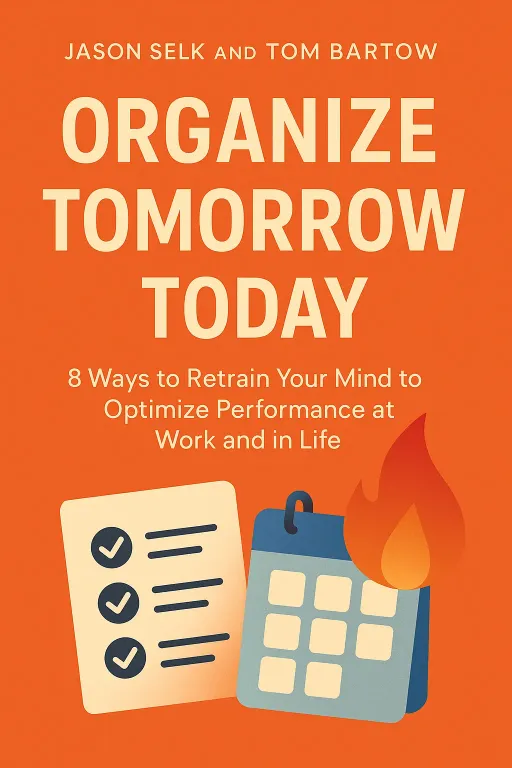
Nova: In many ways, yes! Today, we're dissecting how to engineer your day, not just survive it. We're drawing powerful insights from two incredible resources. First, "Organize Tomorrow Today" by Dr. Jason Selk and Tom Bartow. Dr. Selk, a mental toughness coach for elite athletes and business leaders, brings a truly performance-driven approach to daily planning.
Atlas: Oh, I like that. The idea of applying an athlete's discipline to a regular workday. That immediately resonates with anyone striving for peak performance and impact. So, how do we translate that Olympic-level focus to, say, managing a complex project or crafting a strategic vision?
Nova: Exactly. And we'll also be pulling from Jocelyn K. Glei's "Manage Your Day-to-Day," which compiles wisdom from creative professionals navigating our hyper-connected world. It’s all about building routines that shield your most valuable work from the relentless tide of distraction.
Atlas: That makes perfect sense. Because what good is a meticulously planned day if it's constantly derailed by notifications and urgent-but-not-important interruptions? It sounds like we're talking about a complete reimagining of our daily architecture.
Designing Your Intentional Day: The Power of Proactive Planning
SECTION
Nova: We are. And it starts with a concept Selk and Bartow call the 'Power Hour.' This isn't just about waking up early; it's about identifying your Single Most Important Task—your MIT—for the day, and dedicating the first 60 minutes of your workday to only that task. No emails, no meetings, no social media. Just deep, uninterrupted focus on what truly moves the needle.
Atlas: Hold on. For someone who lives in a world of immediate demands, where the inbox is a constant siren song, shutting everything down for an hour sounds... revolutionary. And maybe a little impossible. What’s the real magic behind this 'Power Hour'? Is it just willpower?
Nova: It's far more strategic than just willpower, Atlas. Think about your brain in the morning. It's often at its freshest, most rested, and least cluttered. This is when your prefrontal cortex—your executive function—is primed for complex problem-solving and creative thought. By tackling your MIT during this peak cognitive window, you're not just doing the task; you're doing it with your absolute best mental resources. It's about strategic energy allocation.
Atlas: So you're saying we're essentially front-loading our day with our highest-value output, leveraging our natural mental prime time. That shifts the entire dynamic from reactive firefighting to proactive creation. I can see how that would appeal to any strategist.
Nova: Precisely. And it’s not just about that first hour. They also introduce the 'Reactive Hour.' This is a dedicated block, usually at the end of your day, for all those smaller, urgent-but-not-important tasks: emails, administrative duties, quick calls. By batching these, you prevent them from fragmenting your focus throughout the day. It’s like having a designated clean-up crew, so your main work area stays pristine.
Atlas: That’s a great analogy. It’s like an architect designing a building: you wouldn't start pouring the foundation while simultaneously trying to hang the drapes. You sequence things strategically. But what about the psychological impact? Does knowing you have that 'Reactive Hour' free up mental space during the 'Power Hour'?
Nova: Absolutely. It dramatically reduces decision fatigue and the nagging feeling of "I should be doing something else." When you're in your Power Hour, you know those emails will be handled, just not right now. This allows for truly deep work, which is essential for impact-driven individuals who seek clarity and want to maximize their potential. You’re not just managing tasks; you’re managing your mental state.
Battling the Digital Deluge: Protecting Deep Work in a Distracted World
SECTION
Nova: But even the most perfectly planned day can crumble under the weight of constant digital interruptions. That's where Glei's insights become crucial: how do we protect that intentional plan from the relentless tide of pings, notifications, and the general hum of our hyper-connected world?
Atlas: Oh man, that's the battlefield for anyone trying to cultivate focus. For our listeners who are constantly in communication, in high-stakes environments, the idea of just 'turning off' feels almost irresponsible. How do you actually build routines that protect deep work without feeling completely disconnected?
Nova: It's about designing boundaries, not just hoping they appear. Glei, drawing from various creative professionals, emphasizes creating dedicated spaces and times for different types of work. For example, scheduling specific "email hours" rather than keeping your inbox open all day. Or even physically moving to a different location for deep work, away from your usual digital triggers.
Atlas: I see. So, it’s not about being a digital hermit, but about creating intentional 'zones' for different cognitive demands. Like a mental firewall. But isn't there always that fear of missing out, or missing something genuinely urgent? How do you manage that anxiety?
Nova: That’s where the proactive planning from Selk and Bartow synergizes beautifully with Glei's strategies. If your MIT is truly the most important thing, you communicate that. You set expectations. And you trust your system. Creative professionals often use a "maker's schedule" versus a "manager's schedule." A maker needs long, uninterrupted blocks to create, while a manager thrives on frequent, shorter interactions.
Atlas: I see. So it's about understanding your role and tailoring your schedule to that, rather than defaulting to a constant state of interruptibility. It’s a strategic choice, not a passive acceptance. It sounds like a shift from being a responder to being a designer of your own attention.
Nova: Exactly. It's about creating a "digital moat" around your deep work. This could mean turning off all non-essential notifications, putting your phone in another room, or even using apps that block distracting websites during your focus times. It sounds simple, but the discipline required to maintain these boundaries is immense, especially when the world is designed to pull your attention in every direction.
Atlas: That’s actually really inspiring. Because it puts the power back in our hands. We often feel like victims of our devices, but this framework suggests we can be the architects of our digital experience, too. It’s about structuring your ambition, as our user profile so aptly puts it.
Synthesis & Takeaways
SECTION
Nova: Ultimately, what these brilliant minds teach us is that peak performance isn't about innate talent or endless hours. It's about intentional design. It's the synergy between proactively planning your day, leveraging your natural energy cycles, and fiercely protecting that focused time from the relentless onslaught of modern distractions.
Atlas: So it’s not just about doing tasks; it's about consciously crafting the conditions for your best work to emerge. It’s about being a strategist with your time and energy, not just a doer. For anyone driven by making an impact, this is foundational.
Nova: Absolutely. And the good news is, you don't need a massive overhaul to start. The 'Tiny Step' from "Organize Tomorrow Today" is incredibly powerful.
Atlas: Okay, lay it on me. What’s the one thing we can do tonight?
Nova: Dedicate just 15 minutes tonight to plan your 'Power Hour' for tomorrow morning. Identify your single most important task—the one thing that, if done, would make tomorrow a success. Then, commit to tackling that before any distractions emerge.
Atlas: Just 15 minutes to set the stage for a more impactful day. That’s tangible. It’s about embracing the journey, as our mindset recommendation suggests. Every step, even a tiny one, is progress towards maximizing potential.
Nova: Precisely. It’s about taking control of your most valuable resource: your focused attention. When you master that, you don't just get more done; you do more of what truly matters.
Atlas: That’s a powerful distinction. Thank you, Nova, for shedding light on how we can truly engineer a productive and impactful day.
Nova: My pleasure, Atlas. This is Aibrary. Congratulations on your growth!