Personalized Podcast
Golden Hook & Introduction
SECTION
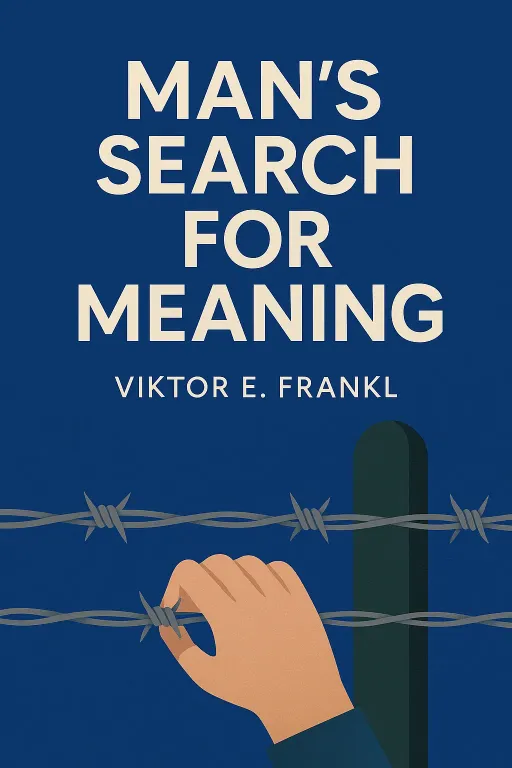
Orion: Imagine being stripped of your name, your clothes, your home, and your family. You are given a number, forced into brutal labor, and faced with the constant threat of death. What keeps you moving forward? This is the central question of Viktor Frankl’s masterpiece,. Today, we are looking at this profound book through a very specific and vital lens: the world of professional caregiving. Joining me is Ali, a healthcare professional with years of experience on the front lines of care. Ali, welcome.
Ali: Thanks, Orion. It is truly an honor to talk about this book. In my line of work, we see people at their most vulnerable. We see pain, decline, and loss every single day. Reading Frankl isn't just an academic exercise for me; it feels like a survival guide for the soul.
Orion: That is a powerful way to put it. Today, we are going to tackle Frankl's insights from two distinct angles. First, we will define and explore what Frankl calls the "last of human freedoms"—the ability to choose our attitude in any given set of circumstances. Second, we will discuss his revolutionary shift in how we define the meaning of life, moving from abstract questions to concrete, daily responsibility.
Ali: I love that roadmap. Because in healthcare, we often cannot change the diagnosis, but we can always change how we show up for the person holding that diagnosis.
Deep Dive into Core Topic 1
SECTION
Orion: Let us begin with the first core concept: the freedom of attitude. To understand this, we must look at the crucible where it was tested. Frankl was a prominent Viennese psychiatrist before he was deported to Nazi concentration camps, including Auschwitz and Dachau. In those camps, the SS attempted to systematically dehumanize the prisoners. They shaved their heads, took their clothes, and reduced their identities to a stamped number. Yet, Frankl observed something extraordinary among the inmates. He noted that while physical robustness did not guarantee survival, a certain inner strength did. Ali, how does this concept of choosing one's attitude resonate with your daily experience as a caregiver?
Ali: It resonates on a deeply personal level, Orion. In caregiving, we often work with patients who have lost almost all of their physical independence. They can't feed themselves, they can't walk, and they are entirely dependent on others. It is incredibly easy for them—and for us as caregivers—to fall into a state of absolute despair. But Frankl reminds us of something beautiful. He writes about prisoners who walked through the huts comforting others, giving away their last piece of bread. He said, "They may have been few in number, but they offer sufficient proof that everything can be taken from a man but one thing: the last of the human freedoms—to choose one's attitude in any given set of circumstances."
Orion: Exactly. Let us break down that definition. Frankl is not talking about a naive, toxic positivity. He is defining a highly structured psychological defense mechanism. Let us look at three specific ways this manifested in the camps: 1.: Prisoners developed an emotional blunting to protect themselves from the constant horror and beatings. 2.: Inmates retreated into memories of loved ones or appreciated fleeting moments of natural beauty, like a sunset over the Bavarian mountains. 3.: They actively cultivated grim humor to create a sense of detachment from their suffering.
Ali: That second point—the preservation of inner life—is something I see all the time. I remember caring for an elderly gentleman who was in the late stages of Parkinson's. His body was failing him completely. But every afternoon, he wanted to sit by the window and look at the oak tree in the courtyard. He told me that looking at that tree reminded him of the summers he spent camping with his children. He was using his inner life, his memories, to transcend the physical prison of his illness. He was exercising that last human freedom.
Orion: That is a beautiful parallel. Frankl actually shares a deeply moving story in the book that mirrors your patient's experience. It is the story of a young woman who was dying in the camp. She knew she had only a few days left to live, yet she was remarkably cheerful. She pointed out the window of her hut to a single branch of a chestnut tree. She told Frankl, "I associate with this tree. It tells me, 'I am here—I am here—I am life, eternal life.'" Frankl noted this was not a hallucination, but a profound spiritual connection that gave her peace in her final moments.
Ali: It makes me think about how we, as caregivers, can facilitate that. Sometimes we get so caught up in the physical tasks—the medication passes, the turning schedules, the charting—that we forget to support the patient's inner life. We forget to help them find their "chestnut tree."
Orion: Yes, and that brings us to a critical point about the caregiver's own mental health. Caregiver burnout is a massive issue in the healthcare industry. When you are constantly absorbing the suffering of others, how do you protect your own spirit?
Ali: You have to find meaning in the care itself. If I view my job as just a list of physical tasks, I will burn out in a year. But if I view each task as an opportunity to preserve another person's dignity, the work changes. It becomes a choice of attitude. I might not be able to cure my patient, but I can choose to bring warmth, respect, and a listening ear into their room. That choice is my own "last of human freedoms."
Deep Dive into Core Topic 2
SECTION
Orion: This transition brings us perfectly to our second core topic: the call to responsibility. Frankl argues that we need to completely reverse our approach to the question of the meaning of life. He writes, and I quote: "Ultimately, man should not ask what the meaning of his life is, but rather he must recognize that it is he who is asked. In a word, each man is questioned by life; and he can only answer to life by answering for his own life; to life he can only respond by being responsible."
Ali: That quote gives me chills every time I hear it. It flips the script entirely. We spend so much time waiting for life to hand us a purpose, or wondering why we are in a difficult situation. But Frankl says the situation itself is asking a question.
Orion: Precisely. Let us define this shift clearly.: "What does this moment require of me? What does this patient need from me right now?"
Ali: That concept of being irreplaceable is so vital in caregiving. Every patient is unique, and the connection you build with them cannot be replicated by anyone else. I remember a colleague of mine who was feeling incredibly discouraged, ready to quit. She felt like a cog in a machine. But then, one of her regular patients, a woman with severe dementia who rarely spoke, held her hand and said, "Thank you for being so gentle." In that moment, my colleague realized that her specific, gentle touch was what life was asking of her in that room. She was irreplaceable to that patient.
Orion: That is the essence of Logotherapy. It is a meaning-centered psychotherapy. Unlike Sigmund Freud, who focused on the "will to pleasure," or Alfred Adler, who focused on the "will to power," Frankl pioneered the "will to meaning." He believed that when our search for meaning is frustrated, we fall into an "existential vacuum"—a state of boredom, apathy, and emptiness. In modern society, this often manifests as depression, aggression, or addiction.
Ali: I see the existential vacuum a lot in patients who have recently retired or transitioned into long-term care. They feel like their usefulness is gone, so they conclude their life has no meaning. They fall into what Frankl called "Sunday neurosis"—that depression that hits when the busywork of the week stops and the lack of content in our lives becomes obvious.
Orion: Yes, and Frankl provides three clear avenues for discovering meaning to combat this vacuum. Let us define them: 1.: This is the active path of achievement and contribution. 2.: This is the passive path of appreciating nature, art, or experiencing love. 3.: This is the path of transforming personal tragedy into a triumph of the human spirit.
Ali: As caregivers, we have a unique opportunity to help patients navigate all three of these avenues. We can help them find small projects to work on, we can facilitate visits from loved ones to foster those deep encounters, and most importantly, we can walk alongside them as they face the third avenue—unavoidable suffering.
Orion: Let us focus on that third avenue, because it is the most difficult. Frankl shares a beautiful clinical example of an elderly general practitioner who was severely depressed after the death of his wife. He loved her deeply and could not find peace. Frankl did not offer empty platitudes. Instead, he asked the doctor a simple question: "What would have happened, Doctor, if you had died first, and your wife would have had to survive you?" The doctor replied that it would have been terrible for her; she would have suffered immensely. Frankl then pointed out that by surviving her, the doctor had spared her that suffering, but at the cost of his own grief. The doctor shook Frankl's hand and left. His suffering had not changed, but his toward it had. It now had meaning as a sacrifice.
Ali: That is incredibly profound. It shows that suffering ceases to be suffering the moment it finds a meaning. In my work, when a patient is grieving a loss or facing a terminal diagnosis, I don't try to fix it or tell them "everything happens for a reason." Instead, I try to help them find their own personal meaning in the struggle. Sometimes, that meaning is simply showing their grandchildren how to face death with dignity and courage.
Synthesis & Takeaways
SECTION
Orion: As we draw our conversation to a close, let us synthesize what we have discussed. Viktor Frankl’s teaches us that we are not merely products of our environment or our biology. We possess a spiritual freedom that can never be taken away.
Ali: Absolutely. We've looked at how we can choose our attitude even in the most restrictive environments, and how we can find our unique purpose by answering the questions life poses to us through our daily responsibilities. For anyone working in healthcare, or anyone caring for a loved one at home, these aren't just nice ideas. They are the bedrock of resilience.
Orion: To wrap up, Frankl introduces the concept of "tragic optimism"—the capacity to remain optimistic despite the "tragic triad" of human existence: pain, guilt, and death. He argues that we can transform pain into a human achievement, derive the opportunity for self-improvement from guilt, and use the transitoriness of life as an incentive to take responsible action. Ali, what is one actionable piece of advice you would leave our listeners with today?
Ali: I would challenge everyone listening, especially my fellow caregivers, to practice what Frankl called "dereflection." Tonight, when you feel overwhelmed by your own stress or exhaustion, shift your focus entirely outward. Find one small, concrete way to make another person's day slightly better. Listen to a patient's story, hold a hand, or simply bring a warm blanket. In forgetting yourself and serving another, you will find that your own sense of meaning—and your strength to carry on—will naturally return.
Orion: A perfect note to end on. Remember Nietzsche’s words, which Frankl so loved to quote: "He who has a to live can bear with almost any." Thank you, Ali, for sharing your profound insights with us today.
Ali: Thank you, Orion. It was a pleasure.
Orion: And thank you to our listeners. Go out and find your "why" today.