The Meaning Paradox
Golden Hook & Introduction
SECTION
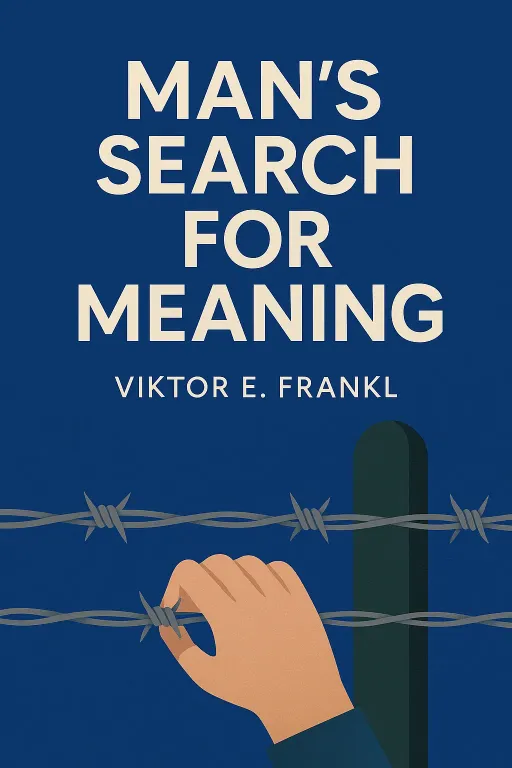
Michelle: Most of us have heard the saying, "What doesn't kill you makes you stronger." It’s a cultural cliché for resilience. Mark: Right, it’s on gym posters and in pop songs. It’s supposed to be motivating. Michelle: Exactly. But what if, in the most extreme case imaginable, survival depended not on becoming stronger, but on finding a reason for your suffering? And what if that very idea is both profoundly inspiring and, at the same time, deeply problematic? Mark: Whoa. That’s a heavy place to start. You’re talking about a situation where strength itself is almost irrelevant. Michelle: I am. And that's the central, difficult question at the heart of Viktor Frankl's Man's Search for Meaning. Mark: A book that is just staggering in its origin story. It was written in only nine days, right after Frankl, who was a trained neurologist and psychiatrist, survived three years in Nazi concentration camps. I also read he initially wanted to publish it completely anonymously. Michelle: That’s right. He wasn't seeking fame or literary acclaim; he was trying to answer a single, urgent question from a clinical and personal perspective: How did anyone find life worth preserving in a place meticulously designed to extinguish it? And his answer begins with a really surprising observation.
The Forge of Meaning: Survival in the Face of the Unthinkable
SECTION
Michelle: Frankl noticed something that defied all logic. It wasn't necessarily the most physically robust or healthiest prisoners who survived. He said, quite hauntingly, "The best of us did not return." Survival often came down to something else, something internal. Mark: That’s completely counter-intuitive. You’d assume physical endurance would be the number one factor. If it’s not that, what is it? What were these unexpected weapons the soul was deploying? Michelle: He points to a few, but one of the most powerful was the cultivation of a rich inner life. He tells this incredible story of a morning when he and other prisoners were being marched out to a worksite in the freezing dark. Their feet were covered in sores, the guards were screaming at them, and a man next to him whispered, "If our wives could see us now!" Mark: Oh, man. Just the thought is heartbreaking. Michelle: It is. But for Frankl, it triggered something profound. He began thinking intensely about his own wife, having vivid, detailed conversations with her in his mind. He saw her smile, he heard her answers. He writes that in that moment, a thought seized him: "The salvation of man is through love and in love." He realized that even if a person has nothing left in the world, they can still know bliss, even for a moment, in the loving contemplation of a beloved. Mark: So, a memory, an imagined conversation, became a shield against the horror right in front of him. That’s an incredible act of mental defiance. Michelle: It’s more than a shield; it was a source of meaning. He even came to the conclusion that it didn't matter if his wife was still alive. He wrote, and this is a direct quote, "Love goes very far beyond the physical person of the beloved. It finds its deepest meaning in his spiritual being, his inner self." The love itself was real, and that couldn't be taken away. Mark: That gives me chills. But was that enough? Love is powerful, but the day-to-day reality was still a nightmare. How did that inner world connect to the will to actually live, to get up the next day? Michelle: That’s the other critical piece. It wasn't just about a rich inner life; it was about having a future goal. A "why" to live for. He gives this devastating case study of a fellow prisoner, a famous composer, who told Frankl about a dream he’d had. In the dream, a voice told him the war would be over for him on March 30th. Mark: Okay, so he had a specific date. A finish line. Michelle: A finish line he clung to with absolute conviction. But as the end of March approached, the news from the front was not good. Liberation wasn't imminent. On March 29th, the composer suddenly fell ill with a high fever. On March 30th, the day of his prophesied freedom, he became delirious. And on March 31st, he died. Mark: Wow. It was the loss of hope that killed him. Michelle: Frankl was convinced of it. He said the official cause was typhus, but the real cause was the profound disappointment that shattered his will to live, which in turn caused his body's resistance to collapse. Frankl saw this pattern again and again. He said, "The prisoner who had lost faith in the future—his future—was doomed." In contrast, Frankl’s own "why" was his burning desire to rewrite the scientific manuscript that had been confiscated from him at Auschwitz. He would spend his nights secretly jotting down notes on scraps of paper. That task, that future purpose, kept him alive. Mark: So it’s not just vague "positive thinking." It’s having a concrete, personal mission that you feel responsible for completing. But that sounds almost superhuman. How many people could realistically invent a mission for themselves in that kind of hell? Michelle: I think that’s the question that haunted Frankl. It’s one thing to observe this phenomenon, but it's another to turn it into something that can actually help people. And that’s exactly what he did after the war. He built a whole school of psychotherapy on this very foundation.
The Blueprint for Resilience: Logotherapy and the Will to Meaning
SECTION
Michelle: He called it Logotherapy. "Logos" is Greek for "meaning." And its central idea is a direct challenge to the other major psychological theories of his day. Mark: You mean like Freud? Michelle: Precisely. Freud argued our primary drive is the "will to pleasure." Another contemporary, Alfred Adler, argued it was the "will to power." Frankl came along and said, no, you're both missing the most fundamental human motivation: the "will to meaning." He believed our deepest need is to feel that our lives have a purpose. Mark: And when that need isn't met, that's when problems start? Michelle: Yes. He called it "existential frustration," which could lead to what he termed "noögenic neuroses"—neuroses that don't come from childhood trauma, but from a sense of meaninglessness. He saw it everywhere in the modern world, this feeling of an "existential vacuum." Mark: Okay, that makes sense. But how does a therapist actually help someone find meaning? You can't just prescribe it like a pill. Michelle: You can't. And this is where Frankl introduces his most powerful idea. He called it the "Copernican Switch." For our whole lives, we tend to ask one question: "What can I expect from life?" We want happiness, success, comfort. Frankl said we have to flip the question entirely. Mark: How so? Michelle: He said, "It did not really matter what we expected from life, but rather what life expected from us." We have to stop asking what life's meaning is, and instead recognize that it is we who are being asked. Life is constantly posing questions to us through our circumstances. Mark: That’s a huge shift in perspective. It’s like life is a relentless job interviewer. So, you’re saying meaning isn’t something you find, it’s something you do? A response you give? Michelle: Exactly. It’s about taking responsibility. And he laid out three main avenues for how we can answer life's call. First, by creating a work or doing a deed—like his mission to rewrite his book. Second, by experiencing something or encountering someone—by loving. And the third, and most radical, is by the attitude we take toward unavoidable suffering. Mark: The one he witnessed firsthand. Michelle: The one he lived. He argued that when we are no longer able to change a situation, we are challenged to change ourselves. He tells a story from his practice about an elderly doctor who was deeply depressed after his wife of many years had died. He couldn't get over his loss. Mark: A very common and understandable grief. What did Frankl do? Michelle: He didn't offer platitudes. He just asked him one question: "What would have happened, Doctor, if you had died first, and your wife would have had to survive you?" The doctor replied, "Oh, for her this would have been terrible! How she would have suffered!" Frankl then gently pointed out, "You see, Doctor, such a suffering has been spared her, and it is you who have spared her this suffering; but now, you have to pay for it by surviving and mourning her." Mark: Wow. In an instant, the suffering wasn't just pain anymore. It was a sacrifice. It had a purpose. Michelle: The doctor didn't say another word. He just shook Frankl's hand and left. His suffering hadn't disappeared, but its meaning had been transformed. And that, for Frankl, is the essence of Logotherapy. It’s about illuminating the meaning that is already dormant in every situation, even the most tragic ones. Mark: It's an incredibly powerful and hopeful message. And the book has been massively influential, sold millions of copies. But it's also faced some really serious criticism, hasn't it? I feel like we have to talk about the controversy.
The Legacy and the Controversy: A Modern Reckoning with Frankl's Message
SECTION
Michelle: We absolutely do. It’s a crucial part of understanding the book's place in the world today. For all its inspirational power, there are some very valid and difficult questions raised about it. Mark: Let's start with the historical account. I’ve read that some historians, like Timothy Pytell, have pointed out that Frankl's time in Auschwitz was actually quite brief and in a specific "depot" area, and that most of his camp experience was in a subsidiary of Dachau. They question the accuracy of some of his detailed Auschwitz descriptions. How does that impact his credibility? Michelle: It's a significant point, and it's true that his narrative has been challenged on those factual grounds. For many, this complicates the book. If the story isn't a precise, journalistic account, what is it? I think the most generous reading is to see the book less as a perfect historical document and more as a psychological composite. He was a psychiatrist observing a phenomenon across multiple camps, and he may have consolidated those experiences into a single, powerful narrative to make his philosophical point. But it definitely opens the door to criticism. Mark: And the criticism gets even sharper, right? The Holocaust Memorial Museum in D.C. reportedly refused to sell the book for a time. And the scholar Lawrence Langer accused Frankl of having a tone of self-aggrandizement and a "detached, clinical attitude" that felt inhumane. Michelle: Yes, that’s a major ethical critique. The idea of framing the Holocaust as an opportunity for spiritual growth can be deeply unsettling. It risks aestheticizing or romanticizing an event of unimaginable horror. It can feel like it smooths over the jagged, senseless brutality of it all. Mark: And that leads to the biggest, most difficult issue for me. The implication that attitude determines survival. If the people who found meaning were the ones who lived, does that not, even unintentionally, blame the millions who died? Does it suggest they just lacked the right mindset or didn't have a strong enough "why"? That feels incredibly unfair. Michelle: That is the most potent and painful critique, and it’s one that has to be taken seriously. I don't think Frankl ever intended to blame the victims. His concept, which he later called "Tragic Optimism," wasn't about being happy in the face of horror. It was about accepting the reality of pain, guilt, and death—what he called the "tragic triad"—and still saying "yes to life" by choosing your response. He’s arguing for the freedom of attitude, not the power to change fate. Mark: But the line is so thin. It’s one thing to say you have the freedom to choose your attitude as you’re being led to your death. It’s another thing to suggest that attitude is what prevents you from being led there in the first place. Michelle: It is an incredibly thin line. And perhaps the book's message is most powerful when it's decoupled from the idea of physical survival. Maybe the ultimate "freedom" he's talking about isn't about living or dying, but about preserving one's human dignity in a system designed to annihilate it. He saw some men behave like saints and others like swine, and he believed that choice was always present.
Synthesis & Takeaways
SECTION
Michelle: Ultimately, I think Frankl's legacy isn't about a set of rules for survival. It's a profound and defiant argument for human freedom, even in the most constrained circumstances imaginable. He forces us to confront the idea that we are not merely products of our environment or our biology. Mark: He’s pushing back against determinism. The idea that we’re just a bundle of instincts and conditioning. Michelle: Exactly. There's a quote near the end of the book that I think sums it all up. He says, "Man has both potentialities within himself; which one is actualized depends on decisions but not on conditions." He saw people share their last crust of bread, and he saw others turn on their friends. The camp was the same for both. The conditions were the same. The decision was different. Mark: So the book isn't really a guide on how to survive a catastrophe. It's a meditation on what it means to be human when everything else is stripped away. Michelle: I think that’s the most enduring way to read it. It’s not a history lesson, and it’s not a simple self-help guide. It’s a philosophical testament. Mark: It leaves you with a heavy but incredibly empowering question, doesn't it? The one he posed: What is life asking of me right now, in my own, much smaller struggles? And how am I choosing to answer? Michelle: That’s the question. And it’s a responsibility that, as he says, never leaves you. It’s a difficult book, and a controversial one, but that question is why it continues to resonate so deeply with so many people. We’d love to hear what you think about this balance between inspiration and controversy. Does Frankl’s message give you hope, or does it trouble you? Let us know. Mark: This is Aibrary, signing off.