The Meaning Crisis: Why You Need to Reframe Your Life's Purpose.
Golden Hook & Introduction
SECTION
Nova: What if the very things we strive for—comfort, success, accumulation—are actually sabotaging our deepest human need? What if 'having it all' is precisely why so many of us feel like we have nothing?
Atlas: Whoa. That's a powerful way to start, Nova. I imagine a lot of our listeners, especially those driven to achieve, might feel a pang of recognition there. That sense of emptiness, even when everything looks perfect on the outside. It’s like a quiet hum of dissatisfaction, isn’t it?
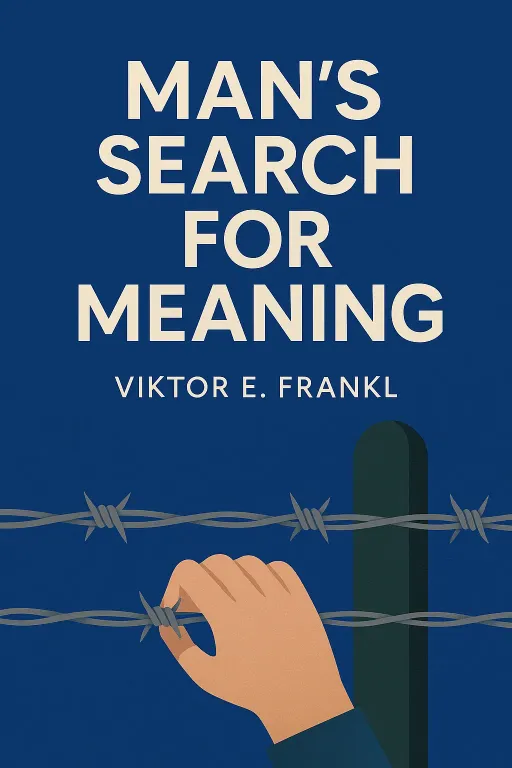
Nova: Exactly, Atlas. It's the "blind spot" we're talking about today. That deeply human need for meaning and purpose, often overlooked in our relentless pursuit of comfort. And to truly understand this, and more importantly, to navigate it, we're turning to two philosophical giants: Viktor Frankl, and his seminal work, "Man's Search for Meaning," and Jean-Paul Sartre, with "Existentialism Is a Humanism."
Atlas: Frankl and Sartre. That's quite a pairing. I know Frankl's book is incredibly well-regarded. If I recall, he wrote it after surviving the horrors of concentration camps, which gives his insights an almost unbearable weight and credibility.
Nova: Absolutely. His experience isn't just background; it’s the very crucible in which his ideas on meaning were forged. And Sartre, on the other hand, developed his radical ideas about freedom and responsibility in the intellectual ferment following World War II, a time when humanity was really grappling with fundamental questions of existence and meaning. These aren't just academic texts; they're blueprints for navigating profound human dilemmas.
Atlas: Okay, so we're talking about blueprints for a life not just filled with things, but with. But let's start with that "blind spot" you mentioned. What exactly is it, and why does it trip us up so consistently?
The Blind Spot: Unmasking the Meaning Crisis
SECTION
Nova: Well, picture this: you've got the great job, the comfortable home, maybe even the picture-perfect social life that looks incredible online. From the outside, you’ve 'made it.' But inside, there's this quiet, persistent void. A sense of 'is this all there is?' That's the blind spot. It’s the mistaken belief that if we just acquire enough, achieve enough, or avoid enough discomfort, we’ll automatically feel fulfilled.
Atlas: Right. I can definitely relate to that. It’s like climbing a mountain, reaching the summit, and then looking around thinking, "Okay, now what?" But why is that need for meaning so easily overlooked? I mean, shouldn't it be obvious?
Nova: It's because our modern world often trains us to look outward for validation and satisfaction. We're bombarded with messages that happiness comes from consumption, from external markers of success. We're taught to optimize for pleasure and minimize pain. And while comfort is wonderful, it can become a kind of anesthetic, dulling our awareness of deeper, more fundamental human cravings. Our brains are actually wired for purpose, for contribution, for connection beyond just personal gratification. Without that, even the most comfortable existence can feel hollow.
Atlas: That makes perfect sense. So, it's not that comfort is bad, but that we sometimes mistake it for the goal, rather than a means to live a meaningful life. It's a subtle but critical distinction. For someone who's spent years striving for career success, for instance, this could be a really unsettling realization.
Nova: It can be. But recognizing it is the first step towards reframing our lives. It’s about understanding that deep joy often isn't found in the absence of struggle, but in the presence of purpose that struggle.
The Philosophical Compass: Navigating Meaning with Frankl and Sartre
SECTION
Atlas: Okay, so we’ve identified the problem. Now, how do Frankl and Sartre help us navigate this meaning crisis? Let’s start with Frankl. His story is just incredible.
Nova: It truly is. Frankl, a psychiatrist, endured unimaginable suffering in Auschwitz and other concentration camps. He saw firsthand how people survived, or didn't. And what he observed was that those who found a reason to live—a future task, a loved one to reunite with, a book to finish—were the ones most likely to endure. His own meaning, in part, was to finish his work on logotherapy, a form of existential analysis focused on finding meaning.
Atlas: So, for him, meaning wasn't something you from life, but something you to life, even in the most horrific circumstances. But how does that translate to the daily grind? To the smaller, everyday struggles that don't involve surviving a concentration camp? I mean, that's a pretty high bar for 'suffering.'
Nova: That's a crucial question, Atlas. Frankl outlined three primary ways we can find meaning. First, through creative work: creating something, contributing. Second, through experiencing something or encountering someone—think love, art, nature. And third, and perhaps most profoundly, by the attitude we take toward unavoidable suffering. It's about choosing our response, finding purpose even in our limitations. It’s not about seeking suffering, but about finding dignity and purpose when it inevitably arises.
Atlas: That makes sense. It's about agency, even when external circumstances are beyond our control. But then we have Sartre, who famously declared we are "condemned to be free." That sounds like a stark contrast to Frankl's idea of meaning. How do these two perspectives fit together?
Nova: They offer different, yet complementary, lenses. Frankl suggests meaning can be discovered, that it exists "out there" to be found. Sartre, on the other hand, argues that there is no pre-ordained meaning, no inherent purpose to our existence. We are born, and then we are absolutely free to create our values, our purpose. There's no divine plan or cosmic script. We are entirely responsible for what we make of ourselves.
Atlas: That's fascinating. But wait, doesn't that just add more pressure? If I have to create my meaning, if there's no pre-existing framework, where do I even start? It feels like a massive, almost overwhelming burden.
Nova: It can feel that way, initially. But Sartre saw it as profoundly empowering. It means you are the author of your own life's story, not merely a character in someone else's. An artist doesn't find their masterpiece; they create it. An entrepreneur doesn't discover their company's value; they define it. For Sartre, this radical freedom is what gives our choices their immense significance. There's no external authority to tell you what's right or wrong; you must choose, and in choosing, you define what it means to be human.
Atlas: So, Frankl tells us to look for the meaning that's already there, and Sartre tells us to build it ourselves. It sounds like two different sides of the same coin: both demand active engagement, rather than passive acceptance. It's not about waiting for purpose to find you, but actively participating in its discovery or creation.
Nova: Precisely. Both thinkers, in their own ways, challenge us to move beyond the blind spot of passive comfort and engage deeply with life. They transform existential dilemmas into opportunities for profound personal growth and resilience by highlighting our agency.
Synthesis & Takeaways
SECTION
Nova: So, whether you're finding meaning in an act of compassion, in a creative endeavor, or in the dignified way you confront a challenge, or whether you're boldly creating your own values and purpose from scratch, both Frankl and Sartre underscore a fundamental truth: meaning isn't a luxury; it's a necessity for a full, joyful life. It’s an active engagement, a constant striving.
Atlas: That's actually really inspiring. It takes the pressure off "finding the one true purpose" and instead puts the power back into our daily choices. It's about cultivating meaning, brick by brick, moment by moment.
Nova: Exactly. It's about recognizing that universal human need and then consciously, intentionally, seeking or creating it. So, for our listeners today, as you go about your day, I want to leave you with this deep question: What small act of meaning can you intentionally create or discover in your day today?
Atlas: That’s a fantastic question to sit with. Whether it's a kind word, a moment of focused work, or simply appreciating a beautiful sunset, those small acts truly add up. Reflect on that, Aibrary listeners, and see how it shifts your perspective.
Nova: This is Aibrary. Congratulations on your growth!