The 'Meaning Crisis': Why Connection and Purpose Are Non-Negotiable for Well-being.
Golden Hook & Introduction
SECTION
Nova: What if I told you that the very things we chase for happiness – success, achievements, material comfort – are often the precise ingredients for a profound sense of emptiness? It sounds counterintuitive, but it's a feeling many of us know all too well.
Atlas: Oh, I know that feeling. It's like you're checking all the boxes, doing everything "right," and there's still this subtle, nagging void. I imagine a lot of our listeners, especially those who are deep thinkers and always striving, can relate to that.
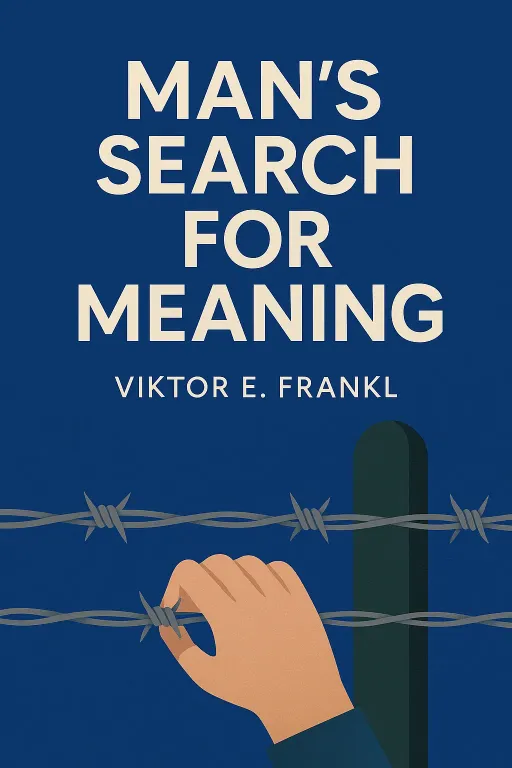
Nova: Absolutely. Today, we're dissecting what many call 'the meaning crisis,' that subtle emptiness even when everything looks perfect on paper. We're drawing insights from two monumental works: Viktor Frankl's "Man's Search for Meaning" and Robert D. Putnam's "Bowling Alone." Frankl, a psychiatrist and Holocaust survivor, penned his work after enduring unimaginable suffering, finding meaning even in the death camps. Putnam, on the other hand, is a political scientist who meticulously documented the decline of social capital in America, providing hard data to show how our communities are fraying.
Atlas: Wow. So one is from the crucible of human suffering, and the other is a rigorous academic look at society. That's quite a spectrum to understand why we might feel disconnected. It makes me wonder, where do we even begin with such a vast topic?
Nova: We begin with the individual, Atlas. Frankl's central thesis, born from the unimaginable horrors of Auschwitz, is that our primary drive isn't pleasure, but the search for meaning. He called it the "will to meaning."
The Inward Search: Purpose as the Primary Drive
SECTION
Atlas: The will to meaning. That’s a powerful phrase, especially coming from someone who experienced the Holocaust. How did he arrive at that conclusion in such an extreme environment?
Nova: He observed it firsthand, in the most brutal laboratory imaginable. In Auschwitz, Frankl saw that prisoners who retained a sense of purpose – a reason to live, a loved one to reunite with, a book to finish, a message to deliver – were often the ones who survived. They were not necessarily the strongest physically, but they possessed an inner 'why.' He tells stories of men who, despite starvation and torture, would share their last piece of bread, or find solace in watching a sunset, or even offer comfort to others.
Atlas: That's incredible. It almost sounds counterintuitive; you'd think in such dire circumstances, basic survival, food, just getting through the day, would be the only drive. But he’s saying it goes deeper than that.
Nova: Much deeper. Frankl realized that when everything else is stripped away – possessions, status, dignity, even physical health – the one thing that can't be taken is our freedom to choose our attitude towards our circumstances. He famously said, "Everything can be taken from a man but one thing: the last of the human freedoms – to choose one's attitude in any given set of circumstances, to choose one's own way." He saw people turn their suffering into a human triumph by finding meaning in it.
Atlas: Okay, but what about our less dramatic, daily suffering? How does a corporate job or a tight deadline, or just the grind of modern life, find meaning in the same way? It feels a world away from Auschwitz.
Nova: That's a great question, and it's where Frankl's insights become incredibly relevant for us today. Meaning isn't some grand, monumental discovery reserved for extreme circumstances. It can be found in three main ways: through work, by doing something significant; through love, by caring for someone; and through the attitude we take towards unavoidable suffering. For us, it might be the meaning we find in our work, the care we give to our families, or even how we choose to respond to a frustrating commute or a demanding boss. It's about shifting from asking, "What can I expect from life?" to "What does life expect from me?"
Atlas: So, it's not about finding a grand, singular purpose that defines your entire existence, but rather recognizing and embracing the meaning in the everyday acts of living, especially how we respond to challenges. I imagine many listeners, especially those in demanding fields, might feel overwhelmed just trying to get through the day, let alone find profound meaning. This reframes it as something accessible.
Nova: Exactly. It's about that shift in perspective. Frankl showed us that even in the darkest moments, the human spirit's capacity for meaning can illuminate a path forward. It’s a powerful internal compass.
The Outward Need: Social Connection and Community
SECTION
Atlas: That internal compass sounds essential. But if meaning is an internal search, what happens when our external world, our social fabric, starts to fray? Does that make the internal search even harder?
Nova: It absolutely does, Atlas. And that's where Robert D. Putnam's groundbreaking work, "Bowling Alone," comes into sharp focus. While Frankl explored the individual's spiritual resilience, Putnam, a political scientist, meticulously documented the decline of in America over several decades. He showed how our engagement in community groups – everything from bowling leagues and bridge clubs to PTAs and neighborhood associations – has significantly dwindled.
Atlas: Hold on, bowling leagues? Are you saying the decline of a casual sports league actually contributes to a 'meaning crisis'? That sounds a bit out there.
Nova: It might sound trivial, but it's not about bowling itself. It's what bowling leagues, or any community group, represent: face-to-face interaction, shared purpose, mutual trust, and a sense of belonging. Putnam's research, which is incredibly data-driven and spans decades, showed a consistent, measurable decline in these forms of collective engagement. He didn't just speculate; he provided empirical evidence of how much less we're joining, volunteering, and simply in meaningful ways.
Atlas: I see. It's like those small, seemingly insignificant connections are actually the threads that weave our social fabric together. So, is it just busyness, or something deeper? How did we get here, where we're 'bowling alone' even when there are more ways than ever to connect digitally?
Nova: Putnam points to several factors: generational shifts, the rise of television which kept people home, suburbanization, and more recently, the individualization driven by technology. While social media offers a form of connection, it often lacks the depth, reciprocity, and shared commitment that builds genuine social capital. It's the difference between having a thousand online "friends" and having three people you can truly count on in a crisis. The quality of connection matters profoundly.
Atlas: That makes perfect sense. So, it's not just about feeling personally adrift, but also about the ecosystem of connection deteriorating around us, making that personal search for meaning even harder because there's less shared context, less support, less of a collective 'why' to latch onto.
Nova: Exactly. If Frankl showed us that meaning builds individual resilience, Putnam shows that genuine social connection builds societal resilience. When that collective infrastructure of belonging breaks down, individuals inevitably suffer. The 'meaning crisis' isn't just an internal void; it's also a reflection of a fractured external world where the opportunities for deep connection and shared purpose have diminished. We are profoundly social creatures, and isolating ourselves, even inadvertently, takes a toll.
Synthesis & Takeaways
SECTION
Atlas: It’s clear these two ideas are deeply intertwined. Finding individual purpose, as Frankl suggests, often involves connecting to something larger than oneself, which inherently requires some form of community or shared understanding.
Nova: Absolutely. The profound insight here is that the 'meaning crisis' isn't a single problem with a single solution. It's a dual challenge that requires both an inward journey to discover our unique purpose and an outward re-engagement with the communities around us. Our purpose often blossoms when we contribute to something beyond ourselves, and that "something beyond ourselves" is inherently communal. When we invest in our connections, we're not just helping others; we're also fortifying our own sense of belonging and, by extension, our meaning.
Atlas: That’s actually really inspiring. It means we don't have to wait for some grand revelation. We can actively cultivate both. So, what's one practical step someone listening right now can take to begin addressing this?
Nova: It's a small but powerful act, and we call it our "Healing Moment." Reach out to someone you haven't spoken to in a while. Not a text, but a genuine call or even a short, personalized message that invites a real connection. Share a genuine moment, even for a few minutes. It might feel small, but those moments are the building blocks of purpose and connection.
Atlas: That's such a simple yet powerful idea. Not a huge commitment, just a genuine touchpoint. That’s going to resonate with anyone who feels that subtle emptiness and wants to start building those bridges again.
Nova: And remember, finding purpose and connection isn't about grand gestures, but often about those genuine, quiet moments.
Atlas: Exactly. This is Aibrary. Congratulations on your growth!