The 'Comfort Zone' Trap: Why Discomfort Builds Resilience.
Golden Hook & Introduction
SECTION
Nova: Atlas, if you had to review the concept of the "comfort zone" in exactly five words, what would they be? No overthinking.
Atlas: Oh man, five words for "comfort zone"... Okay, I've got it: "Cozy, tempting, but ultimately limiting."
Nova: Ha! "Ultimately limiting." I love that. Because today, we're diving deep into why that cozy, tempting space, our beloved comfort zone, might actually be the biggest trap we fall into. We're talking about why leaning into discomfort isn't just brave, it's essential for building profound resilience.
Atlas: And we're going to unpack this with some truly heavyweight thinkers. We’re drawing wisdom from the profound memoir, by Viktor Frankl, a psychiatrist who survived the Holocaust and offered the world an unparalleled exploration of human resilience. His work resonates so deeply because it comes from the crucible of extreme suffering, giving it an authority that few others possess.
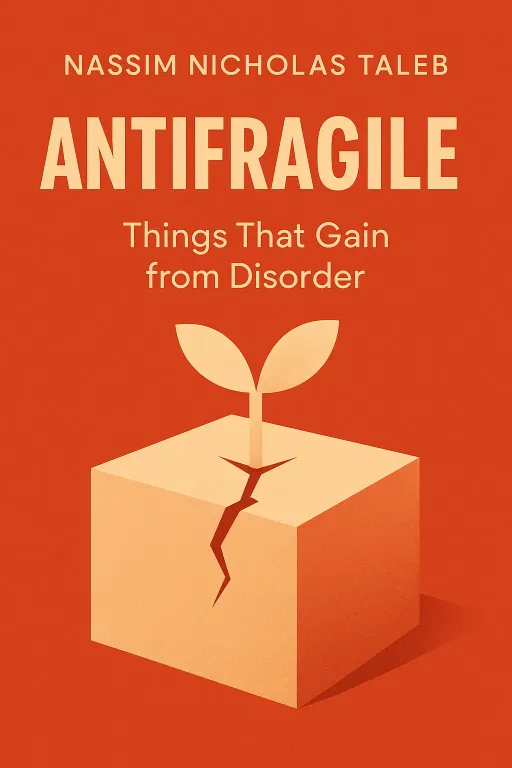
Nova: Absolutely. And then we'll turn to the brilliant, often provocative mind of Nassim Nicholas Taleb and his seminal work,. Taleb, known for his distinctive, sometimes abrasive style, challenges conventional wisdom, arguing that some things actually from disorder. His book became a critical darling and a lightning rod for debate in intellectual circles, forcing us to rethink how we approach risk and stability. So, the big question for today is: what if our relentless pursuit of comfort and stability is actually making us weaker, more brittle, and less prepared for life's inevitable curveballs?
Antifragility: Gaining from Disorder
SECTION
Atlas: That sounds almost counter-intuitive, Nova. We're taught to seek safety, to minimize risk. So you're saying we should actively seek out chaos? Isn't that just reckless for a conscious explorer trying to navigate a complex world?
Nova: Not reckless, Atlas, but strategic. Think about it this way: Taleb introduces three categories. You have the fragile—a ceramic mug, for instance. Drop it, and it shatters. Then you have the robust—a steel thermos. Drop it, and it dents, but largely survives. But then, there's the antifragile. Imagine a package that explicitly asks to be mishandled. The more it's dropped, tossed, and shaken, the stronger its contents become. It's a system that from disorder and volatility.
Atlas: That's a wild concept. So, beyond packages, can you give me a concrete example of something antifragile? Something we might recognize in our own lives or bodies?
Nova: Absolutely. Our bones, for instance. They don't just stay the same; they remodel themselves. When you put stress on them through exercise, they actually become denser and stronger. Or consider your immune system. It needs exposure to pathogens to learn, adapt, and build robust defenses. Constant over-sanitization, while seemingly protective, can actually make it fragile, unable to cope when it finally encounters a real threat.
Atlas: Wow. So, those little daily frustrations, the ones we usually try to avoid—the unexpected project at work, the difficult conversation, the plan that falls through—they're not just annoyances, they're actually opportunities? For someone trying to transform their approach to life, as many of our listeners are, this reframes everything.
Nova: Exactly! If we live in a perfectly cushioned environment, where every potential stressor is removed, we become brittle. Our muscles atrophy, our minds become less adaptable, our problem-solving skills dull. Taleb argues that by constantly optimizing for comfort and predictability, we inadvertently remove the very stimuli that make us resilient, innovative, and capable of handling true crises. It’s about building a system, whether it’s your personal life or an organization, that isn't just robust, but under pressure.
Atlas: But what's the "right kind" of stress, Nova? How do you know when you're building resilience versus just breaking down? Because sometimes, pushing too hard just leads to burnout, not growth.
Nova: That's a crucial distinction. Antifragility isn't about seeking out catastrophic events. It's about having incremental, manageable stressors, and critically, having the capacity to recover and learn. Think of it like lifting weights: you apply stress, your muscles tear microfibers, and then during recovery, they rebuild stronger. The key is the recovery and the learning. It’s about exposing yourself to small doses of volatility – trying new things, taking calculated risks, embracing minor failures as feedback – rather than shielding yourself from everything. It's about having options and redundancy, so if one thing fails, you have others. It's a constant dance with the unknown, but with a safety net built from lessons learned.
Meaning in Suffering: The Ultimate Resilience
SECTION
Nova: And that understanding of how external stressors can make us stronger naturally leads us to a different kind of strength, one born not from external pressures, but from within. This is where Viktor Frankl’s work in becomes profoundly illuminating.
Atlas: I can definitely relate to that. Frankl’s story is just... it's beyond comprehension. To go through what he did in the concentration camps and come out with such a powerful message of hope and purpose... it's almost overwhelming. How did he even begin to articulate that?
Nova: Frankl, as a psychiatrist, observed something remarkable amidst the unspeakable horrors of the Holocaust. He noticed that the survivors weren't necessarily the strongest physically, or the youngest, or even the luckiest. Often, they were those who had a 'why' to live for – a future task, a loved one, a meaning that transcended their immediate suffering. He saw that even when everything was stripped away – dignity, family, freedom – the one thing that could not be taken was the human capacity to choose one's attitude, to find meaning the suffering itself.
Atlas: That’s incredible. So, even in the most horrific circumstances, he found a way to not just survive, but to derive purpose? I imagine a lot of our listeners, the 'Ethical Voyagers' among us, often face situations where they feel powerless, whether it's systemic injustice or personal setbacks. This idea of choosing your attitude, even when everything else is stripped away, that’s a powerful tool against feeling overwhelmed.
Nova: It truly is. This became the foundation of his work, logotherapy, which means "therapy through meaning." Frankl argued that life's primary motivation isn't pleasure or power, but the search for meaning. And crucially, meaning isn't something we; it's something we. We discover it through creating a work or doing a deed, by experiencing something or encountering someone, or by the attitude we take toward unavoidable suffering. The last of human freedoms, he said, is to choose one's attitude in any given set of circumstances.
Atlas: But how does that translate to our everyday discomforts? The small failures, the rejections, the feelings of inadequacy when we step outside our comfort zone? It can’t just apply to extreme suffering, can it?
Nova: No, it absolutely applies to all levels of discomfort. Frankl's insight gives us a framework. When we face a challenge, whether it’s a terrifying new project, a personal setback, or even just the unease of trying to understand a new culture, we have a choice. We can lament the discomfort, or we can ask: "What is this situation asking of me? What meaning can I find here? How can I grow from this experience, not just despite it, but of it?" It's about transforming a perceived obstacle into an opportunity for self-transcendence, for understanding ourselves and the world more deeply. It’s about recognizing that growth often comes dressed as difficulty.
Atlas: So, it's about reframing the "trap" of discomfort as a "pathway" to meaning. It's not about avoiding the pain, but understanding what it can teach us, and how our response shapes who we become. That makes so much sense for someone who wants to understand humanity on a deeper level.
Synthesis & Takeaways
SECTION
Nova: Precisely, Atlas. When we bring these two ideas together, antifragility and meaning in suffering, we see a powerful synergy. Antifragility shows us that external stressors, when properly managed and learned from, can make us structurally stronger. And Frankl shows us that internal meaning-making, even in the face of profound adversity, makes us psychologically and spiritually invincible from within.
Atlas: It feels like they're two sides of the same coin: one about the system's response to stress, the other about the individual's inner response to suffering. Both pointing to growth outside the comfort zone, proving that discomfort is not a weakness, but a pathway to profound strength and deeper understanding of self.
Nova: Absolutely. So, for all our listeners, the conscious explorers and ethical voyagers out there, we invite you to reflect on your own comfort zone traps. Think about a past challenge you faced—perhaps a professional failure, a difficult personal transition, or even just the awkwardness of learning a new skill. Can you identify how that very discomfort, that moment of unease, ultimately made you more resilient, more capable, or gave you a deeper sense of purpose? That nagging feeling of stepping into the unknown, that's not a sign of weakness; it's your inner compass pointing towards genuine growth.
Atlas: And perhaps, embracing that unease, rather than running from it, is the true journey of the conscious explorer. It’s about leaning into the growing pains, knowing that on the other side, there's not just survival, but thriving. We invite you to share your own stories of growth through discomfort. What challenge made you more resilient?
Nova: The path to profound strength and deeper understanding isn't paved with ease, but with purposeful discomfort.
Atlas: Indeed.
Nova: This is Aibrary. Congratulations on your growth!