Navigating the Human Condition: Meaning & Resilience
Golden Hook & Introduction
SECTION
Nova: You know, it’s wild to think about how some of the most profound ideas about human existence come from the darkest corners of history. Like, if you were stripped of everything, absolutely everything, what would you cling to?
Atlas: That's a heavy question, Nova. I imagine most people would say hope, or maybe the memory of loved ones. But what if even those felt out of reach?
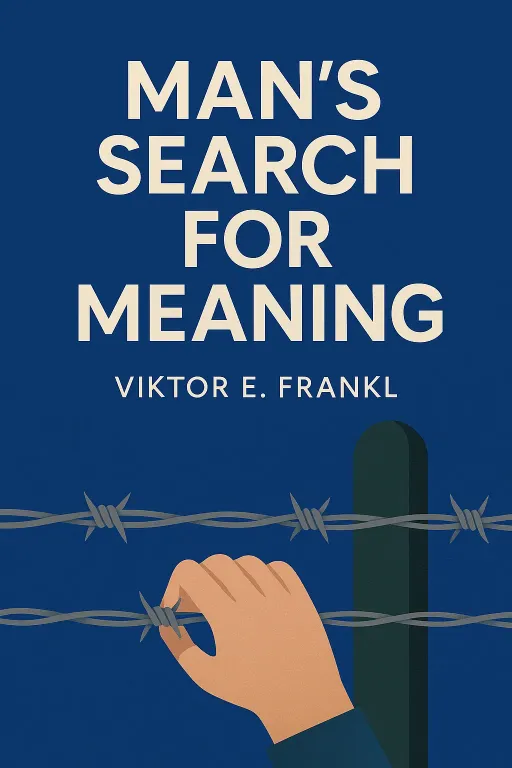
Nova: Exactly! That’s the kind of crucible we’re talking about today. And it brings us to a truly extraordinary book: Viktor Frankl’s "Man's Search for Meaning." What’s particularly striking about Frankl is that he wasn't just observing suffering; he endured the unimaginable as a Holocaust survivor. His insights aren't theoretical; they're forged in the fires of Auschwitz, which gives them an almost sacred weight.
Atlas: Wow. That's a powerful origin story for a book. So, he's basically saying you can find meaning even when everything around you is meaningless? That sounds almost contradictory.
Nova: It sounds impossible, right? But Frankl introduces logotherapy, which is essentially therapy through meaning. His core concept is that even in suffering, even in the most horrific circumstances, we have the freedom to choose our attitude. We can choose how we respond, and it's this choice that can lead us to discover meaning.
Atlas: That’s a massive reframe. So, it's not about avoiding suffering, but about finding a "why" within it?
Nova: Precisely. And what's fascinating is how this idea, born from the 20th century's deepest despair, echoes through centuries. Because then you look back to the Roman Empire, and you find another towering figure grappling with very similar questions about resilience and purpose, and that’s Marcus Aurelius with his "Meditations."
Atlas: Marcus Aurelius, the philosopher-emperor. I’ve always been intrigued by the idea of an emperor writing a personal journal of reflections. It feels so intimate, almost out of place for someone with so much power.
Nova: It’s absolutely extraordinary. "Meditations" wasn't meant for publication; it was his private journal, a series of spiritual exercises he wrote to himself to stay grounded and virtuous amidst the chaos of ruling an empire. It's like peeking into the mind of one of history's most powerful men as he tries to make sense of life, death, and duty. It's why it resonates so deeply with people today – it feels less like a lecture and more like a whispered conversation with a wise friend.
Atlas: That makes so much sense. So, we have Frankl, a survivor of unimaginable horror, and Aurelius, an emperor burdened by immense responsibility, both converging on this idea of finding meaning and resilience. It's like they're offering two different paths to the same profound truth.
Nova: Exactly. They’re separated by nearly two millennia, different cultures, different forms of suffering, yet their core message is strikingly similar: our attitude towards inevitable suffering and the pursuit of a higher purpose are fundamental to a well-lived life.
Atlas: That’s a powerful connection. So, let’s unpack this. How do these two giants guide us in navigating our own human condition today?
Finding Purpose in the Face of Adversity
SECTION
Nova: So, let's start with Frankl and his logotherapy. The central tenet is that meaning is not given to us; it's discovered. And it can be discovered in three main ways: through creating a work or doing a deed, through experiencing something or encountering someone, and by the attitude we take toward unavoidable suffering.
Atlas: Oh, I like that. It’s not just about grand gestures. Experiencing something or encountering someone… that sounds very accessible. Like, a beautiful sunset could be a source of meaning?
Nova: Absolutely. Or a deep conversation with a friend, a moment of connection. But it's that third pathway—the attitude we take toward unavoidable suffering—that really sets Frankl's work apart. He observed in the concentration camps that those who had a "why" to live, those who found meaning even in their despair, were more likely to survive.
Atlas: That gives me chills. So, it wasn't necessarily physical strength, but an internal resolve, a mental and spiritual framework, that made the difference?
Nova: Precisely. He tells this incredibly poignant story about two prisoners. One was convinced he would be liberated by Christmas. When Christmas came and went, he fell into despair and died shortly after. The other prisoner, facing the same grim reality, chose to view his suffering as a test, as an opportunity to grow, to protect his inner freedom. He found meaning in enduring, even if he didn't know the outcome.
Atlas: That’s heartbreaking, but also incredibly illuminating. It suggests that our internal narrative about our circumstances can literally be life or death. But how do you cultivate that? How do you find meaning when you're in such a dark place?
Nova: Frankl believed it starts with understanding that suffering is inevitable. Life isn't about avoiding pain; it's about finding a worthy response to it. He argued that if there is meaning in life at all, then there must be meaning in suffering. It's about turning a personal tragedy into a triumph, or transforming one’s predicament into a human achievement.
Atlas: That’s a heavy lift. Like, if someone loses their job, or goes through a painful breakup, it’s hard to immediately think, "Oh, this is an opportunity for growth." The initial instinct is usually anger or despair.
Nova: And that's natural. Frankl wasn't suggesting we bypass those emotions. He was saying that that initial shock, there's a choice. Do you let the suffering define you and break you, or do you find a way to make it purposeful? Perhaps it's an opportunity to redefine your career, or to understand yourself better in relationships. The meaning isn't always obvious; sometimes you have to actively search for it.
Atlas: So, it's not about being a stoic robot who doesn't feel pain, but about actively engaging with that pain to extract something valuable from it. I guess that makes sense. It's like a mental and spiritual alchemy.
A Moment of Reflective Strength with Stoic Philosophy
SECTION
Nova: And this is where Marcus Aurelius steps in, offering a complementary, yet distinct, pathway to that same internal fortitude. While Frankl's logotherapy is about discovering meaning, Aurelius, through Stoicism, is about cultivating inner peace and resilience by focusing on what you can control.
Atlas: Right, so the classic Stoic idea: control your reactions, not external events. But an emperor, with all that power, how much he control? He could literally command armies!
Nova: That’s the paradox, isn't it? Even an emperor, with all his might, couldn't control disease, betrayal, natural disasters, or the inevitable march of time and death. He faced constant wars, a plague, and the immense burden of governing a vast empire. His "Meditations" are a constant reminder to himself to maintain virtue, reason, and self-control amidst this chaos.
Atlas: So, he was essentially writing a self-help guide for himself, to navigate the ultimate high-pressure environment. That's actually incredibly relatable for anyone under pressure, even if it's not ruling Rome.
Nova: Exactly! He repeatedly drills into himself the idea that external events are indifferent. They're neither good nor bad; it's our judgment of them that makes them so. If you can strip away that judgment, you strip away the emotional turmoil.
Atlas: That sounds incredibly difficult to do in practice. If someone cuts you off in traffic, my first thought isn't usually, "Ah, an indifferent event." It's usually a much more... spirited reaction.
Nova: And that's where the practice comes in. Aurelius wasn't suggesting it was easy; he was reminding himself of it daily. He'd write things like, "You have power over your mind—not outside events. Realize this, and you will find strength." He saw every challenge, every irritation, as an opportunity to practice his philosophy, to strengthen his inner citadel.
Atlas: So, for him, a difficult day at the imperial court wasn't just a bad day; it was a training ground for resilience. That’s a fascinating way to frame it. It transforms setbacks into exercises.
Nova: And he also emphasized our interconnectedness, our duty to humanity. He believed that we are all part of a larger whole, and that our purpose is to contribute to the common good. This sense of duty, of contributing something beyond himself, also gave him strength and meaning. It's a different angle than Frankl's "will to meaning," but it arrives at a similar destination of purposeful existence.
Atlas: So, Frankl tells us to find meaning in suffering, and Aurelius tells us to control our reaction to it, and find meaning in virtue and duty. It's like one is looking outwards for purpose, and the other is looking inwards for control, but both are about navigating the inevitable difficulties of being human.
Nova: You've hit the nail on the head. They both offer frameworks for dealing with the harsh realities of life, not by escaping them, but by confronting them with a profound sense of purpose and inner strength. It's about understanding that while we can't always control what happens to us, we always have control over how we choose to respond.
Synthesis & Takeaways
SECTION
Nova: So, bringing it all together, what Frankl and Aurelius teach us is that resilience isn't about being impervious to pain. It's about finding meaning in it, or finding the internal fortitude to face it with grace and purpose. It's about that deep, fundamental choice of attitude.
Atlas: It’s truly powerful to see how these two minds, separated by so much time and circumstance, arrived at such similar conclusions. It suggests there's a universal truth there about the human spirit.
Nova: Absolutely. Whether it's the search for meaning in a concentration camp or the cultivation of virtue on an imperial throne, the core message is that our inner landscape, our chosen perspective, is our most powerful tool. It’s what allows us to not just survive adversity, but to truly live a well-examined, purposeful life.
Atlas: That makes me think about that deep question we posed earlier: in what areas of our lives can we shift our perspective to find meaning or exercise greater control over our reactions rather than external events? It's not just a theoretical exercise; it's a daily practice, isn't it?
Nova: It truly is. And the beauty of both Frankl and Aurelius is that they don't offer quick fixes. They offer profound, enduring wisdom that requires introspection and consistent effort. It's a lifelong journey of self-discovery and conscious choice.
Atlas: That’s a really hopeful takeaway. It suggests that even when things feel completely out of control, we still have that ultimate freedom, that ultimate power within ourselves.
Nova: Exactly. And that's a message that transcends time, culture, and personal circumstance. It's a testament to the enduring strength of the human spirit.
Atlas: That's actually really inspiring. Thank you, Nova, for guiding us through these incredible insights.
Nova: My pleasure, Atlas. And to all our listeners, we encourage you to reflect on these ideas. How can you apply Frankl's search for meaning or Aurelius's Stoic resilience in your own life today? Your perspective is your power.
Atlas: This is Aibrary. Congratulations on your growth!