Decoding Human Purpose and Global Evolution
Golden Hook & Introduction
SECTION
Nova: We love the comforting myth that if you work hard enough, you can conquer any obstacle. It is the bedrock of modern ambition. But history suggests that geography, resources, and plain old environmental luck have a massive head start on your ambition before you even wake up in the morning.
Atlas: That sounds like a brutal reality check to start the day, Nova. It is essentially saying the game is rigged from the start. If I am listening to this while stuck in a career rut or feeling like my progress is stalled, you are telling me it might not be my lack of effort, but the environment I am operating in?
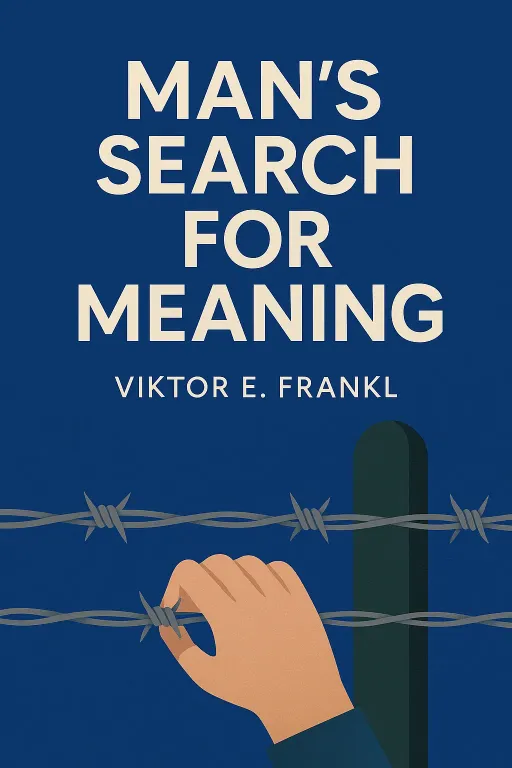
Nova: In a way, yes. Today we are looking at two titans of thought that seem to sit at opposite ends of the human experience. We are diving into Guns, Germs, and Steel by Jared Diamond, which looks at the macro—the massive environmental forces that shape global history. And we are balancing that with Man’s Search for Meaning by Viktor Frankl, which looks at the micro—the absolute, unshakable power of the individual mind.
Atlas: That is a fascinating duality. You have Diamond looking at the world as a game of chance and geography, and Frankl looking at the human spirit as the final, unassailable fortress. I am curious how we reconcile those. If the world is shaped by luck, as Diamond argues, how does Frankl’s idea of finding personal meaning actually hold up?
Nova: It is the ultimate puzzle of the human condition. Jared Diamond, a physiologist by trade who wandered into geography and history, famously argued that the unequal development of human societies wasn’t due to intellectual or genetic superiority. It was all about the hand they were dealt by the environment. Viktor Frankl, a psychiatrist who survived the horrors of the Holocaust, argued the exact opposite—that no matter what hand you are dealt, your freedom to choose your attitude is the last of the human freedoms. Let’s start with the hard reality of Diamond’s world before we get to the redemption of Frankl’s.
The External Reality: Diamond’s Geography of Luck
SECTION
Atlas: Okay, let’s dig into the Diamond perspective first. It is a tough pill to swallow, but I have always been fascinated by why some civilizations zoomed ahead while others stayed stationary. If it is not about intelligence or work ethic, what is it?
Nova: Diamond’s central thesis is about the axes of the continents. He points out that the Eurasian landmass lies on an East-West axis. That means similar climates stretch for thousands of miles. This allowed crops and livestock to spread easily from one region to another. If you domesticate a cow in one place, it is likely to thrive in a place hundreds of miles to the West because the latitude is similar.
Atlas: Right, because the climate doesn't change drastically. That makes total sense.
Nova: Exactly. Now, compare that to the Americas or Africa, which are oriented North-South. You have to cross vastly different climate zones to move from one region to another. A crop that thrives in the temperate zones of North America might die instantly in the tropics of Central America. This made the development of agriculture—the foundation of civilization—much harder and slower. It meant fewer surplus resources, less time for specialization, and ultimately, less development of tools like steel or advanced weaponry.
Atlas: So, the "guns, germs, and steel" weren't the result of some inherent genius on the part of the people who had them. They were the result of having enough food surplus to sit around and invent things, which only happened because the geography allowed for easy farming.
Nova: You nailed it. It is the ultimate argument against exceptionalism. It wasn't that the people in Eurasia were smarter; they were just luckier in their geography. They had a longer growing season, more easily domesticatable animals, and a climate that supported the exchange of ideas and technologies.
Atlas: That creates a really interesting tension for anyone trying to build a career today. If I feel like I am struggling to get ahead, and I look at Diamond’s work, I could easily fall into the trap of thinking, well, the geography of my industry or my life is just bad. The environmental factors are stacked against me. Why bother trying to build an empire if the terrain is hostile?
Nova: That is the danger of reading Diamond without a counterweight. It can lead to a kind of fatalism. If you believe your environment is the sole determinant of your success, you surrender your agency. You start viewing yourself as a victim of your circumstances.
Atlas: I see that happening all the time in professional circles. People blame the economy, they blame their location, they blame the industry cycle. It is a very easy out. But that is where Frankl has to come in, right? Because Diamond explains the field we play on, but Frankl explains the player.
The Internal Agency: Frankl’s Search for Meaning
SECTION
Nova: Precisely. And Frankl’s story is the most powerful evidence for his philosophy. He wasn't theorizing from a comfortable office. He was a psychiatrist who spent years in Nazi concentration camps. He watched his family, his friends, and his colleagues disappear. He was stripped of everything—his status, his possessions, his clothes, and eventually, his name.
Atlas: I have read his work, and it is staggering. He posits that even when you are stripped of every external freedom, there is one thing left that no one can take: the ability to choose your attitude in any given set of circumstances.
Nova: That is the core of logotherapy. He noticed that the people who had the best chance of surviving the camps were not necessarily the strongest physically. They were the ones who had a reason to live. They had a "why." They weren't just trying to survive the day; they were holding onto a purpose, whether it was a project they wanted to finish, a person they wanted to see again, or a truth they wanted to articulate.
Atlas: It is a radical shift in perspective. Diamond says the environment dictates the outcome, but Frankl says the outcome is secondary to the meaning you derive from the process.
Nova: Think about how this applies to the professional world. We often focus on the "what" and the "how." What is my job title? How much money am I making? How fast am I climbing the ladder? Frankl asks us to focus on the "why." If you are in a high-pressure, perhaps even toxic, environment—which is a form of environmental bad luck, similar to what Diamond describes—you cannot always change the terrain. But you can change your relationship to it.
Atlas: Let me play devil’s advocate here. It is easy to talk about "meaning" when you have a roof over your head. Is it not a bit privileged to tell someone struggling with, say, a dead-end job in a failing industry to just "find meaning"? Doesn't that sound like a way to ignore the structural issues that Diamond talks about?
Nova: That is a fair critique. And Frankl himself would agree that changing the environment is important. If you are in a cage, you should try to get out. But while you are in the cage, despair is the most dangerous emotion. If you let your environment crush your spirit, you lose your ability to even strategize your way out. You become a victim of the circumstances. The meaning isn't a replacement for success; it is the fuel that allows you to survive long enough to create it.
Atlas: Okay, I see that. It is the distinction between "coping" and "thriving." If I am in a bad situation, I can either let it define me—which makes me bitter and ineffective—or I can use it as a crucible to refine my character.
Nova: Exactly. And that is the bridge between these two thinkers. Diamond teaches us to be humble about our success and realistic about our obstacles. He teaches us that a lot of what we achieve is due to the "fertile crescent" of our own lives—our upbringing, our network, our timing. Frankl teaches us that regardless of the cards we are dealt, the way we play them is entirely our own.
Synthesis: The Pragmatic Strategy
SECTION
Atlas: So, how do we synthesize this? If I am a listener wanting to be a "Focused Strategist," how do I use these two ideas? Diamond gives me the map of the world, and Frankl gives me the compass.
Nova: You use Diamond to perform a realistic audit of your situation. Be honest about your environment. If you are in a shrinking industry, don't pretend you are in a growing one. Acknowledge the external factors. This is the "Pragmatic Learner" part of the profile. You don't ignore the terrain; you study it. You identify the "guns, germs, and steel" of your specific life—the resources you have, the limitations you face, the luck you’ve had.
Atlas: That is the strategy part. You aren't fooling yourself. You are looking at the board, seeing where the pieces are, and accepting the reality of the game.
Nova: And then, you pivot to Frankl. Once you have accepted the reality of your environment, you ask: "What is the meaningful attitude I choose to adopt here?" If the environment is tough, your purpose becomes resilience. If the environment is boring, your purpose becomes mastery. If the environment is chaotic, your purpose becomes order. You stop asking "Why is this happening to me?" and start asking "What does this situation demand of me?"
Atlas: That is a powerful shift. It turns every problem into a task. It is not "I am stuck in this job," it is "I am in a situation that demands I learn how to navigate corporate politics," or "I am in a situation that demands I develop a new skill set." It changes the emotional weight of the experience.
Nova: And it gives you agency. When you view a challenge as a demand for a specific response, you are no longer a victim. You are a strategist. You are actively choosing how to engage. That is the essence of resilience.
Atlas: It reminds me of the concept of "radical acceptance" in psychology. You accept the external truth—the Diamond reality—because fighting reality is a waste of energy. But you insist on your internal sovereignty—the Frankl reality—because that is where your power lies.
Nova: Absolutely. And let’s talk about the cultural impact of this. Diamond’s work was massive because it forced us to rethink our history. It challenged the Eurocentric view of progress. It forced us to look at the world as a complex system of interconnected variables. But Frankl’s work is arguably more enduring on a personal level because it speaks to the universal human need for significance. We don't just want to be successful; we want to matter.
Atlas: It makes me think of the "15 minutes a day" growth recommendation in our profile. If you have a chaotic, Diamond-style environment—say, a demanding job that leaves you no time—you can't change the environment overnight. But you can carve out those 15 minutes. That is the Frankl choice. That is the moment where you say, "My day belongs to my boss, but these 15 minutes belong to my growth."
Nova: That is the perfect implementation. Those 15 minutes are your sanctuary. They are the proof that you have not surrendered your agency to the environment. It is a small act, but it is an act of defiance against the idea that you are just a product of your circumstances.
Atlas: It is a way of saying, "I see the cards I have been dealt, I see the board I am playing on, and I am still going to play my game."
Nova: And that is how you build a resilient personal philosophy. You don't need to be a philosopher in an ivory tower. You just need to be a person who understands that while you cannot control the wind, you can adjust your sails.
Atlas: Or, in Diamond’s terms, you might not have chosen the ocean you are sailing in, but you can definitely choose to build a better ship.
Nova: I love that. You are using the resources you have—the geography of your life—to build the best ship possible, and you are using your purpose as the captain to steer it.
Synthesis & Takeaways
SECTION
Atlas: This has been a really grounding conversation. We started with the idea that we are products of our environment, and we ended with the idea that we are the architects of our meaning. It feels like the ultimate takeaway for anyone feeling stuck.
Nova: The takeaway is this: You cannot control the starting line. Diamond showed us that the world is messy, unfair, and shaped by forces far beyond our control. But Frankl showed us that the finish line is not the point. The point is the dignity with which you run the race.
Atlas: If you are out there feeling the weight of your circumstances, remember that the "meaning" you create is not dependent on the environment. It is independent of it. That is your true competitive advantage.
Nova: Exactly. Don't look for meaning in your circumstances; bring meaning to them. That is the ultimate act of leadership and the ultimate strategy for a fulfilling life.
Atlas: I love that. "Don't look for meaning in your circumstances; bring meaning to them." That is going to stay with me.
Nova: And for everyone listening, if you want to sharpen that professional edge or cultivate that resilience, start with that one small, meaningful choice today. Whatever your "geography" looks like, your attitude is the one thing that remains entirely yours.
Atlas: This has been a great exploration of both the world and the self. Thank you for walking through this with me, Nova.
Nova: It was a pleasure, Atlas. And to our listeners, keep building your ship, no matter what ocean you are in. This is Aibrary. Congratulations on your growth!