Beyond the Diagnosis: How to See the Whole Person in Clinical Practice.
Golden Hook & Introduction
SECTION
Nova: What if the very thing we try to avoid—suffering—holds the key to our deepest sense of purpose?
Atlas: Oh, I love that. That's a bold statement right out of the gate. Given how much we're conditioned to escape discomfort, that feels almost… counter-intuitive.
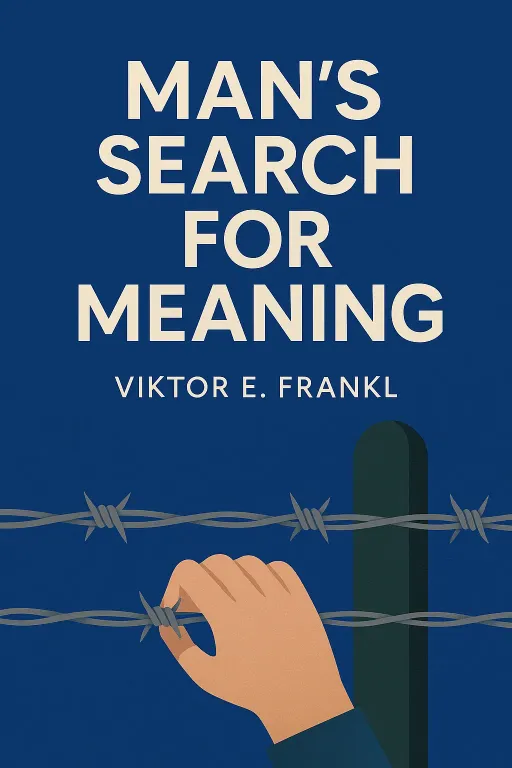
Nova: Absolutely. And that's precisely the radical wisdom we're unpacking today, drawing from two profoundly impactful books: Viktor Frankl's "Man's Search for Meaning" and Eckhart Tolle's "The Power of Now."
Atlas: Two heavyweights! I know Frankl's story is legendary – developing his therapeutic approach, logotherapy, while imprisoned in concentration camps. That's a stark origin for a philosophy of meaning.
Nova: It is. And Tolle, from a very different, yet equally intense personal crisis, found his path to presence. Today, we're exploring how these two seemingly distinct philosophies converge to offer a holistic view of human well-being, moving us beyond mere diagnosis to seeing the whole person.
Meaning in Suffering: Frankl's Logotherapy
SECTION
Nova: So, let's start with Frankl and this powerful idea: meaning in suffering. It challenges the very foundation of how we often approach mental health, which is to alleviate symptoms, to remove pain. Frankl suggests that suffering, while not desirable, is an inescapable part of life, and our response to it, our search for meaning within it, is what defines us.
Atlas: That’s going to resonate with anyone who struggles with chronic illness or profound loss. It’s not just about coping, but finding something in the midst of it. But how does that actually work in practice? It sounds almost too grand.
Nova: It's not grand in the way you might think. Frankl's logotherapy isn't about ignoring pain; it's about shifting perspective. He often spoke of a patient, a doctor, who had lost his wife and was in deep despair. Frankl asked him, 'What if your wife had outlived you? How much would she have suffered?'
Atlas: Oh, wow. That’s a powerful reframing.
Nova: Exactly. The doctor realized that his suffering was, in a way, a testament to his wife's spared pain. He was suffering her, and in that, he found a profound meaning in his grief. It wasn't about minimizing his loss, but about recognizing the love that fueled it and the purpose his continued life could hold. This isn't about a quick fix; it's about a fundamental shift in how we perceive our experiences.
Atlas: So it’s like transforming the of the pain. Instead of 'Why me?', it becomes 'What am I being called to do with this?' I imagine a lot of our listeners, especially those in high-pressure caregiving roles, might feel immense guilt for their own struggles. This reframes that, doesn't it?
Nova: Absolutely. It moves us from victimhood to responsibility and agency. Frankl observed that those who survived the concentration camps weren't necessarily the strongest physically, but those who clung to a sense of purpose – a loved one to reunite with, a book to finish, a message to share. They had a 'why' to live.
Atlas: That's actually really inspiring. It suggests that even in the most extreme circumstances, there's always a choice in our attitude.
Nova: Precisely. It’s about discovering that unique meaning that only you can fulfill. It’s not imposed; it’s discovered. It’s about finding the purpose that resonates uniquely with your spirit, regardless of external circumstances.
Atlas: So, it's not about avoiding the hard parts of life, but about finding the profound lessons and purpose within them. That makes so much sense when you think about long-term resilience.
Nova: And it’s a constant process. Meaning isn't a static thing you find once and keep; it's something you continually uncover and reaffirm, especially when faced with new challenges. It’s an active engagement with life.
Atlas: I can see how that would be incredibly empowering. It puts the agency back in our hands, even when everything else feels out of control. It’s like saying, 'My life still has value, even if I'm struggling.'
Nova: Exactly. And that inner strength, that sense of purpose, is what can carry us through even the darkest times. It’s the ultimate antidote to despair, a profound affirmation of human spirit.
The Power of Presence: Tolle's Mindfulness
SECTION
Nova: And that naturally leads us to the second key idea we need to talk about, which often acts as a powerful complement to finding meaning: the transformative power of presence, as articulated by Eckhart Tolle in "The Power of Now." While Frankl helps us find meaning suffering, Tolle guides us to transcend suffering by living fully in the present moment, rather than being consumed by past regrets or future anxieties.
Atlas: Okay, so I get the connection. Once you have a 'why,' you need the mental clarity to pursue it. But 'living in the present moment' sounds simple, yet it's incredibly hard in our hyper-connected, always-on world. How does Tolle make that accessible?
Nova: Tolle's approach is about recognizing the 'pain-body' – the accumulation of past emotional pain, and the 'mind-made self' – the ego constantly projecting into the future or dwelling on the past. He argues that most of our suffering comes from identifying with these mental constructs, rather than the pure awareness of the present moment.
Atlas: So basically you’re saying, my constant worrying about tomorrow’s workload or dwelling on yesterday’s awkward conversation is the real source of my stress, not the actual events themselves?
Nova: Exactly. He uses a beautiful analogy: "The stream of life flows now." If you're constantly looking at the past or the future, you're missing the actual flow. He encourages practices like simply observing your breath, or noticing the sensations in your body. It's not about about the present; it's about in it.
Atlas: I totally know that feeling. I still struggle with that myself. Like, I'll be playing with my kids, but my mind is already drafting emails. So, what's a 'tiny step' for someone like me, or our listeners who are constantly juggling a million things?
Nova: A tiny step could be what Tolle calls "stopping the clock." For instance, when you're washing your hands, truly the water, notice the soap, the warmth, the scent. Don't let your mind race ahead to the next task. Or, when you're listening to someone, genuinely without formulating your reply. It's about bringing conscious awareness to mundane activities.
Atlas: That’s a bit like what some therapists call 'grounding' techniques, isn't it? Bringing your attention to sensory input to pull you out of an anxious loop.
Nova: Absolutely. It’s a practical way to dissolve the illusion of time and step into the only reality we ever truly have: now. When you combine Frankl's search for meaning with Tolle's cultivation of presence, you get a powerful synergy. You have a profound 'why' for your life, and the mental clarity and peace to actually live it, fully and consciously.
Atlas: That makes me wonder, could this actually backfire for some people? What if someone is in a genuinely difficult situation, and being 'present' just means they're more aware of their pain?
Nova: That’s a valid concern. Tolle would argue that true presence isn't about denying or suppressing pain; it's about observing it without judgment, without letting the mind create a narrative it that amplifies the suffering. It's the difference between feeling a physical sensation of pain versus the mental anguish of 'this pain will never end' or 'I can't handle this.' Presence allows us to experience the feeling without the added layer of mental resistance.
Atlas: So, it's about creating a little bit of distance from the narrative of the pain, even if the sensation is still there. That sounds incredibly challenging, but also deeply liberating.
Nova: It is. And it’s a muscle you build. Just like Frankl's logotherapy isn't about wishing away suffering, Tolle’s presence isn't about wishing away discomfort. Both are about radically changing our to what is.
Atlas: I can see how, for our listeners who are trying to foster secure attachments or improve assertive communication, being present would be absolutely critical. You can't truly connect or communicate effectively if your mind is always somewhere else.
Nova: Exactly. Both of these philosophies underline the importance of internal work – the shift in perspective, the cultivation of awareness – as foundational to any external change or healing.
Synthesis & Takeaways
SECTION
Nova: So, bringing it all together, we started by acknowledging that focusing solely on diagnoses can obscure an individual's inherent drive for meaning and purpose. Frankl and Tolle offer us two profound navigational tools. Frankl helps us find our unique 'why,' even in the face of immense suffering, reminding us that meaning is discovered, not invented.
Atlas: And Tolle gives us the 'how' – how to actually inhabit the life we're building, right now. How to stop the constant mental chatter that pulls us away from that purpose, and instead, be fully present for the journey. It's about having both the compass and the clear vision to use it.
Nova: Exactly. Imagine a clinician, or anyone for that matter, who can not only identify symptoms but also gently explore what gives someone a sense of meaning, and then help them cultivate a present-moment awareness to engage with that meaning. That's seeing the whole person. That's holistic care.
Atlas: That gives me chills. It’s not just about fixing what's broken; it’s about nurturing what makes us profoundly human. So, for our listeners, what’s one small thing they can do this week to integrate these powerful ideas?
Nova: My tiny step for you this week is to simply pause three times a day for just one minute. Use that minute to consciously notice what you are doing, feeling, and thinking in that exact moment. No judgment, just observation. See if you can identify one tiny thread of meaning, or just one moment of pure presence.
Atlas: That’s manageable. One minute, three times a day. It’s like a micro-reset button. And who knows, those micro-resets might just lead to a macro-shift in how we experience our lives.
Nova: Precisely. It’s about building those muscles, one conscious breath at a time. It's in these small moments that we begin to see beyond the surface, beyond the label, and truly connect with the profound depth of human experience.
Atlas: That’s such a hopeful way to look at it. It takes the pressure off 'finding' meaning and makes it about 'discovering' it, right where you are.
Nova: Absolutely. It’s always there, waiting to be seen.
Atlas: This is Aibrary. Congratulations on your growth!