The Architecture of Persuasion: How to Win Minds with Scalia and Garner
Content
Content
Socrates: -
Golden Hook & Introduction
SECTION
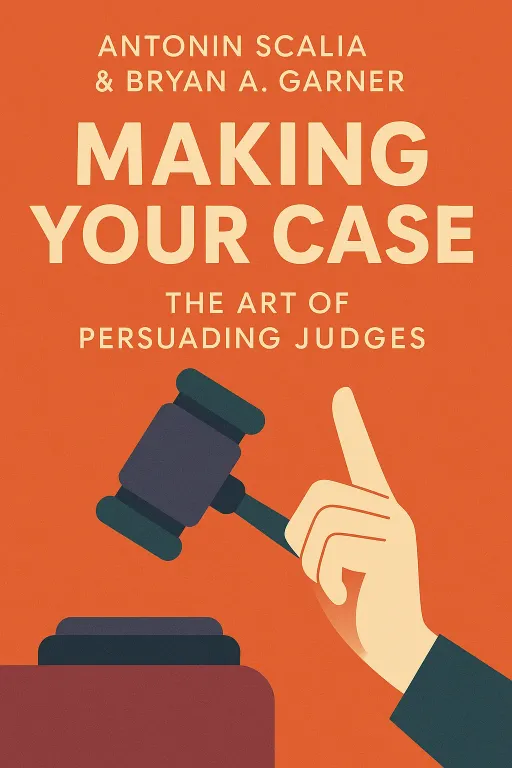
Socrates: Imagine you have exactly fifteen minutes to convince a highly skeptical, deeply analytical decision-maker to completely change their mind on a high-stakes issue. No pressure, right? But how do you actually do it? Do you overwhelm them with data, or do you appeal to their emotions? According to Supreme Court Justice Antonin Scalia and legal writing expert Bryan Garner, the secret isn't flashiness, it's structural architecture. Today, we're going to tackle their classic book, Making Your Case: The Art of Persuading Judges, but we're not just talking to lawyers. We're looking at this as a masterclass in human cognition and strategic communication. Joining me is Mk, an analytical thinker who loves to find the hidden patterns connecting different fields. Welcome, Mk.
Mk: Thanks, Socrates. I'm really excited about this. When you look at Making Your Case, it's easy to see it as just a manual for the courtroom. But if you strip away the legal terminology, what you're actually looking at is a profound guide on how to design information so that a skeptical human brain can process it, trust it, and ultimately agree with it. It's cognitive design disguised as legal strategy.
Socrates: Cognitive design. That's a fascinating way to put it. Today, we'll dive deep into this from three perspectives. First, we'll explore how to map the cognitive landscape of your decision-maker. Then, we'll dissect the logical skeleton of an airtight argument. And finally, we'll focus on why intellectual honesty is actually your strongest rhetorical weapon. Let's start with the audience. Scalia and Garner write extensively about understanding the judge. But who is this judge, really, in the psychological sense?
Mk: Well, in the book, the authors paint a very realistic, almost brutal picture of judges. They aren't these detached, omniscient deities of logic. They are busy, tired, over-worked human beings who are constantly flooded with information. They have hundreds of cases, limited time, and a deep fear of making a mistake that gets overturned. So, when you write a brief or make an oral argument, you aren't writing for an abstract ideal of justice. You are writing for a highly distracted, highly skeptical professional who is actively looking for reasons to reject your argument just to clear their desk.
Socrates: So, the judge is a bottleneck of attention. How does that change how we present our ideas?
Mk: It changes everything. If your audience has limited cognitive bandwidth, then any friction in your argument is a fatal flaw. Scalia and Garner emphasize that you must make the judge's job as easy as possible. If they have to search through your document to find your main point, or if they have to decipher overly complex jargon, they will simply tune out. In cognitive psychology, we talk about cognitive load, the amount of mental effort being used in the working memory. Scalia's advice is essentially a guide to minimizing cognitive load. You present your strongest point first, you use simple, clear language, and you avoid unnecessary filler. You design your argument for maximum processing efficiency.
Deep Dive into Core Topic 1
SECTION
Socrates: Minimizing cognitive load. That sounds simple, but why do so many advocates fail at it? Why do we naturally tend to overcomplicate our arguments when the stakes are high?
Mk: I think it comes down to a fundamental insecurity. When we feel pressured, we tend to equate complexity with thoroughness. We think, if I just throw every single piece of data, every minor point, and every legal precedent at the wall, something will stick. But Scalia and Garner warn that this kitchen-sink approach is actually self-defeating. They write that a clear, powerful argument is like a sharp spear. If you try to throw a bundle of fifty sticks at someone, they can easily catch them or brush them aside. But if you throw one sharp spear, it penetrates. Overcomplicating is often a sign that the advocate hasn't done the hard work of deciding what actually matters.
Socrates: A sharp spear. That's a vivid image. But how do we choose which spear to throw? How do we know what will actually resonate with a skeptical mind?
Mk: You have to understand their underlying philosophy and constraints. In the legal world, Scalia was famous for his commitment to textualism and originalism. If you were arguing before him, trying to persuade him based on what you thought was fair or socially progressive, you would lose instantly, because those weren't the rules of his intellectual framework. You had to argue based on the text of the statute. The lesson here is that persuasion requires a deep, almost empathetic understanding of the decision-maker's operating system. You can't persuade a data-driven CFO with purely emotional stories, and you can't persuade a visionary creative director with nothing but spreadsheets. You have to translate your argument into their native language.
Socrates: So, we must speak their language. But what if their language, or their initial bias, is hostile to our position? Scalia and Garner talk about the unfriendly court. How do you handle an audience that starts with a prejudice against your case?
Mk: That's where the concept of framing becomes critical. Scalia and Garner suggest that you should never let your opponent frame the issue. You must define the terms of the debate from the very first sentence. Let's look at a classic case study they discuss, which is how to state the question presented. They argue that the way you frame the question should practically dictate the answer. For example, if you are defending a company accused of environmental damage, you don't ask, did our company pollute the river? That invites a hostile response. Instead, you frame it around the legal standard, such as, did the regulatory agency exceed its statutory authority when it issued this specific fine? By shifting the focus from the emotional issue of pollution to the structural issue of regulatory authority, you move the battle to ground where you have a strategic advantage. You're not lying; you're choosing the lens through which the facts are viewed.
Socrates: Choosing the lens. But doesn't that risk looking evasive? How do we maintain credibility while framing the issue to our advantage?
Mk: You do it by grounding your frame in undeniable facts and clear logic. You can't just spin a narrative out of thin air. The frame has to feel like a natural, logical extension of the reality of the situation. If the judge feels like you are playing semantic games or trying to trick them, you lose all credibility instantly. And in persuasion, credibility is your currency. Once you go bankrupt on credibility, no amount of clever framing will save you. That brings us to the actual structure of the argument itself, the physical skeleton that holds the frame up.
Deep Dive into Core Topic 2
SECTION
Socrates: Yes, let's talk about that skeleton. Scalia and Garner are obsessed with structure. They argue that the ultimate tool of persuasion is the formal syllogism. Why is the syllogism so powerful?
Mk: The syllogism is the gold standard of deductive reasoning. It's a three-step logical model. You have a major premise, which is a general, undisputed rule. Then you have a minor premise, which is a specific fact of your case. And finally, you have the conclusion, which must logically follow if the first two premises are true. The classic textbook example is: All men are mortal. Socrates is a man. Therefore, Socrates is mortal. It's simple, elegant, and mathematically airtight.
Socrates: But legal cases, and indeed most real-world decisions, are rarely that simple, are they? How does a syllogism work when the facts are messy and the rules are disputed?
Mk: That's the beauty of it. The syllogism forces you to isolate exactly where the disagreement lies. Scalia and Garner show how a great advocate uses the syllogism to structure their entire brief. Let's take a real-world contract dispute case study from the book. Imagine a case where a party wants to void an agreement because they claim there was no consideration, meaning no value was exchanged. A bad advocate might write a long, rambling story about how unfair the contract is, how their client was taken advantage of, and how the other party acted in bad faith. A great advocate, following Scalia's advice, structures the argument as a clean syllogism. Major premise: Under state law, a contract is only legally binding if there is mutual consideration. Minor premise: In this specific agreement, no consideration was exchanged between the parties. Conclusion: Therefore, this agreement is not a legally binding contract.
Socrates: Hmm. If the major premise is the law, and the minor premise is the fact, then the conclusion seems inevitable. But what if the other side disputes the minor premise? What if they say there was consideration?
Mk: Exactly! That is where the real battle happens. But notice what the syllogism has done. It has cleared away all the emotional noise and irrelevant details. It has focused the entire debate onto one specific, testable question: Was there consideration or not? By structuring your argument this way, you make it incredibly easy for the judge to see the path to your conclusion. You are essentially saying, if you agree with this established rule, and you agree with this documented fact, then you must, as a matter of logical necessity, rule in my favor. It removes the judge's personal feelings or biases from the equation. It makes your conclusion feel like the only rational choice.
Socrates: It sounds almost mechanical. But does this mechanical approach risk losing the human element? What about the emotional appeal, what the ancient Greeks called pathos? Does that have a place in Scalia's framework?
Mk: It does, but not in the way most people think. Scalia and Garner are very skeptical of overt emotional appeals. They argue that judges are trained to spot emotional manipulation from a mile away, and they resent it. If you try to make a judge cry, you will probably just make them angry. But they do believe in what they call the eloquence of facts. You don't tell the judge to feel outraged; you present the facts in such a clear, stark, and structured way that the outrage arises naturally in the judge's own mind. The emotion should be a byproduct of the logic, not a substitute for it. It's the difference between showing and telling. If you show the judge a sequence of events where a vulnerable person was systematically defrauded, the logic of your syllogism provides the path to a remedy, while the facts provide the emotional drive to take that path.
Socrates: The eloquence of facts. I like that. It suggests that logic and emotion aren't enemies, but partners, where logic must always lead. But what happens when our logic has a crack in it? What do we do when our opponent points out a major flaw in our minor premise?
Mk: That is the ultimate test of an advocate. And it leads directly to Scalia and Garner's third major pillar, which is how we handle vulnerability and the art of defensive advocacy.
Deep Dive into Core Topic 3
SECTION
Socrates: Defensive advocacy. In a high-stakes argument, our natural instinct is to hide our weaknesses, to sweep them under the rug and hope no one notices. Why do Scalia and Garner say this is a mistake?
Mk: Because they know that in a professional setting, your opponent will notice, and the judge will notice. And if they find your weakness before you disclose it, you look like you were trying to deceive them. Scalia and Garner have a golden rule: always bring up your weakest point yourself, and deal with it on your own terms. They call this preemptive disclosure. If you know there is a damaging fact, or a hostile precedent, you don't ignore it. You bring it up, you explain why it doesn't defeat your syllogism, and you move on. By doing this, you disarm your opponent. You take away the shock value of their discovery. And most importantly, you show the judge that you are an intellectually honest guide who can be trusted.
Socrates: Trust. It seems that persuasion is ultimately a relationship of trust, even in a formal courtroom. But how does this play out in the heat of oral argument, when a judge is firing hostile questions at you?
Mk: This is one of the most exciting parts of the book. Scalia and Garner describe oral argument not as a speech, but as a conversation. And the most important part of that conversation is answering questions from the bench. Many advocates make the mistake of viewing questions as interruptions or attacks. They try to dodge them, or they say, I will get to that point later in my presentation. Scalia says that is a fatal error. When a judge asks a question, they are telling you exactly what is blocking them from ruling in your favor. Their mind is a locked door, and that question is the key. If you say, I will get to that later, you are leaving the door locked. You must answer immediately, directly, and with absolute candor.
Socrates: Even if the answer hurts your case?
Mk: Yes, even then. If the answer hurts, you acknowledge the damage, but you immediately put it into context. You show why, even with that damage, your overall syllogism still stands. Scalia gives a great example of this. If a judge asks, doesn't this precedent completely contradict your position? You don't try to twist the words of the precedent to make it fit. You say, yes, Your Honor, if you read that precedent broadly, it does. However, we believe that precedent should be read narrowly because of these specific factual differences. By admitting the contradiction first, you show respect for the judge's intelligence. You don't insult them with a weak defense. You meet them on the level of honest intellectual debate.
Socrates: It takes a lot of courage to do that. It requires you to be comfortable with vulnerability.
Mk: It really does. But it's a strategic vulnerability. It's about knowing that no case is perfect. Every real-world problem has gray areas and weak spots. The person who wins the argument isn't the one who pretends their case is flawless; it's the one who can acknowledge the flaws but still demonstrate that their solution is the most logical and stable option available. It's about building a robust structure that can take a hit and still stand.
Socrates: A robust structure. That brings us back to the idea of architecture. If you were to summarize this entire philosophy of persuasion, what is the core truth we should take away?
Synthesis & Takeaways
SECTION
Mk: I think the core truth is that persuasion is an act of service. It's not about dominating your opponent or showing how smart you are. It's about serving the decision-maker. It's about doing the hard cognitive work of organizing information, stripping away the noise, building a clear logical path, and being completely honest about the challenges. When you do that, you aren't just making a case; you are helping someone make a good decision. And that is the most persuasive thing you can possibly do.
Socrates: Helping someone make a good decision. That is a beautiful synthesis. If our listeners wanted to apply this immediately in their own lives, perhaps in their next meeting or presentation, what is one practical tool they can use?
Mk: I would recommend what I call the Syllogism Test. Before you go into any important meeting or write any proposal, try to write down your core argument in a single, three-sentence syllogism. Major premise: what is the accepted rule or reality? Minor premise: what is the specific fact or solution you are bringing? Conclusion: what is the inevitable action that must follow? If you can't fit your argument into that simple structure, then you don't fully understand your own case yet. Keep refining it until the logic is that sharp.
Socrates: The Syllogism Test. A simple tool for complex times. Mk, thank you for sharing these insights with us today. You've helped us see that persuasion isn't about tricks or manipulation; it's about clarity, structure, and intellectual honesty.
Mk: Thank you, Socrates. It was a pleasure.
Socrates: And to our listeners, the next time you find yourself needing to persuade someone, don't just raise your voice or add more slides. Ask yourself: have I built a clear path for their mind to follow? Until next time, keep asking questions.