The Architecture of Audacity: An Innovator's Guide to Building from Scratch
Golden Hook & Introduction
SECTION
Albert Einstein: What if the greatest obstacle to innovation isn't a lack of resources, but a fear of imperfection? We're often told to plan, to strategize, to perfect. But the founders of Summit—a global community that started with four guys in their twenties sleeping on bunk beds—built their empire on a radically different principle: 'Ready, Fire, Aim.' They proved that sometimes, the most powerful thing you can do is launch the crazy idea you're ready.
hh: That's a thought that keeps a lot of product managers up at night. The pressure to have a flawless launch is immense.
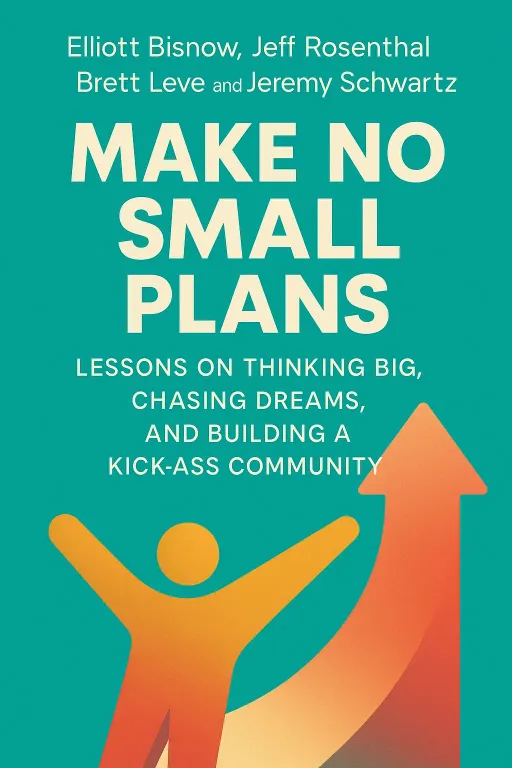
Albert Einstein: Exactly! And that's why we're here. Today, with my brilliant guest hh, a product manager in the demanding world of healthcare, we're exploring the lessons from their book, 'Make No Small Plans,' from two critical angles for any innovator. First, we'll dive into the 'Ready, Fire, Aim' principle—how to create unstoppable momentum from nothing.
hh: And then, I'm really curious to discuss the second part: what happens after you 'fire'. We'll uncover a powerful paradox: how their biggest, most public failures became the secret to building a fiercely loyal community.
Albert Einstein: A perfect roadmap. So, hh, let's start there. The 'crazy idea.' Summit began in the ashes of the 2008 financial crisis. Four friends with no money, no big connections. Their idea? A ski trip for entrepreneurs. But their first attempt was a total, unmitigated failure. Elliott Bisnow, one of the founders, invited twenty people from his network... and every single one said no. What do you think they did wrong?
hh: My first thought is that the value proposition wasn't clear. Or maybe the audience wasn't right. In product development, if your initial outreach gets zero response, it's usually a sign of a mismatch between the problem you think you're solving and what the user actually needs.
Albert Einstein: Precisely! Elliott realized his idea wasn't inspiring enough. It was too small. So he scrapped the list and started over. This is where 'Ready, Fire, Aim' truly begins. He didn't write a 50-page business plan. He made a new, more audacious list of young, successful founders he he knew. And he just... started calling.
Deep Dive into Core Topic 1: The 'Ready, Fire, Aim' Engine of Innovation
SECTION
Albert Einstein: His first target was a guy named Joel Holland, founder of VideoBlocks, who was on a '25 Under 25' list. Elliott called, no answer. He called again. No answer. So he bombarded him with Facebook messages until Joel finally, probably out of sheer exhaustion, agreed to lunch. Elliott pitches his idea: a ski trip in Utah for young founders to connect. And Joel says... no.
hh: Of course. It sounds like a time-share pitch. There's no social proof yet. No one wants to be the first person to a party they're not sure is going to be any good.
Albert Einstein: Exactly! But here's the genius of 'Ready, Fire, Aim.' Elliott didn't give up. He just changed his aim. He asked Joel, "Okay, who else do you know that might be interested?" As Joel started suggesting names, he essentially started selling the idea to himself. By the end of the conversation, Joel was in. Elliott realized in that moment: "If I can get four yeses, I can get twenty." He had his first domino.
hh: That's the classic 'tipping point' for product adoption. You don't need the whole market at first; you need the right. In healthcare tech, getting that first prestigious hospital or a key opinion-leading physician on board is everything. They become your social proof. They validate the vision for everyone else who is risk-averse.
Albert Einstein: And the next dominoes were even more surreal. He targeted the founders of CollegeHumor, Ricky and Josh. Their assistant blocked his calls for days. When he finally got through, Josh thought he was a lunatic but saw a chance for a prank. He told Elliott it was a brilliant idea and gave him Ricky's personal cell number. Ricky, thinking it was a scam, was about to hang up until Elliott made a bold, un-funded promise: "First-class airline tickets to Utah. All-expenses-paid."
hh: Wow. So the incentive wasn't just the trip, it was the sheer audacity of the offer. That's a fascinating insight. The 'first-class tickets' are a perfect metaphor for the incentives you have to create for early adopters. It's not always a discount; sometimes it's exclusive access, a seat at the advisory table, or just making them feel like a co-creator in something new and exciting. You're selling the vision, not just the current, imperfect feature set.
Albert Einstein: And it worked! With the CollegeHumor guys and Joel Holland on board, he called Blake Mycoskie, the founder of TOMS Shoes. When Blake asked who else was going, Elliott could finally rattle off a list of names. That was enough. Blake said yes. He had his momentum. No big plan, no funding, just a series of audacious, persistent, and slightly crazy actions. He was firing, and aiming as he went.
hh: It's messy, but it's how innovation actually happens. You have a hypothesis, you run a small, scrappy experiment, and you learn. His experiment was getting those first few people to say yes. That validated the core idea and gave him the leverage—the 'money'—to go get sponsors.
Albert Einstein: And he did! He raised $30,000 in sponsorships and got The North Face to provide free gear, all by selling this vision that was, at the time, just four guys who had agreed to go skiing. It's a powerful lesson in creating value out of thin air.
Deep Dive into Core Topic 2: Building a Resilient Community Through 'Authentic Failure'
SECTION
Albert Einstein: Exactly! You sell the vision to get momentum. But that momentum can be incredibly fragile. Which brings us to our second, and perhaps more counterintuitive, idea. What happens when you build this incredible hype... and then you spectacularly drop the ball? Summit's reputation was nearly destroyed before it even truly began.
hh: This is the part I'm most interested in. Building something is hard, but rebuilding trust after a failure feels almost impossible, especially in a field like healthcare where trust is the entire currency.
Albert Einstein: Well, prepare yourself. After a couple of successful free events, the founders got overconfident. They decided to host their next event in Aspen at the luxurious St. Regis hotel and, for the first time, charge for it. The price? Three thousand dollars. They sent out an email to their community with a 'Fight Club' theme, full of inside jokes and a smug tone. It said things like, "The first rule of Summit Series is you do not talk about Summit Series."
hh: Oh no. I'm cringing already. That's a classic case of a team falling in love with their own brand and forgetting who their audience is. They're not communicating value; they're communicating exclusivity in an alienating way.
Albert Einstein: It was a catastrophe. The community was furious. One person wrote back, "This is offensive. You traded on our names for your own profit." The email was leaked to the media blog Gawker, which ran a story mocking them as entitled party boys. Ticket sales flatlined. They were on the verge of bankruptcy and, more importantly, their community felt betrayed. The founders were in despair, ready to quit.
hh: This is a powerful lesson in user trust. As an ISFJ, the idea of betraying a community's trust is my worst nightmare. But the story shows that the to failure is what defines the relationship. In product management, when we push a buggy update or a health app has a data breach, the worst thing we can do is hide or get defensive.
Albert Einstein: And that's the turning point. One of the founders, Brett, refused to give up. He said, "Fold this epic business idea with so much potential just so we can go get some puppies? No way." His solution was profound. He said, forget the hundreds of people who hate us. Let's focus on the ten people who actually bought a ticket. Let's call each one, personally. Let's build from them.
hh: That's it. That's the pivot. They went back to their 'first believers.' In product terms, that's your super-user base. When you mess up, you don't issue a blanket corporate apology. You go directly to your most loyal users, you're radically transparent: 'We messed up. Here's why. Here's how we're fixing it. And most importantly, how can we make it right for?' That Aspen failure forced them to define their community not by who was cool, but by who truly believed in the mission.
Albert Einstein: It's the principle of 'Authenticity Trumps Perfection.' Their first ski trip was also a mess—they ran out of beer, the host got pranked—but it worked because it was authentic. The shared, slightly awkward experience created bonds. The Aspen crisis was the same lesson on a much larger, more painful scale. By being vulnerable and rebuilding from a place of service to their core believers, they forged an even stronger, more resilient community. They learned, as Tony Hsieh from Zappos later told them, that "culture steamrolls strategy." They had to build a culture of trust, not just a cool event.
hh: And that culture becomes the product's immune system. A strong community built on trust will forgive a mistake. A transactional user base will leave at the first sign of trouble. That's the difference between building a tool and building a movement.
Synthesis & Takeaways
SECTION
Albert Einstein: What a beautiful way to put it. So, as we look back, we have these two powerful, almost opposing forces. On one hand, the bold, forward-thrust of 'Ready, Fire, Aim' to create something from nothing. On the other, the grounding, trust-building power of authentic failure. It seems true, sustainable innovation lives in the tension between the two.
hh: It really does. You need the audacity to launch, but the humility to listen and adapt when you inevitably get it wrong. The book shows that these aren't separate stages; they're a continuous cycle. You fire, you miss, you learn from the miss, you re-aim, and you fire again, but this time you're a little smarter and your community is a little more invested.
Albert Einstein: A perfect synthesis. So, hh, as we close, what's the one thought or question you'd leave with our listeners, especially those in roles like yours, trying to innovate within established structures?
hh: It makes you think. We all have product ideas, new features, or even just process improvements that we're polishing, waiting for the 'perfect' time to launch. The lesson here seems to be: what if you launched it tomorrow to just ten trusted users or one supportive department? What if you embraced the feedback, even the harsh criticism, as a gift? The book's title is 'Make No Small Plans,' but maybe the secret is to start with small, authentic, and very bold steps.
Albert Einstein: Wonderful. Make no small plans, but take bold, small steps. A brilliant paradox to end on. hh, thank you for your incredible insights today.
hh: This was a real pleasure. Thank you.