The Strategic Scholar: Mastering Focused Learning in Demanding Fields.
Golden Hook & Introduction
SECTION
Nova: Okay, Atlas, quick question for you: What's the one thing almost everyone does every day that they makes them productive, but actually makes them worse at their job?
Atlas: Oh, I like this. My gut says... multitasking? Or maybe checking email every five minutes, like it's some kind of vital organ you have to constantly monitor?
Nova: You nailed it, both times! Multitasking is the big one. It feels like you're doing more, you're juggling all these balls, but you're actually doing less, or at least doing it poorly. It's the illusion of efficiency.
Atlas: That’s a great way to put it. The illusion of efficiency. I mean, who hasn't felt that rush of accomplishment just by having twenty tabs open and switching between them every thirty seconds? It feels busy.
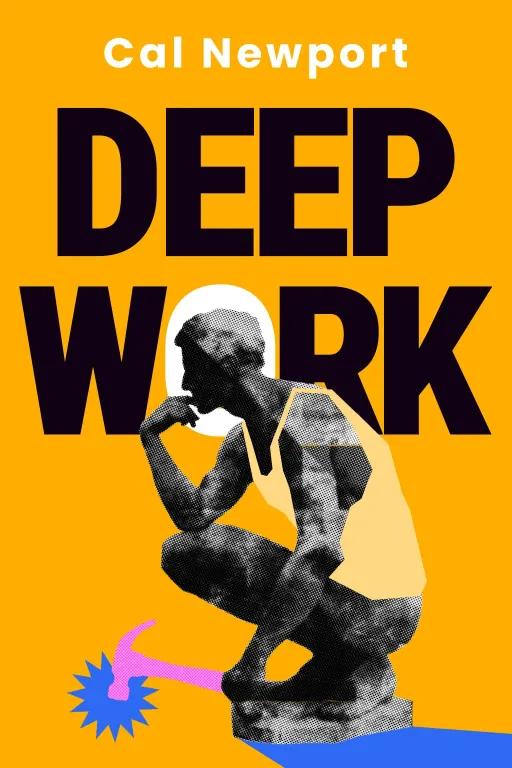
Nova: Exactly. And that's precisely what Cal Newport's groundbreaking book, "Deep Work," and the equally essential "Make It Stick" by Peter C. Brown, Henry L. Roediger III, and Mark A. McDaniel, are here to dismantle. Newport, who's a computer science professor at Georgetown, literally wrote these books while publishing multiple acclaimed academic papers and books. He's living proof of his own methods. And "Make It Stick" isn't just theory; it's the culmination of decades of cognitive science research, directly challenging how we've been taught to learn.
Atlas: So you're saying these aren't just productivity gurus with opinions, these are people who've either walked the walk or compiled the scientific evidence?
Nova: Absolutely. They’re offering a counter-narrative to the always-on, always-connected, superficially engaged world we live in. And for anyone who's trying to master a demanding field – think medicine, complex engineering, or high-stakes problem-solving – this isn't just about getting ahead. It's about fundamental competence.
The Imperative of Deep Work: Why Focus is Your Superpower
SECTION
Nova: So, let's dive into Deep Work. Newport argues that the ability to perform deep work—focused, uninterrupted concentration on a cognitively demanding task—is becoming increasingly rare and incredibly valuable. This isn't just about getting tasks done quicker; it's about reaching the absolute limits of your cognitive abilities to produce new value, to solve truly difficult problems.
Atlas: Oh, I know that feeling. For anyone operating in a high-pressure environment, where there's a constant stream of information, alerts, and demands, the idea of "uninterrupted concentration" sounds like a luxury, almost a fantasy. How does one even begin to carve out that kind of focus when you're already stretched thin?
Nova: That’s where the "attention residue" concept comes in. It’s a fascinating insight. The moment you switch from one task to another, even if it's just a quick check of your phone or an email notification, your attention doesn't immediately snap back to your primary task. A residue of your attention remains stuck on the previous task.
Atlas: Hold on. So if I'm studying a complex medical diagram, and I glance at a text message, even if I don't reply, part of my brain is still thinking about that text?
Nova: Precisely. It's like leaving a tiny bit of your mental energy behind. That residue then hinders your full immersion in the new task. Imagine a medical student trying to memorize intricate anatomical structures. Every time their phone buzzes, or they quickly check social media, they're leaving a little piece of their focus on that distraction. They might like they're back to the anatomy, but their cognitive horsepower is actually diminished.
Atlas: Wow. So it's not just about the time lost, it's about the of the focus being compromised. That's actually really insidious, because it's so subtle. You don't even realize you're doing it.
Nova: Exactly. And the cumulative effect of constantly fragmenting your attention is that you never truly reach that deep, immersive state required for true mastery. You end up with superficial engagement, which, as our core content points out, is a constant threat to absorbing deep knowledge in demanding fields.
Atlas: So what do we do about it? For our listeners who are managing high-pressure situations, where communication is often vital, is "uninterrupted" just an impossible ideal?
Nova: It's about being strategic, not monastic. Newport suggests scheduling deep work blocks. Treat them like important meetings you cannot miss. You'd never schedule two meetings at once, right? So don't schedule a deep work block and then allow yourself to be constantly interruptible. He also talks about creating rituals – specific routines to transition into deep work mode, like a particular coffee, a certain music playlist, or even just clearing your desk.
Atlas: I can see how that would be helpful. A ritual creates a mental boundary. It signals to your brain, "Okay, we're going into serious mode now." But what about the constant pull of the digital world, the need to respond to emails, to be 'available'? It's almost a cultural expectation now.
Nova: That's where embracing boredom comes in. Instead of instantly reaching for your phone whenever there's a lull, just sit with the boredom. Allow your mind to wander, to process. It's like training a muscle. The more you resist immediate gratification and distraction, the stronger your focus muscle becomes. You're teaching your brain to tolerate being alone with its thoughts, which is crucial for deep thinking.
Mastering Learning: Science-Backed Strategies for Retention and Application
SECTION
Nova: And once you've that deep work time, once you've carved out that precious hour or two of uninterrupted focus, you need to make every minute count. That’s where "Make It Stick" comes in, challenging almost everything we thought we knew about effective learning.
Atlas: Oh, I'm ready for this. I still remember cramming for exams in college, pulling all-nighters, re-reading chapters until my eyes blurred. It felt productive, but half the time, the information just evaporated the next day.
Nova: That’s a classic example of what "Make It Stick" calls "illusions of knowing." Re-reading and highlighting create a sense of familiarity, making you like you know the material, but it doesn't actually embed it deeply in your memory or make it accessible for real-world application.
Atlas: So basically, all those hours I spent re-reading textbooks were largely wasted? That’s kind of heartbreaking. What actually works then?
Nova: The book advocates for three key strategies: retrieval practice, spaced repetition, and interleaving. Retrieval practice is simply testing yourself. Instead of re-reading, close the book and try to recall everything you just read. If you can't, look it up. The act of struggling to retrieve information strengthens the memory trace.
Atlas: So you're saying, don't wait until you're ready to be tested, just test yourself constantly, even when you feel unprepared? That sounds counter-intuitive. It feels like you'd just get frustrated.
Nova: That initial struggle is the "desirable difficulty." It feels harder in the moment, but it leads to much stronger, more durable learning. Think of a medical student learning the hundreds of bones and muscles in the human body. Instead of just reviewing flashcards, they actively try to draw the system from memory, then check their drawing against the textbook. Or they use flashcards, but instead of just flipping them, they try to the concept on the back aloud before checking.
Atlas: Okay, I can see that for facts. But what about spaced repetition and interleaving? How do those fit in, especially for someone who needs to master complex procedures or ethical frameworks, not just isolated facts?
Nova: Spaced repetition is reviewing material at increasing intervals over time. Instead of cramming all your anatomy review into one day, you review it briefly today, then in three days, then a week, then a month. This forces your brain to retrieve the information from deeper memory each time, solidifying it. Interleaving is mixing different subjects or types of problems during a single study session.
Atlas: Mixing subjects? So instead of doing all my pharmacology, then all my pathology, I should jump between them in one sitting? That sounds like the opposite of focus! My brain would feel like it's scattering.
Nova: It feels like scattering initially, but it forces your brain to identify the underlying principles and discriminate between different types of problems, rather than just applying a learned formula from the previous problem. For our aspiring healer, imagine them not just learning different diseases one by one, but also mixing in aspects of medical ethics or patient communication scenarios within the same study block. It trains your mind for the complexity of real-world application, where problems don't come neatly categorized.
Atlas: That’s a perfect example. Because in a clinical setting, you're not just diagnosing a disease; you're also considering the patient's context, the ethical implications of treatment, the communication strategy. It’s all intertwined. So these techniques aren't just about memorizing, they're about building a flexible, interconnected web of knowledge.
Synthesis & Takeaways
SECTION
Nova: Exactly. The synergy between deep work and strategic learning is profound. Deep work creates the mental space for focused engagement, and these science-backed techniques ensure that the engagement is maximally effective, building durable, accessible knowledge. It's about optimizing both the quantity and quality of your learning effort.
Atlas: So for someone who's driven, pragmatic, and wants to make a real impact in a demanding field, what's the thing they can do to start applying these ideas today? Something tangible, not just conceptual.
Nova: For your very next study session, commit to 60 minutes of uninterrupted, single-task focus. Turn off all notifications. Put your phone in another room. Close all unnecessary tabs. Just for 60 minutes.
Atlas: And for that 60 minutes, maybe try testing yourself you feel ready. Embrace that initial struggle. Ask yourself a question, try to answer it, and look up the answer.
Nova: Precisely. It's not about working harder, it's about working smarter and with deeper intention. This isn't just about passing an exam; it’s about building the deep, integrated knowledge and resilience required to navigate complex decisions with integrity, to sustain your passion in demanding environments, and ultimately, to influence positive change.
Atlas: That’s actually really inspiring. It frames learning not as a chore, but as a strategic path to truly making a difference.
Nova: Absolutely. Mastery is not an accident; it's the result of deliberate practice and smart, focused effort.
Atlas: This is Aibrary. Congratulations on your growth!