The Learning Loop: How to Master Anything Without Burning Out
Golden Hook & Introduction
SECTION
Nova: What if everything you thought you knew about learning was actually slowing you down? Forget the 10,000-hour rule for a moment, because today we're talking about mastering anything in a fraction of that time.
Atlas: Whoa. Really? I think a lot of our listeners, myself included, have definitely felt that uphill battle of learning something new, especially when it feels like endless hours are just… not sticking. How is this even possible?
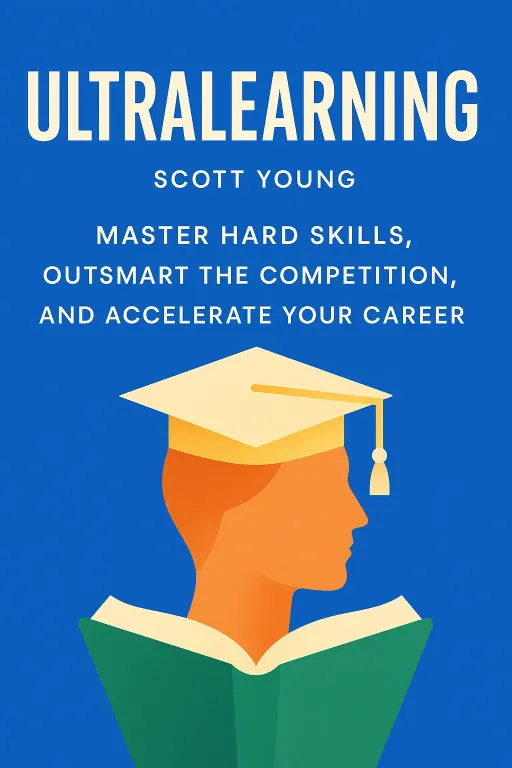
Nova: Well, it might sound counter-intuitive, but it boils down to combining two incredibly powerful, science-backed approaches. We’re diving into the brilliant insights from Scott H. Young’s book, "Ultralearning," and then we’ll pair that with the cognitive science goldmine that is "Make It Stick," by Peter C. Brown, Henry L. Roediger III, and Mark A. McDaniel. These books aren't just theory; they're blueprints for accelerating mastery without the typical burnout.
Atlas: Okay, so we're talking about a smarter way to learn, not just harder? Because the idea of working to learn definitely has my attention. I know our audience, those curious learners always exploring new areas, are tired of the exhaustion.
Nova: Exactly. And Scott H. Young isn’t just talking; he’s proven it. This is a man who famously completed MIT’s entire 4-year computer science curriculum in just 12 months, all on his own. He then went on to learn four new languages in a single year. His work shows that focused intensity can radically compress learning time.
The Power of Focused Intensity: Ultralearning's Direct Approach
SECTION
Atlas: That’s an audacious claim—MIT in a year. For most of us, learning a new hobby feels like a monumental task. What exactly is the core idea behind this "Ultralearning"? Is it just about grinding harder?
Nova: Not at all. It’s about being incredibly deliberate and strategic. Ultralearning isn't just about intensity; it's about intensity and. Young argues that the fastest way to learn something isn't always through textbooks or lectures, but by getting as close to the real thing as possible, right from the start.
Atlas: So you’re saying, if I want to learn to code, I shouldn't just read a book about Python? I should... start building something immediately?
Nova: Precisely. Think about Scott’s language learning. Instead of years of grammar drills, he immersed himself. He chose a target language, like Spanish, and then he spoke it, read it, listened to it, and thought in it, almost exclusively. He built a mental environment around the language, forcing himself into situations where he to use it.
Atlas: That sounds rough, but also incredibly effective. It's like learning to swim by jumping in the deep end, rather than just reading a manual on buoyancy.
Nova: It’s a perfect analogy! The directness forces immediate feedback. You quickly discover what you don't know, and that pinpoint accuracy in identifying gaps is crucial for rapid progress. You’re not wasting time on things you already understand or things that aren’t directly applicable.
Atlas: But wait, for our listeners who are managing high-pressure teams or have demanding jobs, isn't this 'ultralearning' approach a recipe for burnout? You can't just drop everything to learn Spanish for three months.
Nova: That’s a very fair point, and it’s a common misconception. Ultralearning isn't about abandoning your life; it’s about. It requires intense planning upfront to create those focused bursts. It might be a dedicated project on weekends, or a concentrated month-long dive into a skill, rather than a full year. The key is to design your learning environment to maximize direct feedback and minimize distraction, even if it's for shorter, more intense periods. It’s about working smarter, not just longer.
Atlas: So, it's about carving out those periods of intense, direct application, rather than just passively absorbing information over a long time. That makes a lot of sense for someone who wants to move quickly to mastery.
Mastering Retention: The Science of 'Make It Stick'
SECTION
Nova: And that naturally leads us to the second key idea we need to talk about, which often acts as a critical counterpoint to simply being intense: how do you ensure that intense learning? Because if you learn something quickly but forget it just as fast, what's the point?
Atlas: Exactly! I mean, I’ve been there. I’ll read a fascinating book, feel like I understand it completely, and then a week later, I can barely recall the main points. It’s incredibly frustrating. I re-read my notes so many times, and it just… disappears.
Nova: Well, that’s because re-reading, highlighting, or passively listening creates what the authors of "Make It Stick" call an "illusion of knowing." It feels familiar, so your brain tricks you into thinking you it. But familiarity isn't recall. The book emphasizes retrieval practice and spaced repetition as the true powerhouses for deep, lasting retention.
Atlas: Retrieval practice? What exactly do you mean by that? Is it just quizzing yourself?
Nova: It’s more than just quizzing yourself, it’s about. Every time you try to retrieve a piece of information from your memory, you’re not just accessing it; you’re actually strengthening the neural pathways associated with that memory. The harder you have to work to pull it out, the stronger the memory trace becomes. It’s like a muscle: the more you challenge it, the stronger it gets.
Atlas: So, the struggle is actually part of the point? That’s kind of counter-intuitive. I always thought if it was hard to remember, it meant I hadn't learned it well enough.
Nova: Absolutely! That "desirable difficulty" is precisely what makes it effective. Instead of just passively reviewing notes, try to explain a concept aloud without looking at your notes. Or, after reading a chapter, close the book and write down everything you remember. You’ll immediately see the gaps, which tells you exactly what to focus on.
Atlas: Oh, I like that. Explaining it aloud to an imaginary student. That really forces you to articulate and connect the ideas. That's a great practical application.
Nova: And pair that with. Don't just cram. Review material at increasing intervals over time. So, if you learn something today, review it tomorrow, then in three days, then a week, then a month. Just as you’re about to forget it, you retrieve it again, cementing it deeper into your long-term memory.
Atlas: That makes me wonder, how does this apply to learning complex skills, not just facts? Like, if I'm learning a new software, how do I "retrieve practice" that?
Nova: Excellent question. For skills, retrieval practice looks like deliberately trying to perform a complex task from memory. For software, it might be: "Can I build this specific feature without looking at the documentation?" Or, for a creative skill, trying to recreate a style or technique from memory. It’s actively testing your ability to rather than just. It’s about building a robust, accessible knowledge base that you can pull from effortlessly when you need it most.
Synthesis & Takeaways
SECTION
Nova: So, when you combine these two powerful ideas—the intense, direct practice of Ultralearning with the effortful retrieval and spaced repetition of Make It Stick—you create a learning loop that is incredibly efficient and resilient. You’re not just learning fast; you’re learning deep.
Atlas: That’s actually really inspiring. For anyone who feels like they’re constantly learning new things but not retaining them, this offers a tangible path to real mastery. It’s about being intentional with both the input and the retrieval.
Nova: Exactly. My take is that by strategically combining focused intensity with smart retrieval strategies, you can master complex topics faster and with deeper retention. It's about optimizing your brain's natural learning mechanisms.
Atlas: So, if our curious listeners had to pick just one "tiny step" to start with from everything we’ve discussed today, what would be the most impactful thing they could do right now?
Nova: It’s the one we just touched on, and it comes directly from these principles: pick one new concept you’re learning today—anything at all—and try to explain it aloud to an imaginary student for five minutes, without looking at notes.
Atlas: That’s brilliant. It forces retrieval, highlights gaps, and solidifies understanding, all in one quick, active step. No excuses, everyone. Just five minutes!
Nova: It’s a powerful way to immediately apply what we’ve discussed and start building those stronger neural connections. You'll be amazed at how quickly you identify what you truly understand and what needs a little more work.
Atlas: Honestly, that sounds like my Monday mornings, trying to explain my weekend projects to my cat. But seriously, this is such a practical, actionable insight. It’s not just about learning more, it’s about learning smarter to avoid that burnout we all dread.
Nova: Absolutely. And that’s the true power of these approaches: achieving mastery without feeling like you’re constantly running on empty.
Atlas: This is Aibrary. Congratulations on your growth!