Rethinking Learning: How to Master Complex Skills Faster and More Effectively
Golden Hook & Introduction
SECTION
Nova: Alright Atlas, quick game. I say 'learning,' you give me the first five words that come to mind.
Atlas: Oh, I love this! Textbooks, lectures, forgetting, cramming, and… honestly, dread.
Nova: Dread! That’s actually a perfect encapsulation for so many, isn't it? What if I told you most of what we think about learning, all those traditional methods we grew up with, are actually holding us back from true mastery?
Atlas: That definitely resonates! I imagine a lot of our listeners, especially those in high-stakes fields trying to stay ahead, feel that constant pressure to learn, but often hit a wall. It sounds almost liberating to think our struggles might not be our fault, but the fault.
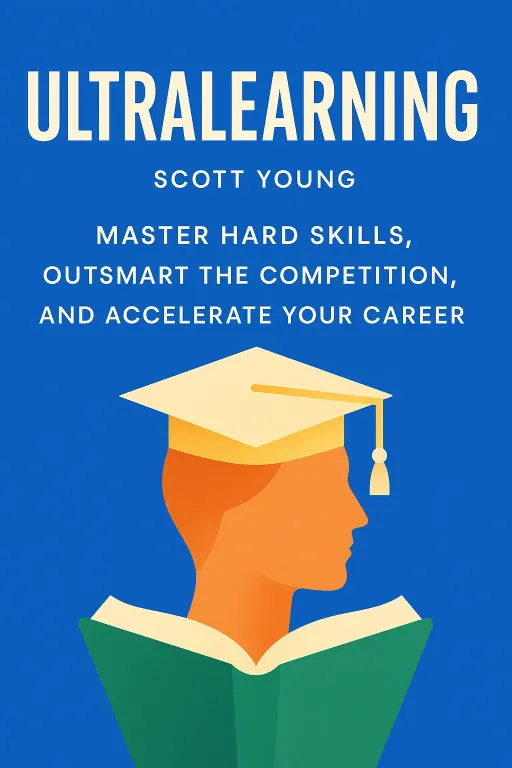
Nova: Exactly! And that's what we're dissecting today, pulling insights from two phenomenal books that fundamentally reshape our understanding of how we acquire and retain knowledge: "Ultralearning" by Scott H. Young, and "Make It Stick" by Peter C. Brown, Henry L. Roediger III, and Mark A. McDaniel. What’s truly fascinating about 'Ultralearning' is that Scott Young himself isn't an academic; he's a self-taught polymath who famously learned the MIT computer science curriculum in a year, and then mastered four languages in another year—all without attending university classes. He truly lives what he preaches.
Atlas: Wow, that’s actually really inspiring. To hear someone not just theorize but such a daunting learning challenge… it certainly makes you sit up and pay attention.
Nova: Absolutely. Today we'll dive deep into this from three perspectives. First, we'll challenge the conventional wisdom around learning; then, we'll discuss the powerful principles of ultralearning for rapid skill acquisition; and finally, we'll focus on the science of making knowledge truly stick.
The Ineffectiveness of Passive Learning
SECTION
Atlas: So, if these traditional methods are so ingrained, why do they persist if they’re so inefficient? It’s like we’re stuck in a learning loop that just isn't serving us.
Nova: Well, the answer lies in a powerful psychological phenomenon, what the authors of "Make It Stick" call the 'illusion of fluency.' Picture this: a student, let's call her Sarah, is preparing for a big exam. She spends hours re-reading her notes, highlighting key passages, feeling a growing sense of familiarity and confidence. She feels productive, like she's absorbing everything.
Atlas: Oh, I know that feeling! That comfortable sensation of 'I've got this,' only to get to the test and realize… I actually don’t. It’s like her brain is saying, "Yep, seen this before," but not "Yep, this."
Nova: Precisely. Sarah is experiencing fluency with the text, but not mastery of the material. Her brain recognizes the words and concepts, but she hasn't actually them deeply enough to retrieve them under pressure or apply them in new contexts. It’s a very common trap.
Atlas: But wait, looking at this from a high-stakes professional perspective, isn't that what we're to do? Just consume more information? Read all the reports, attend all the webinars. We’re often rewarded for the of information we process, not necessarily the of understanding.
Nova: That’s a sharp observation, and it highlights why this illusion is so insidious. It like learning, which is why it persists in both academic and professional settings. We equate effort with outcome, but it’s not always true. The real story here is that our brains are incredibly efficient at forgetting what they deem unimportant, and passive re-reading often signals 'unimportant' because it doesn't require active mental effort. It’s a bit like watching someone else work out; you see the movements, but you don't build any muscle yourself.
Ultralearning: Principles for Rapid Skill Acquisition
SECTION
Nova: So if passive consumption isn't the answer, what? This is where Scott Young's "Ultralearning" really shines, offering a radical alternative that flips conventional learning on its head. He outlines nine principles, but two incredibly powerful ones are 'Directness' and 'Immersion.'
Atlas: Okay, so you’re saying we need to get out of the metaphorical library and into the real world? What exactly do you mean by 'directness'? For someone trying to master complex business strategies, how does that translate beyond just 'doing'?
Nova: That’s a perfect question, Atlas, because it's not just about 'doing,' but about doing. Directness means learning in contexts as close to the real application of the skill as possible. Scott Young’s own MIT Challenge is a prime example. He didn't just read textbooks on computer science; he did the from the MIT curriculum. He bypassed lectures and traditional study by directly engaging with the output of that learning.
Atlas: So, for our strategist, it could mean running simulations, analyzing real case studies, or even building a mock business plan for a client, rather than just reading theoretical frameworks?
Nova: Exactly! It’s about minimizing the transfer gap between what you learn and where you apply it. And then you layer on 'Immersion.' This isn't just about spending a lot of time; it’s about, minimizing distractions, and maximizing exposure to the target skill. Think about someone learning a language by moving to a foreign country. They’re immersed. Scott Young did this with his accelerated language projects, committing to only speaking the target language for extended periods. It's intense, yes, but the results are astonishing.
Atlas: That sounds rough, but incredibly effective. It’s like creating a pressure cooker environment for your brain, forcing it to adapt and learn at an accelerated pace. I imagine it cuts through a lot of the fluff that traditional learning environments often have.
Nova: It absolutely does. It’s about being deliberate and aggressive with your learning, identifying the core components of a skill, and then directly practicing them, often with very little hand-holding. It’s a mindset shift from 'I'll learn it when I need it' to 'I'm going to my learning environment to force mastery.'
Making Learning Stick: Science-Backed Retention Strategies
SECTION
Atlas: Okay, so we can learn fast using these ultralearning principles, but what about making sure it actually learned? Because for lasting impact and making those lasting contributions, retention is absolutely key.
Nova: Absolutely, Atlas, and this is where "Make It Stick" provides the crucial scientific underpinning. They introduce two incredibly powerful, yet often overlooked, strategies: 'Retrieval Practice' and 'Interleaving.' Retrieval practice isn’t about testing yourself as a measurement; it’s about testing yourself as a.
Atlas: So you’re saying we should deliberately try to recall information looking it up, even if it feels difficult? That sounds almost counter-intuitive. We're taught to focus on one thing at a time, to make learning as smooth as possible. Are you saying we should deliberately make our learning?
Nova: That's the beautiful paradox! It’s about introducing what they call 'desirable difficulties.' When you struggle to retrieve a piece of information, and then successfully recall it, that effort strengthens the neural pathways in your brain, making that memory far more durable than if you had simply re-read it. It's like a muscle: the harder you work it, the stronger it gets. And the same goes for 'Interleaving.'
Atlas: Interleaving? That makes me wonder… is that about mixing things up?
Nova: Exactly! Instead of practicing one skill or concept repeatedly until you master it, then moving on to the next, interleaving means mixing up different types of problems or concepts during your practice sessions. For example, if you're learning different types of math problems, instead of doing 20 of type A, then 20 of type B, you'd mix them: A, B, C, A, B, C.
Atlas: That’s a bit like a musician practicing different pieces in one session rather than just drilling one song for hours. Or an athlete mixing different drills in training. It forces your brain to constantly differentiate and choose the right strategy.
Nova: Precisely. It builds flexibility and a deeper understanding of when to apply what knowledge. Both retrieval practice and interleaving feel slower, even harder, in the moment, but the research is overwhelmingly clear: they lead to dramatically better long-term retention and transfer of knowledge. It's about effective difficulty, not just any difficulty, leading to more durable learning. This is how you build knowledge that doesn't just pass a test, but truly becomes part of your cognitive toolkit.
Synthesis & Takeaways
SECTION
Nova: So, what emerges from these profound insights is a clear message: true mastery, whether it’s a new language, a complex skill, or an entire field of knowledge, isn't about innate intelligence or simply putting in more hours. It’s about strategy. It's about active engagement, direct application, and deliberate recall. These aren't just study tips; these are fundamental shifts in how we approach growth and skill development, leading to profound personal and professional transformation.
Atlas: I love that. It reframes learning from a passive chore into an active, strategic pursuit. For anyone listening who feels like they’re constantly learning but not truly, this is a game-changer. It means we don't have to accept mediocrity in our learning journey.
Nova: Not at all. In fact, research on retrieval practice alone suggests it can reduce the time needed to learn and retain information by 50% or more compared to passive methods. It's about working smarter, not just harder.
Atlas: That’s actually really inspiring. It empowers us to take control of our learning. So, for our listeners who are ready to embrace these ideas, what's a tiny step they can take today?
Nova: My recommendation, directly inspired by these books, is this: choose a small skill you want to learn or improve. It could be anything from a new software feature to a cooking technique. Then, apply just ultralearning principle, like direct practice, for thirty minutes today. Don't just read about it; it.
Atlas: That's a perfect, actionable challenge. Start small, but start with intent. That’s how lasting contributions are made, one deliberate step at a time.
Nova: Absolutely. It’s about building those durable learning habits.
Atlas: Fantastic. Thank you, Nova, for shedding light on these incredible insights.
Nova: My pleasure, Atlas.
Atlas: This is Aibrary. Congratulations on your growth!
Nova: Congratulations on your growth!