Mastering Your Mind: The Cognitive Science of Learning
Golden Hook & Introduction
SECTION
Nova: What if I told you that the way you've been taught to study your entire life, the way you highlight textbooks and re-read notes, is actually one of the effective ways to learn anything for the long term?
Atlas: Whoa, that's a bold claim, Nova! I feel like I've been doing that since elementary school. Are you saying everything I thought I knew about learning is wrong?
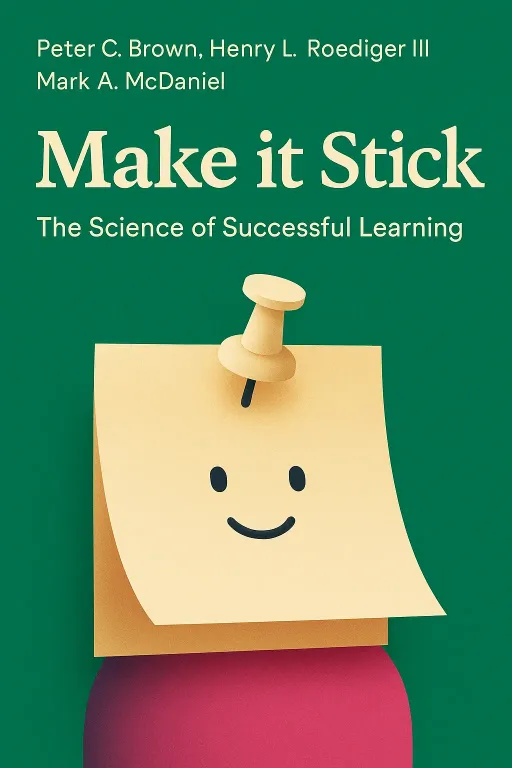
Nova: Not entirely wrong, Atlas, but definitely suboptimal for true mastery. We're talking about going beyond surface-level familiarity to deep, lasting understanding. And today, we're diving into the cognitive science behind that with two foundational texts. First up, the incredibly insightful "Make It Stick" by Peter C. Brown, Henry L. Roediger III, and Mark A. McDaniel.
Atlas: Ah, the book that basically tells us to rethink how we learn. I know it's based on decades of rigorous research from places like Roediger's lab at Washington University, which makes it incredibly credible. For anyone, like me, who craves understanding and wants to truly master complex subjects, this sounds like an essential guide.
Nova: Absolutely. And what's fascinating is how these authors, a cognitive psychologist, an experimental psychologist, and a science writer, brought together such robust, evidence-based strategies. This isn't just theory; it's practically a user manual for your brain.
Atlas: Okay, so if highlighting and re-reading aren't the answer, what is? I’m imagining a lot of our listeners, especially those trying to build knowledge systematically, are thinking, "Where do I even start?"
The Counter-Intuitive Truth of Effective Learning
SECTION
Nova: Well, it starts with something they call "desirable difficulties." The core idea is that learning often feels harder when it's actually more effective. It's counter-intuitive because our brains prefer the path of least resistance, right?
Atlas: That makes sense. I can definitely relate to picking the "easy" study method, even if I suspect it's not the best. So, struggling is good? How does that work?
Nova: Exactly! One of the most powerful desirable difficulties is called "retrieval practice." It's essentially self-testing. Instead of just re-reading a chapter, you close the book and actively try to recall what you just read.
Atlas: So, after reading a chapter, just close the book and try to remember? That’s going to resonate with anyone who struggles with retention after finishing a lengthy text.
Nova: Precisely. And the magic happens in that moment of struggle, that effort to pull the information out of your memory. That act of retrieval strengthens the memory traces, making them more accessible next time. It’s like exercising a muscle – the more you work it, the stronger it gets.
Atlas: I’m curious, have they done studies on this? Because it sounds so simple, it almost feels too good to be true.
Nova: They have, extensively! One classic experiment involved students studying passages. One group re-read the material multiple times. Another group studied it once and then was tested repeatedly. The re-reading group more confident immediately after, but in the long run, the group that was tested frequently retained significantly more. The feeling of fluency from re-reading can be deceptive; it tricks your System 1 into thinking you know the material when you often don't.
Atlas: That’s a powerful distinction. So, that comfortable feeling of "Oh, I remember this" while re-reading is actually a trap?
Nova: Often, yes. It's familiarity, not true recall. Another powerful strategy is "interleaving," which means mixing up different topics or problem types during study instead of massed practice, or "cramming" one topic until you feel you've mastered it.
Atlas: Oh man, that's a tough one. My default has always been to master one thing completely before moving to the next. But I can see how mixing it up might force your brain to discriminate between concepts.
Nova: And then there's "elaboration." That’s about explaining new information in your own words, connecting it to what you already know, or finding new examples. It forces you to process the information more deeply, rather than just passively absorbing it.
Atlas: That makes sense. It's like you're building a network of understanding, rather than just isolated facts. I imagine that takes a lot more conscious effort, though. It definitely sounds like a System 2 activity, which leads me to my next question...
Navigating Your Two Minds: System 1 and System 2
SECTION
Nova: Excellent segue, Atlas! This idea of how our brains about learning, versus what's actually effective, leads us directly to another foundational text that unpacks the very operating system of our minds. We're talking about Daniel Kahneman's Nobel Prize-winning masterpiece, "Thinking, Fast and Slow."
Atlas: What a book! Kahneman's work, alongside Amos Tversky, fundamentally changed how we understand human judgment and decision-making. It’s like getting the secret internal manual for how our minds actually work. I’m excited to dive into this because understanding our brains do what they do is crucial for growth.
Nova: It truly is. Kahneman introduces us to two distinct systems of thought: System 1 and System 2. Think of System 1 as your fast, intuitive, emotional, and automatic mind. It's what allows you to recognize a face, understand a simple sentence, or answer "2+2." It operates effortlessly and constantly.
Atlas: So, like when I instantly know a joke is funny, or I feel a sudden urge to get a snack. That's System 1?
Nova: Exactly. It's gut reactions, habits, and quick judgments. It's incredibly efficient but also prone to biases and shortcuts. For example, that feeling of confidence you get from re-reading notes, making you think you've learned something when you haven't truly stored it deeply – that's System 1 at play, creating an "illusion of knowing."
Atlas: Wow. So, System 1 can actually deceive us into thinking we're learning when we're not. That's a powerful insight for anyone trying to systematically build knowledge.
Nova: It is. Now, System 2 is your slow, deliberate, logical, and effortful mind. This is what you engage when you're solving a complex math problem, learning a new language, or carefully parking your car in a tight spot. It requires attention and concentration.
Atlas: I'm curious, so learning effectively, like retrieval practice or interleaving, that's a System 2 activity, right? Because it takes effort, it feels hard.
Nova: Precisely, Atlas. Those "desirable difficulties" we talked about with "Make It Stick" are designed to System 2 engagement. System 1 wants to take the easy route – re-reading, highlighting – because it conserves mental energy. But true, deep learning, the kind that leads to mastery, demands the focused, deliberate work of System 2.
Atlas: So, the struggle isn't just good; it's a sign that System 2 is engaged and actually building those robust memory networks. That's a huge reframing.
Nova: And Kahneman shows us how often System 1 makes quick judgments, sometimes leading to cognitive biases like confirmation bias, where we only seek out information that confirms what we already believe. To overcome that, to critically analyze information and truly learn, we need System 2 to step in and override those automatic impulses.
Atlas: So, for our aspiring scholars and insight seekers, it’s about consciously choosing to activate System 2, even when System 1 is screaming for comfort and ease. That's a powerful takeaway for anyone trying to dissect ideas and build knowledge. How can we actively engage System 2 more, especially when facing really complex subjects?
Synthesis & Takeaways
SECTION
Nova: It all comes back to intentionality. Understanding Kahneman's two systems gives us the 'why' – why effective learning feels hard, why we sometimes fall for illusions of knowing. And "Make It Stick" gives us the 'how' – the specific strategies like retrieval practice, interleaving, and elaboration that are essentially System 2 workouts.
Atlas: So, the synthesis is clear: to truly master complex subjects, we need to understand our cognitive architecture and then apply strategies that intentionally engage our deliberate, effortful System 2, rather than just coasting on the intuitive System 1.
Nova: Exactly. It means trusting the process, even when it feels uncomfortable. That "Tiny Step" we mentioned earlier, after reading a chapter, closing the book and trying to recall as much as you can without looking, and then connecting new information to what you already know – that’s a perfect microcosm of engaging both systems for powerful learning.
Atlas: That's incredibly actionable. For anyone listening, that's a concrete step you can take today to immediately improve your learning. Just close the book and recall. Don't re-read first.
Nova: And as you reflect on this, consider this: how might understanding the interplay between your fast, intuitive mind and your slow, deliberate mind change how you approach not just learning, but challenging situation in your life? It's about taking control of your own cognitive processes.
Atlas: That’s a profound question, Nova. It really puts the power back into the learner’s hands.
Nova: This is Aibrary. Congratulations on your growth!