How to Think, Not Just Read: The Guide to Deep Learning.
Golden Hook & Introduction
SECTION
Nova: Okay, Atlas, quick word association. I say "reading," you say...?
Atlas: Oh man, "pile," "guilt," and honestly, "did I actually absorb any of that?"
Nova: Exactly! That last one, in particular, resonates with so many of us. We spend hours with books, articles, online courses, expecting the knowledge to magically adhere to our brains, only to find ourselves staring blankly when we actually need to recall it.
Atlas: Right? It’s like, I put in the time, I highlighted all the important bits, I even folded a few page corners. Why isn’t it sticking? Why do I feel like I'm just decorating my brain with facts instead of actually building something?
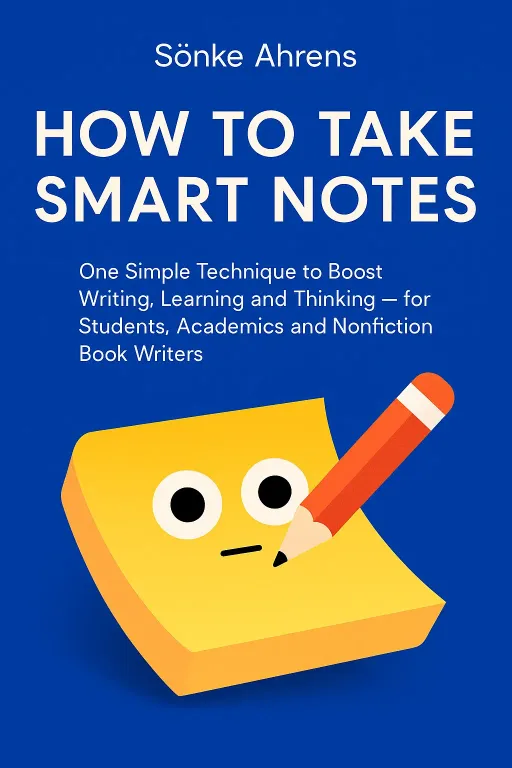
Nova: Well, that's precisely the "cold fact" we're dissecting today, and it's the core message woven through incredible insights from works like "How to Take Smart Notes" by Sönke Ahrens and the game-changing "Make It Stick" by Peter C. Brown, Henry L. Roediger III, and Mark A. McDaniel. These aren't just random books; they're foundational texts in understanding how our brains truly work, offering tactical insights from cognitive science itself. The overarching theme is simple, yet profoundly overlooked: reading is not learning if you don't actively engage.
Atlas: Oh, I've been there. I totally know that feeling of finishing a dense chapter and thinking, "Okay, I read it. Now what?" So, what's the big secret? Why do we so often fall into this trap of passive consumption?
Nova: It’s because our brains are designed for efficiency, not necessarily for deep, long-term retention of every single piece of information. Passive reading feels easy, so our brains don't flag it as something important enough to commit to long-term memory. It's like browsing a grocery store versus actually cooking a meal. One requires observation, the other active transformation.
From Passive Consumption to Active Engagement: The Zettelkasten Method
SECTION
Nova: And that brings us perfectly to our first tactical insight, a method that transforms reading into active thinking: the Zettelkasten method, popularized by Sönke Ahrens. Imagine a single person, Niklas Luhmann, who wrote over 70 books and hundreds of articles, all from a simple box of index cards.
Atlas: Wait, a box of index cards? In the age of digital everything, we’re talking about index cards? That sounds a bit out there, honestly. Isn't that just more work? More manual labor on top of reading?
Nova: That's the common misconception, Atlas. It’s not about the physical cards; it’s about the. Luhmann’s Zettelkasten wasn't just a collection of notes; it was a 'second brain,' a dynamic network of interconnected thoughts. You don't just summarize what you read; you extract atomic ideas, write them in your own words, and then – this is the crucial part – you link them to other related ideas you've already captured.
Atlas: So basically you’re saying, instead of just highlighting a passage in a book, I take that idea, rephrase it, and then explicitly connect it to something else I've learned, building a web of knowledge?
Nova: Exactly! Instead of isolated facts, you're building a conversation between your notes. Let’s say you read something about the psychology of habit formation. You write down that core idea on a note. Then, a few weeks later, you read an article about how marketing campaigns leverage human psychology. You write that down, and then you link it to your habit formation note, perhaps noting the synergy or contrast. Suddenly, you're not just remembering two separate facts; you're seeing how they interact, how they create a larger understanding.
Atlas: That makes me wonder, how is that different from just, you know, writing notes in the margins or keeping a journal? I mean, I do that sometimes.
Nova: The key difference is the and the of the notes. Margin notes are tied to a specific book. Journal entries are often chronological. Zettelkasten notes are independent, self-contained ideas that can be linked in multiple ways, across different sources and topics. It forces you to process the information, to understand it well enough to explain it in your own words, and then to actively think about where it fits into your existing knowledge structure. It’s like building with LEGO bricks instead of just organizing a pile of books. Each brick is a complete idea, and you can connect them in infinite ways to build new structures of thought.
Atlas: That’s actually really inspiring. For someone who wants to move beyond just consuming information to actually new insights, this sounds like a powerful tool. It’s not just about storage; it’s about synthesis.
Making Knowledge Stick: The Science of Retrieval Practice and Spaced Repetition
SECTION
Atlas: But wait, even with the best note-taking system, isn't there still the challenge of making that knowledge truly? I've definitely organized notes beautifully only to forget what half of them mean a month later.
Nova: Absolutely, and that leads us to our second profound insight from "Make It Stick"—the counter-intuitive truth about how our brains truly build lasting memory. The authors explain that the very things we often think are helping us learn, like passive re-reading, are actually hindering us.
Atlas: Come on… so all those times I've reread my lecture notes until I practically memorized them, that was a waste of time? That feels like such a common, ingrained study habit.
Nova: It's not entirely a waste, but it creates an "illusion of knowing." When you re-read, the material feels familiar, which tricks your brain into thinking you it. But familiarity isn't recall. The real power comes from what they call "desirable difficulties"—practices that feel harder in the moment but dramatically improve long-term retention.
Atlas: Okay, but what does "desirable difficulties" actually mean? Like, I should just make learning harder for myself? That sounds rough, but what if I’m already struggling?
Nova: No, it's about making it and in the right ways. The two big ones are active recall and spaced repetition. Active recall means retrieving information from memory without looking at your notes. For example, after reading a chapter, close the book and try to explain the main points aloud, or write them down from memory. It’s like a mini-test you give yourself.
Atlas: So you’re saying, instead of re-reading the chapter ten times, I should read it once, then try to remember what I just read, even if it's hard?
Nova: Precisely. That struggle, that effort to retrieve, is what strengthens the neural pathways in your brain. It’s like a muscle; you don’t build it by passively looking at it, but by actively engaging it. Spaced repetition builds on this: don't try to recall immediately after learning. Instead, space out your retrieval practice over increasing intervals. Review it tomorrow, then in three days, then a week, then a month.
Atlas: That makes sense, but how do you actually do that in real life without it feeling like a massive, tedious scheduling project? Can you give an example?
Nova: Think about our "Tiny Step" from the initial content: "After your next reading session, try to explain the core idea aloud to an imaginary friend without looking at your notes." That's pure active recall. Or, after learning a new concept, try to teach it to someone else—or even just to your dog! The act of explaining forces your brain to retrieve, organize, and articulate the information, revealing gaps in your understanding. That immediate feedback is invaluable. And for spaced repetition, simply set a reminder to briefly revisit a key concept you learned last week.
Atlas: That’s a perfect example. I can see how that would be much more effective than just passively highlighting. It’s about challenging your brain to retrieve and connect, not just absorb. It’s quite literally making it stick.
Synthesis & Takeaways
SECTION
Nova: So, bringing these two powerful ideas together, we see a clear path to true learning. The Zettelkasten method helps you a rich, interconnected network of ideas, ensuring that every new piece of information finds its place and sparks new connections.
Atlas: And then, the principles of active recall and spaced repetition from "Make It Stick" ensure that those connections don't just exist on paper or in a digital file, but are deeply etched into your brain, ready for application when you need them. It's about transforming shallow understanding into profound insight.
Nova: Exactly. The goal isn't just to remember facts, but to build a mental latticework, a dynamic ecosystem of knowledge that allows for creative problem-solving, deeper understanding, and genuine innovation. You're not just filling your mental library; you're actively cross-referencing, debating, and generating new ideas from within it.
Atlas: That's actually really profound. It means that the effort isn't just about passing a test or finishing a book; it's about literally rewiring your brain to be a better thinker, a more effective learner, and a more creative problem-solver. It's about empowering your own cognitive growth.
Nova: And it starts small. Our "Tiny Step" for you this week is incredibly simple, but incredibly powerful: after your next reading session, try to explain the core idea aloud to an imaginary friend without looking at your notes. Just five minutes of that active retrieval can make a world of difference.
Atlas: I love that. It’s actionable, it’s immediate, and it leverages everything we just talked about. We invite all our listeners to give that "Tiny Step" a try this week. Let us know how it goes or share your own active learning strategies. We'd love to hear how you're making your knowledge stick!
Nova: This is Aibrary. Congratulations on your growth!