Crafting Your Message: Impactful Words & Clear Writing
Golden Hook & Introduction
SECTION
Nova: You think you're choosing your words, but what if your words are actually choosing? Or, more accurately, choosing your? Turns out, a single, tiny word can be the difference between a 'yes' and a 'no', a sale and a scroll past, or even trust and skepticism. We're talking about the invisible strings of language.
Atlas: Whoa. Invisible strings? That sounds a bit out there, but I'm intrigued. Honestly, I've sent emails where I felt like I was talking to a wall, and then others that just... landed. I always wondered what the secret sauce was.
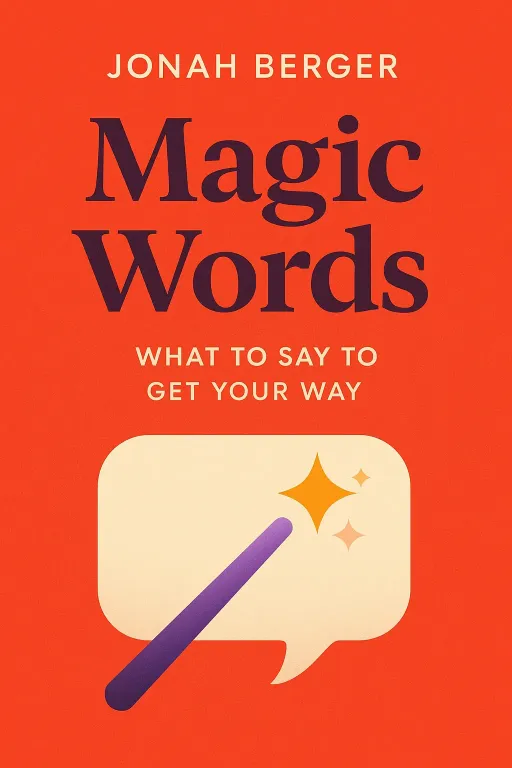
Nova: Well, today, Atlas, we're diving into that secret sauce with two incredible books that, when combined, offer a communication superpower. First, we have by Jonah Berger, a brilliant marketing professor from Wharton. He’s renowned for dissecting the hidden forces that shape our everyday decisions, making complex social science incredibly accessible.
Atlas: Okay, so sounds like the secret decoder ring for influence. But what’s the other half of this power duo? Because getting people to listen is one thing; getting them to quickly is another challenge entirely.
Nova: Exactly! And that’s where by Todd Rogers, PhD, and Jessica Lasky-Fink, PhD, comes in. They come from a background in behavioral science and public policy, focusing on practical, evidence-based communication strategies. So, while Berger shows you the subtle power within individual words, Rogers and Lasky-Fink teach you how to structure those words so they actually get read and understood efficiently in our attention-scarce world.
Atlas: Ah, I see. So it's not just about having powerful words, but also making sure those powerful words don't get lost in the noise. For our listeners who are constantly trying to cut through the information deluge, whether in a pitch, an email, or a presentation, this feels incredibly relevant.
Nova: Absolutely. Today we'll explore how to make your words not just heard, but deeply felt and efficiently understood, transforming your communication from average to magnetic. We’ll dive into the subtle power of "magic words" to influence and persuade, then discuss the critical importance of clarity and brevity, and finally, connect how mastering both can elevate your entire communication game.
The Invisible Power of "Magic Words"
SECTION
Nova: Let’s start with Jonah Berger’s. Berger isn't talking about spells or incantations here. He’s talking about specific, often overlooked, linguistic choices that tap directly into fundamental human psychology. These aren't just buzzwords; they're psychological levers.
Atlas: Psychological levers. That’s a great way to put it. Can you give me an example of one of these "magic words" and how it works? Because I'm picturing someone just sprinkling "abracadabra" into their emails.
Nova: Not quite! Think about the word "because." It’s incredibly powerful. There’s a famous psychology experiment where researchers tried to cut in line at a photocopier. When they said, "Excuse me, I have five pages. May I use the Xerox machine?" compliance was around 60%.
Atlas: Okay, standard politeness.
Nova: Right. But when they added "Excuse me, I have five pages. May I use the Xerox machine?" compliance shot up to 94%. The reason provided justification, triggering a psychological need for understanding.
Atlas: That’s fascinating. So, just adding a reason, even a simple one, makes a huge difference. What’s even more interesting is that it wasn't even a particularly reason. "I'm in a hurry" could apply to anyone in line.
Nova: Exactly! What’s truly magic is that even when they used a less compelling reason – "Excuse me, I have five pages. May I use the Xerox machine?" – compliance was still around 93%. The of the word "because" and the implied justification was often enough, regardless of the quality of the reason. It taps into our human need for logic and explanation.
Atlas: So, for our listeners, whether they're trying to get a report approved or just convince their kids to clean their room, simply providing a "because" can significantly increase their chances? That's a game-changer for anyone trying to persuade. It’s not manipulation; it’s understanding how brains work.
Nova: Precisely. It’s about leveraging these deep-seated psychological triggers. Another powerful category is words of "agency" or "control." Think about the difference between saying, "You can choose to participate" versus "You have the opportunity to participate."
Atlas: Oh, I like that. "You can choose" feels like there's an option to say no, which, of course, there is. But "you have the opportunity" frames it as something valuable, something to be seized. It's subtle, but it shifts the power dynamic.
Nova: It absolutely does. "Opportunity" suggests a benefit, something to gain, and appeals to our desire for growth and advantage. Words like "imagine" are also incredibly potent. They don't just convey information; they invite the listener to it mentally. If I say, "Imagine a world where your emails are always read," it's far more engaging than "Your emails will be read."
Atlas: That makes me wonder, if you're trying to connect with someone, say, a new client or a potential collaborator, what kinds of "magic words" foster trust and connection? Because building rapport is often the first hurdle.
Nova: Great question. Words that create "social proof" or "belonging" are excellent here. Words like "together," "we," "our team," "join us." These words tap into our innate desire for connection and community. If you're pitching a new idea, instead of saying, "Here's my idea," you might say, "Here's opportunity to innovate." It makes the listener part of the solution, not just an audience.
Atlas: So, it's about shifting from an "I" or "me" perspective to a "we" or "us" perspective, drawing them into the circle. That's actually really inspiring, especially for people who feel overwhelmed by options and want to make impactful choices. It empowers them to influence their environment.
Nova: It truly does. Berger’s work shows us that every word carries weight, an invisible psychological charge. Understanding these charges allows us to craft messages that resonate more deeply, fostering trust, driving action, and ultimately, getting our way, ethically, by aligning with human nature.
Communicating with Clarity in a Noisy World
SECTION
Nova: But what good are magic words if no one bothers to read them? This brings us to the crucial complement: clarity and brevity, championed by Todd Rogers and Jessica Lasky-Fink in. They operate on a fundamental truth: busy readers don't read; they skim.
Atlas: That's a painful truth for anyone who's spent hours crafting a perfectly detailed report. I totally know that feeling of putting so much effort into something, only for it to be glanced over. So, what's the core principle here? How do you make sure your message isn't just skimmed, but?
Nova: The core principle is deceptively simple: make your message immediately apparent and easily digestible. They talk about the "five-second rule" or the "envelope test." Imagine your email or document arrives in an envelope. If someone can't grasp the main point in five seconds or less just by glancing at the first few lines, it's failed.
Atlas: Five seconds? That's brutal! But I get it. My inbox is a war zone. If I have to dig for the point, I’m probably going to flag it for "later," which often means "never." So how do you pass this five-second test?
Nova: They advocate for what’s called "BLUF": Bottom Line Up Front. Don't build up to your conclusion; state it immediately. For instance, instead of starting an email with background, context, and then the ask, you start with: "We need X by Y date because Z." Then, if the reader needs more, they can read on.
Atlas: So basically you’re saying, get to the point. No suspense, no dramatic reveal. For our strategic thinkers who want to make impactful choices, this is about respecting the recipient's time and cognitive load. It’s not just about being polite; it’s about being effective.
Nova: Exactly. They also stress the power of active voice over passive voice. "The decision was made by the committee" is weaker and longer than "The committee decided." Active voice is more direct, clear, and takes fewer words. Short sentences are another key. Break down complex ideas into digestible chunks.
Atlas: I've been thinking about this a lot in terms of reports or presentations. Sometimes I feel like I need to include all the details to prove I did my homework. But it sounds like that's actually counterproductive if the goal is to get buy-in.
Nova: It absolutely is. Their research shows that adding more words, more jargon, or more unnecessary detail doesn't make your message sound more intelligent; it makes it less likely to be understood or acted upon. Think of it like this: for every additional word you add, you’re adding a small amount of friction for the reader. Busy readers have zero friction tolerance.
Atlas: That’s a great analogy. Zero friction tolerance. So, beyond BLUF and active voice, what’s another actionable framework they offer? Because I imagine a lot of our listeners are looking for concrete steps to simplify their communication.
Nova: One crucial framework is to organize your information hierarchically, using clear headings and bullet points. Don't just dump information. Guide the reader's eye. Use white space. Make it easy for them to scan and find the essential information. If you have a complex proposal, start with an executive summary that the proposal, not just an introduction to it.
Atlas: In other words, make it look like it's easy to read, even before they start reading. That makes sense. It's like a well-designed road map versus just a pile of ingredients. The goal isn't just to convey information, but to facilitate comprehension and decision-making.
Nova: Precisely. They also emphasize "audience-centered writing." Before you write, ask yourself: Who is my reader? What do they already know? What do they to know? What do I want them to? Answering these questions helps you strip away everything that isn't essential for.
Atlas: That’s a powerful distinction. It’s not about what want to say, but what need to hear. It sounds like these two books are almost in a dance. One gets them to listen and feel, the other makes sure they actually it quickly and clearly.
Synthesis & Takeaways
SECTION
Nova: They are absolutely in a dance, Atlas. Jonah Berger's gives you the nuanced understanding of specific words to choose to stir emotion, build trust, and drive action. It's the art of influence, the deep psychological triggers.
Atlas: And Todd Rogers and Jessica Lasky-Fink’s then provides the blueprint for to present those words with such clarity and efficiency that they cut through the noise, respecting the reader's time and ensuring your message isn't just heard, but immediately understood and acted upon.
Nova: So, imagine combining them. You're not just using a "magic word" like "because" in a sentence; you're putting that sentence right at the top of a clearly structured email that gets to the point in five seconds flat. That's truly impactful communication.
Atlas: For our listeners who are navigating complex careers, constantly seeking clarity, and wanting to make impactful choices, this is gold. It’s not just about sounding smart, it’s about effective. It’s about making your communication a strategic asset, not a burden.
Nova: And it’s crucial to reiterate the ethical aspect. These aren't tools for deception. They are tools for amplification. If your message is genuine, clear, and valuable, these principles ensure it reaches its intended audience with maximum impact. Clarity builds trust, and trust amplifies your message.
Atlas: So, the real takeaway isn't just to talk or write more, but to talk and write. To choose every word with intention, and structure every message with respect for the reader's time. It's about mastering your craft, connecting deeply, and persuading effectively.
Nova: Precisely. It’s about communication that truly connects and persuades, making your words not just heard, but felt and understood. What single word will you choose more intentionally this week? And how will you front-load your next important message? The power is in your hands.
Nova: This is Aibrary. Congratulations on your growth!