The Art of Scientific Storytelling: Communicating Complex Environmental Truths
Golden Hook & Introduction
SECTION
Nova: What if I told you that the most compelling data, the most rigorous scientific analysis, often fails to move people not because it's wrong, but because it's missing one crucial element that our brains crave more than facts?
Atlas: Hold on. You're saying all those meticulously crafted environmental impact reports, all those scientific papers with their undeniable evidence, they're falling short not because of their content, but because of… something else? That feels a bit contrarian, Nova.
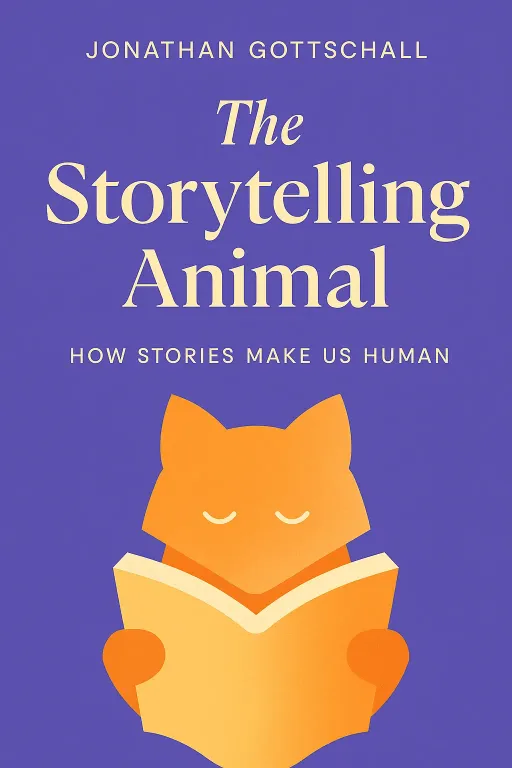
Nova: Absolutely, Atlas. And that 'something else' is story. Today, we're diving into the profound insights of two incredible works: by Jonathan Gottschall, and by Chip Heath and Dan Heath. What's fascinating about Gottschall is that he's a literary scholar who didn't just appreciate stories; he delved into evolutionary psychology and neuroscience to prove that our brains are fundamentally wired for narrative. He really built a bridge between the humanities and hard science.
Atlas: Wow. So he's not just saying 'stories are nice.' He's saying they're. That's a huge claim, especially for anyone knee-deep in environmental systems analysis, where the data is often so dense and complex. It's tough to imagine how you weave a narrative into a climate model.
The Inherent Power of Narrative: Why Stories Stick
SECTION
Nova: Precisely. Gottschall’s core argument is that humans are, at our very essence, storytelling animals. We don't just stories; we in them. Our brains are constantly processing information, not as isolated facts, but as narratives. Think of your brain not as a spreadsheet processor, but as a mini-movie studio, constantly creating and interpreting plots, characters, and conflicts.
Atlas: So you’re saying a detailed climate model, with all its projections and uncertainties, needs a narrative arc to truly land with people? I mean, we're talking about incredibly complex, often abstract data. How does a story bypass the need for rigorous understanding?
Nova: It's not about bypassing understanding, it's about it and making it. Stories do something remarkable: they bypass our rational defenses, engage our emotions, and make information personally relevant. Imagine presenting a dry statistic about rising sea levels—say, "global mean sea level has risen by 0.14 inches per year between 2006 and 2015." Now, imagine a story about a specific coastal community, maybe a fishing village, where generations have lived by the sea, but now their homes are being slowly swallowed, their livelihoods threatened, and their children are afraid.
Atlas: Oh, I see. The statistic is a fact, but the story makes you the impact of that fact. It gives it a face, a place, a consequence.
Nova: Exactly. Gottschall argues that stories are essentially simulations for life. They allow us to experience scenarios, understand cause and effect, and learn lessons without facing real-world risks. When we hear that story about the fishing village, our brains simulate what that feels like, what it means for those people. That emotional connection is what drives action, not just a line on a graph.
Atlas: That makes me wonder, though. For an analytical architect, the integrity of the data is paramount. If we start focusing on stories, are we not at risk of simplifying too much, maybe even sensationalizing, and losing the scientific rigor?
Nova: That's a crucial question, Atlas, and it's a common misconception. It's not about fabricating facts or diluting the science. It's about the truth. The data remains the bedrock. The story provides the context and meaning that data alone often struggles to convey. Think of it this way: data gives you the 'what' and the 'how much.' Stories give you the 'so what?' and the 'why should I care?' They make the complex comprehensible and the distant immediate. They turn abstract concepts into tangible realities.
Atlas: That’s a great way to put it. The 'so what' and 'why should I care' are often the missing pieces when we're trying to inspire action on sustainable solutions. It's not enough to just present the problem; you have to make people the problem and then envision the solution.
Crafting 'Sticky' Environmental Stories: Principles for Impact
SECTION
Nova: And that naturally leads us to the second key idea we need to talk about: if we agree stories are essential, how do we make them truly? How do we ensure they don't just entertain, but actually stick, resonate, and inspire measurable change? That's where Chip and Dan Heath, with their book, provide an invaluable toolkit. They outline the SUCCESs principles: Simple, Unexpected, Concrete, Credible, Emotional, and Stories.
Atlas: Okay, so for an environmental report on, say, water scarcity in a specific region, how do you make that 'unexpected' or 'emotional' without resorting to sensationalism? Because the data itself can be alarming, but we want to avoid panic, and instead, inspire thoughtful action.
Nova: That's a fantastic challenge, and it's where these principles shine. Let's take 'Simple' and 'Concrete' first. Instead of starting with complex hydrogeological models and rainfall averages over decades, you start with the core message: "This community's main well is drying up." That's simple. Then, you make it concrete: "Children now walk three miles every morning before school to fetch water from a communal tap that only runs for an hour a day."
Atlas: Wow. That immediately paints a picture and creates a connection. I can see how that's more impactful than a chart showing declining water tables. It’s like, you’re not just telling me about water scarcity, you’re showing me the direct, human consequence.
Nova: Precisely. And then, for 'Emotional,' it's about connecting to universal human values. It's not about making people cry, necessarily, but about evoking empathy, responsibility, or even hope. The story of those children walking for water connects to our innate desire to protect the vulnerable, to ensure basic human needs are met. Or, you show the ingenuity of a community developing new, sustainable water solutions, evoking hope and inspiring replication.
Atlas: So it’s about finding the human element, the relatable struggle or triumph, within the larger environmental issue. But what about 'Credibility'? For analytical minds, that's paramount. How do you maintain scientific rigor while still leaning into storytelling? Isn't there a tension there?
Nova: Not at all! In fact, credibility is enhanced, not diminished, by good storytelling. The story doesn't replace the data; it the data. The Heath brothers emphasize that credibility comes from truthfulness – the story must be rooted in accurate facts and verifiable science. You're not fabricating the well drying up; you're just presenting that truth in a way that resonates. The detailed scientific analysis provides the backbone, the evidence. The story provides the heart, the reason to care. It's showing, not just telling, the data's impact.
Atlas: That makes perfect sense. It’s about making the science accessible and impactful, not watering it down. For an Analytical Architect driven by results and making a real-world impact, this is powerful. We want to engage both the logical and emotional sides of our audience to drive sustainable solutions, and it sounds like these books offer the ultimate toolkit for that.
Synthesis & Takeaways
SECTION
Nova: Absolutely, Atlas. What we've discussed today is that the mastery of communication, especially for complex environmental truths, isn't just about presenting facts. It's about understanding that our brains are hardwired for stories, and then intentionally crafting those stories to be memorable and impactful using principles like those in. Data plus narrative isn't a compromise; it's the ultimate tool for driving change.
Atlas: That's incredibly insightful. As an Analytical Architect, I often focus on the precision of data, but understanding the human element – how people and that data – is critical for true impact. To be effective, we can't just be data experts; we also need to be compelling storytellers.
Nova: Exactly. So, for our listeners who are grappling with communicating complex findings, here's a tiny step: choose one key finding from your environmental systems analysis, or any complex data set, and try to reframe it as a compelling, simple story. Focus on one or two of the SUCCESs principles – make it concrete, make it emotional, or find the unexpected angle.
Atlas: That's a practical, actionable step. Because ultimately, we want to inspire action on sustainable solutions, engaging both the logical and emotional sides of our audience. This approach gives us the tools to do just that, to make our analysis not just understood, but truly felt and acted upon.
Nova: The power of a well-told story, especially when grounded in truth, is immense. It's how we connect, how we learn, and how we ultimately drive the change our world so desperately needs.
Atlas: That's a truly profound thought to end on.
Nova: This is Aibrary. Congratulations on your growth!