Crafting Compelling Narratives: The Art of Impactful Storytelling
Golden Hook & Introduction
SECTION
Nova: Alright, Atlas, quick challenge for you. If you had to review the entire concept of 'impactful storytelling' in exactly five words, what would they be? Go!
Atlas: Ooh, five words. Hmm. 'Connect. Simplify. Engage. Inspire. Transform.' How's that for a lightning round?
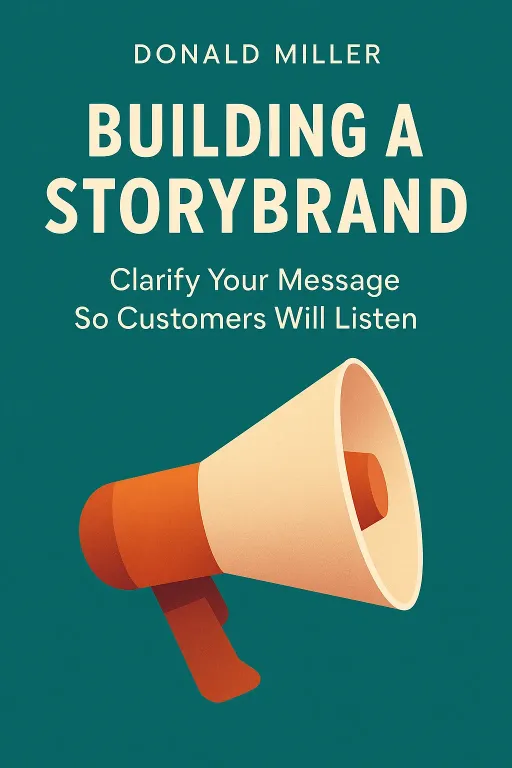
Nova: Very solid, very solid. You hit all the key notes without giving me a novel. And that, my friends, is precisely what we're dissecting today: the art of crafting compelling narratives. We're diving into some absolute foundational texts that transform how we think about communication, specifically 'Building a StoryBrand' by Donald Miller, and 'Made to Stick' by Chip and Dan Heath.
Atlas: Donald Miller, the memoirist? The guy who wrote 'Blue Like Jazz'? How did he end up revolutionizing business communication? That feels like a plot twist in itself.
Nova: It’s a fantastic origin story, actually. Miller himself was a struggling business owner, trying to market his work, and realized he was terrible at it. He kept asking, 'Why do some messages just cut through the noise and others don't?' He then discovered that all great stories, from ancient myths to Hollywood blockbusters, follow a consistent pattern. And businesses, surprisingly, could use that exact same pattern to clarify their message. It wasn't about being clever; it was about being clear. And that clarity, Atlas, is what makes your customer the hero.
Atlas: Oh, I like that! So, not 'my product is the hero,' but 'my customer is the hero.' That's a huge reframing.
The Hero's Journey: Making Your Customer the Protagonist
SECTION
Nova: Exactly. Miller’s 7-part framework is all about making your customer, your audience, the Luke Skywalker of your narrative, and your product or service, the Yoda. You're the wise guide helping them overcome their Death Star, rather than trying to be the Death Star and the hero all at once.
Atlas: But wait, looking at this from a product-market fit perspective, isn't that risky? We spend so much time perfecting our product, making it innovative, powerful. Why shouldn't be the shining star? How do we get people to care if we don't highlight how brilliant our solution is?
Nova: That's the trap, isn't it? When your product is the hero, your customer feels like a sidekick, or worse, just a wallet. Think about a high-tech startup we worked with. They had this incredibly sophisticated AI solution for corporate data analysis. Their marketing was all about the AI's processing power, its algorithms, its cutting-edge architecture. They were essentially saying, 'Look how amazing are!'
Atlas: And I imagine the target audience, busy executives, just glazed over.
Nova: Precisely. They were getting no traction. We helped them flip the script. Instead of leading with their AI, they started with the executive, Jane. Jane was overwhelmed, drowning in spreadsheets, making slow decisions because of data overload. was the hero facing a dragon of corporate chaos. Their AI became the wise, intuitive guide that helped Jane slay that dragon, giving her clarity and speed.
Atlas: So, the story became about Jane's transformation from overwhelmed to empowered, with the AI as her trusty lightsaber.
Nova: Exactly! The cause was Jane's problem: data paralysis. The process was the AI providing clear insights. And the outcome was Jane making faster, better decisions, becoming the hero of her own career. Their sales soared because they made the executive the protagonist, not the software. It’s about framing your vision, your product, your team's journey, within a narrative that resonates deeply because it's story.
Atlas: That makes sense. It's about identifying that core problem the hero faces, and then positioning yourself as the wise mentor, not the all-conquering champion. That's a huge mindset shift for many of us who are deeply invested in our 'heroic' products. It's less about shouting 'buy my thing!' and more about whispering 'I can help you win.'
Nova: And that whisper cuts through the noise far more effectively. The key is clarity over cleverness in identifying that problem and the desired transformation. It's not just features; it's a solution to a hero's problem.
SUCCESs Principles: Crafting Ideas That Stick
SECTION
Nova: Speaking of clarity and making ideas stick, that leads us perfectly to Chip and Dan Heath's 'Made to Stick.' They give us a formula for why some ideas just… resonate, why they stay with us, and why we pass them on.
Atlas: Okay, so we've got the hero's journey for our customers. Now, how do we make about that journey actually stick? Is there some kind of secret sauce or universal principle we can apply? For those of us trying to build a movement or get everyone on board with a vision, this is crucial.
Nova: The Heath brothers say there absolutely is. They boiled it down to six principles, which they conveniently acronymed as SUCCESs: Simplicity, Unexpectedness, Concreteness, Credibility, Emotions, and Stories. We could spend hours on each, but let's zoom in on Unexpectedness and Concreteness, because they're so powerful together.
Atlas: Unexpectedness and Concreteness. So, surprise me and make it real?
Nova: Precisely. Think about a public health campaign. One campaign tried to raise awareness about a silent killer disease. Their message was: 'Millions of people are affected by X disease every year. Get tested.' It was factual, credible even, but it failed to gain traction. People nodded, thought 'that's sad,' and moved on. It lacked stickiness.
Atlas: That sounds like a lot of corporate communications, to be honest. All the facts, none of the impact.
Nova: Exactly. Now, consider another campaign for a similar cause. Instead of statistics, they showed a single, perfectly ripe apple. The voiceover began: 'This apple looks healthy, but inside, it's slowly rotting, silently spreading decay.' Then, it cut to a time-lapse of the apple visibly deteriorating, and ended with: 'Some diseases are like this apple. They look fine on the surface, but they're silently destroying you from within. Don't wait until it's too late.'
Atlas: Whoa. That's a completely different emotional punch. The rotting apple is so visceral.
Nova: That's Unexpectedness Concreteness working together. The unexpected visual of a beautiful apple slowly rotting, combined with the concrete, tangible image of decay, made the abstract concept of a 'silent killer' instantly understandable and memorable. It went viral, driving significantly more donations and screenings than the fact-based campaign. It was simple, unexpected, concrete, tapped into emotions, and told a mini-story.
Atlas: That's brilliant. So it's about cutting through the noise with something that genuinely surprises you, and then making it tangible. For someone trying to rally a team around a product vision, or someone building a movement, 'concreteness' seems particularly powerful, right? How do you make an abstract vision feel real, not just like corporate jargon?
Nova: That's where the visionary part of you comes in. Instead of saying, 'Our goal is to achieve market leadership in the AI-driven analytics sector,' which is abstract, you make it concrete. You say, 'We're building a world where every small business owner, no matter their size, has the intuitive tools to understand their customers as deeply as a Fortune 500 company, starting with a single, easy-to-read dashboard on their phone.'
Atlas: That paints a picture. I can see that dashboard. I can imagine that small business owner. It's not just a metric; it's a future.
Nova: It's a future you can. You make the abstract tangible. You use vivid language. You create a mental image that sticks. This is how you simplify complex ideas into a narrative so clear that even an outsider immediately grasps its value and feels a connection to its purpose.
Synthesis & Takeaways
SECTION
Nova: So, bringing it all together, Donald Miller gives us the narrative structure – make your customer the hero, and you the guide. And the Heath brothers give us the ingredients to make that narrative unforgettable – Simplicity, Unexpectedness, Concreteness, Credibility, Emotions, and Stories. It’s about designing a story where your customer wins, and your message about that win is clear, surprising, and feels real.
Atlas: So it's not just about what you say, but how you frame it and how you deliver it. It's the difference between a dry manual and an epic tale that inspires action. For those of us trying to align stakeholders, build a strong team, and truly lead with impact, this is gold. It transforms communication from mere information transfer into an act of connection and inspiration.
Nova: Absolutely. And the tiny step today? Draft a 'StoryBrand' one-liner for your current product or initiative. Identify your customer's problem, your solution, and their success. Focus on clarity over cleverness. And then, ask yourself that deep question: how can you simplify your complex ideas into a narrative so clear that even an outsider immediately grasps its value and feels a connection to its purpose?
Atlas: That's a powerful challenge. It makes you realize that even the most complex movements begin with a simple, compelling story. It's about building that connection, that shared journey.
Nova: Exactly. It's about making your impact undeniable through the power of narrative.
Atlas: Fantastic. A lot to chew on there. Thanks for breaking it all down, Nova.
Nova: My pleasure, Atlas.
Nova: This is Aibrary. Congratulations on your growth!