Beyond the Product: Crafting Narratives That Resonate.
Golden Hook & Introduction
SECTION
Nova: What if I told you that focusing on your product's features is actually the fastest way to make your audience tune out? That the secret to an unforgettable brand isn't about what you do, but what you understand?
Atlas: Oh man, that's going to hit home for a lot of our listeners. We spend so much energy perfecting our offerings, only to wonder why the message isn't quite landing. It feels like shouting into a void sometimes.
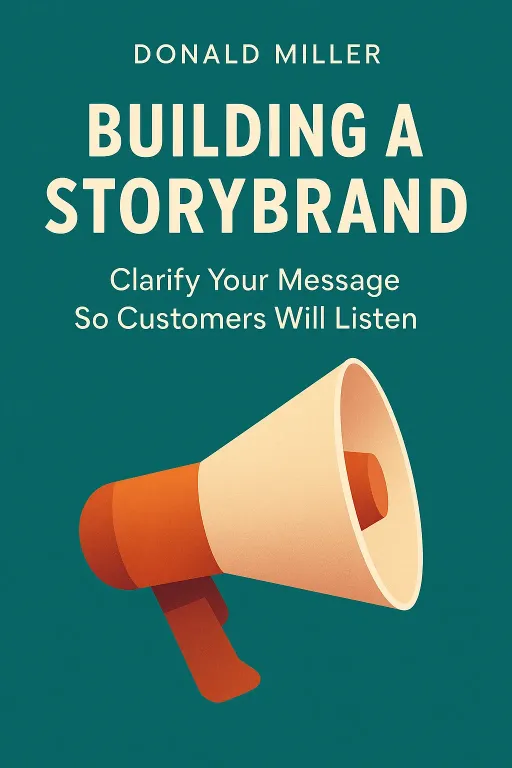
Nova: Exactly! And that's why today we're diving into two absolute powerhouses in communication: "Building a StoryBrand" by Donald Miller and "Made to Stick" by Chip and Dan Heath. Miller's framework has become a go-to for countless businesses and non-profits, praised for its straightforward approach to clarifying brand messaging. And the Heath brothers, both professors, brought an academic rigor to their work, but delivered it in such an accessible, anecdote-driven way that "Made to Stick" remains a perennial bestseller and a staple in communication courses.
Atlas: So, we're talking about going beyond just having a great product. We're talking about cutting through the noise in a really strategic way. As innovators, we constantly wrestle with articulating value, especially when our solutions are complex.
Nova: Precisely. Many businesses struggle to articulate their value clearly, leading to muddled messages that simply fail to resonate. We're here to give you a simple, powerful framework to clarify your brand message and connect deeply with your audience, making your brand unforgettable.
The StoryBrand Blueprint: Making Your Customer the Hero
SECTION
Nova: Let's kick things off with Donald Miller's "StoryBrand." The core premise is brilliantly simple, yet so many brands miss it: your customer is the hero of the story, not your brand.
Atlas: Oh, I like that. It's like flipping the script in a movie. Most brands want to be the dashing protagonist, but you're saying we should be the wise mentor?
Nova: Exactly! Think of it this way: no one wants to watch a movie where the sidekick is the main event. They want to see the hero's journey. Miller breaks this down into a seven-part framework, but the most crucial shift is understanding the 'hero' and their 'problem.' Your brand isn't Luke Skywalker; it's Yoda. It's not Frodo; it's Gandalf. You're the guide who understands their struggle and offers a plan to help them win.
Atlas: That's a great analogy. But wait, for our listeners who are building complex B2B solutions or highly innovative products, isn't it incredibly hard to identify one clear 'hero' and one 'problem' without oversimplifying what they do? Your customer might have multiple problems, and your product might solve several of them.
Nova: That's a perceptive question, Atlas, and it's where the nuance comes in. StoryBrand isn't about ignoring complexity; it's about simplifying the of that complexity. The 'problem' typically has three layers: an external problem, an internal problem, and a philosophical problem. A successful brand speaks to all three. For example, a cloud storage company isn't just solving the external problem of 'not enough disk space.' It's solving the internal problem of 'I'm anxious about losing my data' and the philosophical problem of 'my precious memories shouldn't be held hostage by a failing hard drive.'
Atlas: Oh, I see. So it's not just the surface-level issue, but the emotional cost and the deeper injustice of it all. That makes so much sense. It adds that human element. Can you give an example of a brand that really nails this?
Nova: Absolutely. Think about Salesforce, for instance. They don't just talk about CRM software. They talk about 'customer success.' Their marketing often positions small business owners as the heroes, overwhelmed by managing customer relationships, struggling to grow. Salesforce steps in as the guide, offering a clear path to streamline operations, understand their customers better, and ultimately, achieve growth and peace of mind. Their messaging focuses on the, not just the features of their platform. They help the hero win.
Atlas: Wow, that's powerful. It really reframes the competitive landscape, making their value undeniable because they're speaking directly to the deeper aspirations and fears of their audience. It's not about what sell, but what achieve.
The SUCCESs Principles: Crafting Messages That Stick
SECTION
Nova: And that naturally leads us to the second key idea we need to talk about, which often acts as a critical counterpoint to what we just discussed. Once you know story to tell – your customer's heroic journey – the next challenge is making sure that story. That's where Chip and Dan Heath's "Made to Stick" comes in. They explore why some ideas spread like wildfire while others, no matter how good, just fizzle out.
Atlas: So, what's the secret sauce? Are these just common sense, or is there a real method behind the madness? I mean, we all want our messages to be memorable, but how do you actually engineer that?
Nova: It's definitely more than common sense, though it feels obvious once you see it. They identified six principles, which form the acronym SUCCESs: Simple, Unexpected, Concrete, Credible, Emotional, and Story-driven. These aren't just buzzwords; they're the DNA of sticky ideas. Let's take 'Concrete' as an example. Instead of saying 'our product offers advanced data management capabilities,' which is abstract, you'd say 'our software lets you find any file you’ve ever created in less than 3 seconds.'
Atlas: That's a perfect example. I can instantly picture that, and it makes the benefit tangible. But what about making a message 'Unexpected,' especially for a company in a well-established or even 'boring' industry? How do you surprise people when they think they already know what you're about?
Nova: That's where creativity and understanding human psychology truly shine. 'Unexpected' isn't about being outlandish; it's about breaking a pattern. It creates a 'knowledge gap,' making people curious. Take for instance, the classic "Wendy's Where's the Beef?" campaign. It wasn't about listing ingredients; it was about a simple, unexpected question that highlighted a problem with competitors and stuck in everyone's mind. For a 'boring' product, you could highlight a counter-intuitive benefit, or a surprising consequence of using it. Maybe your accounting software isn't just about numbers; it's about the unexpected freedom it gives small business owners to spend more time with their families.
Atlas: Oh, I've been there. The emotional problem of 'missing out on family time' because of paperwork. So, you're tapping into the 'Emotional' principle there too, right? Making people something.
Nova: Exactly! Emotion is incredibly powerful. When people feel something, they remember it. Appeals to self-interest are good, but appeals to identity or social connection are even better. Think about environmental campaigns that focus on protecting 'our children's future' rather than just 'carbon emissions.' They connect to something deeper, more human. The Heath brothers provide so many examples that just hit you with an 'aha!' moment.
Atlas: Honestly, that sounds like my Monday mornings, trying to make a quarterly report sound exciting. This is incredibly valuable for strategic innovators who are constantly trying to communicate vision and value. How do you make a dry, data-driven concept Simple, Unexpected, or Emotional without sounding disingenuous?
Nova: It's about finding the human truth within the data. For a data-driven concept, 'Concrete' is your best friend. Instead of 'we increased efficiency by X percent,' say 'we saved our clients enough time to take an extra two weeks of vacation each year.' That’s concrete, emotional, and even a little unexpected for a business metric. It's about translating the abstract into something relatable and tangible.
Synthesis & Takeaways
SECTION
Nova: So, bringing these two giants together, StoryBrand gives you the robust narrative structure – who is your hero, what's their problem, how do you guide them to success? And "Made to Stick" gives you the powerful ingredients to make that narrative unforgettable. It's not enough to have a good story; it has to be a sticky story.
Atlas: That's actually really inspiring. It frames brand building not as a marketing chore, but as an act of empathy and clear communication. For anyone who's an adaptive learner or a brand builder, this is gold. So, if our listeners want to make their brand truly unforgettable, what's one immediate, actionable thing they can do based on everything we've discussed?
Nova: Take your current brand's primary message. Who is your hero? What is their core external problem, their internal frustration, and the philosophical injustice they face? And how does your brand help them win? Once you have that clear story, then ask: how can I make this message more Simple, more Concrete, and more Emotional?
Atlas: It's about continuous adaptation, isn't it? Not just a one-time fix, but a constant refining of that story, always putting the customer at the center. It’s a journey of empathy and clarity.
Nova: Absolutely. Embrace that journey, because the brands that resonate are the ones that tell the stories their customers are desperate to hear.
Atlas: Incredible insights today, Nova. Thank you.
Nova: My pleasure, Atlas.