Emotional Mastery and Social Comparison
Golden Hook & Introduction
SECTION
Nova: The average person spends over two hours a day on social media. That is roughly seven hundred hours a year spent staring at a curated mirror, wondering why your own reflection does not look as shiny as the one on the screen.
Atlas: That is a staggering number. It feels like we are all just sitting in a digital theater, watching a movie called Someone Else's Life, and then feeling bad that our own life does not have the same lighting budget.
Nova: Exactly. We are effectively paying an emotional tax for a product we did not even want to buy. And that brings us to two books that act as a tax audit for your mental and emotional state.
Atlas: I am intrigued. Which ones are we breaking down today?
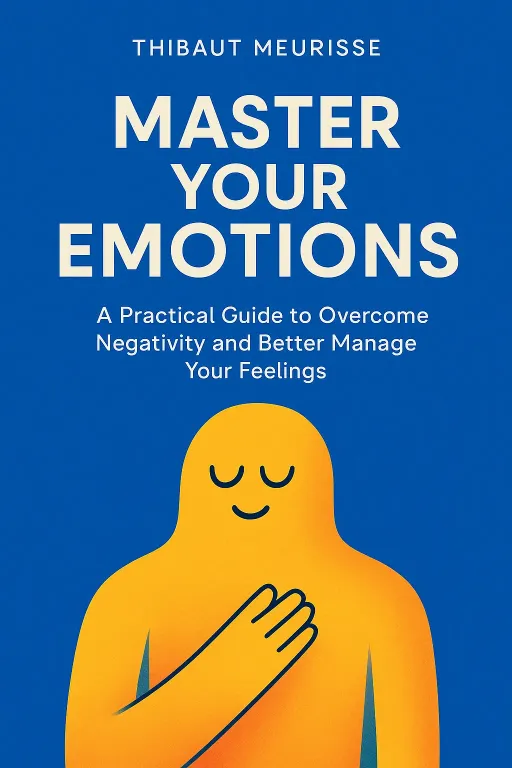
Nova: We are looking at Master Your Emotions by Thibaut Meurisse and Love Your Life Not Theirs by Rachel Cruze. Meurisse offers a framework for deconstructing emotions into simple bio-chemical signals, while Cruze provides a roadmap for stopping the financial and emotional hemorrhage caused by social comparison.
Atlas: It is an interesting pairing. One is focused on the internal chemistry of our feelings, and the other is about the external pressure of keeping up appearances. It feels like we are tackling the two biggest thieves of our peace of mind.
Nova: That is the perfect way to frame it. The Reflective Sage, the archetype we are leaning into today, is all about that—curating for meaning and mental peace. So, let us dive into the internal landscape first.
The Bio-Chemical Nature of Emotions
SECTION
Atlas: Let us start with Meurisse. The title Master Your Emotions sounds like a tall order. Most people think emotions are these uncontrollable tidal waves. Are you telling me I can just flip a switch?
Nova: It is not about flipping a switch and suppressing everything. That is a misunderstanding. Meurisse argues that we often identify with our emotions. We say, I am angry, or I am sad. The breakthrough happens when you change that language to, I am experiencing anger, or I am experiencing sadness.
Atlas: That sounds like semantics. Is there a real difference between saying I am angry and I am experiencing anger?
Nova: The difference is massive. When you say I am angry, you are merging your identity with the emotion. You become the anger. When you say I am experiencing anger, you create space. You become the observer. Meurisse reframes emotions as temporary bio-chemical signals. They are messengers, not masters.
Atlas: So, if I am in a meeting and someone says something that makes my blood boil, I should just treat that like a warning light on my car dashboard?
Nova: Precisely. Think of it as a check engine light. The light tells you that something in the system needs attention, but the light itself is not the engine. If you stare at the light and panic, the car still does not run better. You have to look at the underlying cause.
Atlas: That makes sense, but let us get practical. How do I do that in the heat of the moment? If my boss is criticizing my work, my brain is already flooded with cortisol. I am not thinking, Oh, look at this fascinating bio-chemical signal. I am thinking, This is a disaster.
Nova: You are right, the physical sensation comes first. That is the nature of our biology. Meurisse suggests that we need to intervene before the emotion hijacks the narrative. It starts with the pause. You feel the heat, the tightness in the chest, the rising irritation. Instead of immediately reacting, you label it. You name it.
Atlas: So, I label it. I say, Okay, this is frustration. And then what? Do I just sit there and wait for it to pass?
Nova: You observe it. You treat it with curiosity rather than judgment. You ask, What is this signal trying to tell me? Is it telling me I feel undervalued? Is it telling me I feel threatened? Once you identify the root, you can address the root rather than reacting to the emotional spike.
Atlas: That takes a level of detachment that is incredibly hard to master. It requires you to be the scientist of your own life.
Nova: It does. And that is the point. Most of us go through life reacting to our internal weather, letting every storm dictate our actions. Meurisse is challenging us to be the meteorologist. You can acknowledge the storm is happening without letting it blow your house down.
The Comparison Trap
SECTION
Atlas: I can see how that helps with internal regulation. But what about when the emotion is triggered by the outside world? Specifically, other people? That brings us to Rachel Cruze and Love Your Life Not Theirs. We are talking about the social comparison trap.
Nova: This is where it gets interesting. Meurisse helps you manage the feeling, but Cruze helps you manage the environment that creates the feeling in the first place. Cruze argues that comparison is the thief of joy, but it is also the thief of your bank account.
Atlas: Wait, how does comparison hit the bank account? I thought that was just an emotional issue.
Nova: It is deeply financial. Think about the standard cycle. You see someone on a platform, they have the new car, the perfect vacation, the renovated kitchen. You feel a pang of inadequacy. That feeling creates a desire to close the gap. You spend money to look the part, to achieve the status, to feel as successful as they appear to be.
Atlas: That is a vicious cycle. We are essentially buying props for a play we are not even enjoying.
Nova: Exactly. Cruze outlines seven habits to build a life aligned with your own values, and the first step is realizing that you are comparing your behind-the-scenes footage with someone else's highlight reel. You do not see their debt, their arguments, or their stress. You only see the curated final edit.
Atlas: I think everyone knows this intellectually. We all know social media is fake. But knowing it and feeling it are two different things. How do we actually stop the comparison when it feels like it is hard-wired into our brains?
Nova: The shift happens when you define your own values. Cruze suggests that if you do not define what a successful life looks like for you, the world will define it for you. And the world’s definition is usually, You need more of everything.
Atlas: That is a heavy thought. If I do not have a clear vision of my own definition of success, I am just defaulting to the societal standard, which is usually just more consumption.
Nova: Right. When you have a clear set of values—whether that is family time, financial freedom, creative work, or simple presence—you have a filter. When you see someone else’s life, you can ask, Does this align with my values? If the answer is no, the pang of envy loses its power.
Atlas: It is like having an internal compass. If I value simplicity and someone else is flaunting luxury, I do not feel inadequate. I feel indifferent because that is not the direction I am heading.
Nova: That is the key. The Reflective Sage knows that time and attention are the most precious currencies. When you spend your energy comparing, you are literally hemorrhaging your own life force. Cruze pushes us to redirect that energy back into our own lane.
Atlas: I like that imagery. Staying in your own lane. It sounds simple, but it is radical in a world that screams for your attention.
Nova: It is radical because it requires intentionality. It means you have to be willing to be out of step with the crowd. You might have to say no to the upgrade, no to the trend, no to the status symbol, because your resources are committed to something else that matters more to you.
Synthesis & Takeaways
SECTION
Atlas: So, we have two distinct but connected paths here. Meurisse gives us the tools to manage the internal reaction when the world gets under our skin, and Cruze gives us the tools to protect our environment so we do not get triggered as often.
Nova: That is a great synthesis. They work together. You use Meurisse’s techniques to stay centered when life feels chaotic, and you use Cruze’s principles to design a life that is inherently more peaceful because it is built on your own foundation, not on the shifting sands of what everyone else is doing.
Atlas: It makes me think about the idea of the Reflective Sage. This is not just about reading books; it is about treating your time as a sacred appointment with yourself. If you are constantly looking at other people's lives, you are breaking that appointment every single day.
Nova: That is the most profound takeaway. Your time is a gift. If you use it to compare, you are wasting the gift. If you use it to curate your own peace, you are mastering your life.
Atlas: I want to leave our listeners with a question to sit with. Think about your daily routine. Where is the friction? Where do you feel the most pressure to be, do, or have more? Is that pressure actually yours, or is it something you picked up while watching someone else's highlight reel?
Nova: And once you identify that, you can gently shift that energy. You do not need to overhaul your entire life overnight. Just start by reclaiming one area. Maybe it is your morning routine, where you choose reading over scrolling. Maybe it is your financial habits, where you choose saving over performing.
Atlas: It is about quality over quantity. It is about the clarity that comes when you stop trying to live everyone else's life and start falling in love with your own.
Nova: Exactly. And that is the work of a lifetime, but it is the only work that truly matters. We hope this episode helps you reclaim a bit of that precious mental space today.
Atlas: That is a perfect place to land. Thank you for walking through this with me, Nova.
Nova: Always a pleasure, Atlas. And to our listeners, thank you for choosing to spend this time with us. This is Aibrary. Congratulations on your growth!