Stop Guessing, Start Measuring: The Guide to Data-Driven Product Success.
Golden Hook & Introduction
SECTION
Nova: Many leaders feel this deep, almost primal pull. It's the battle between trusting your gut, that sharp, intuitive instinct you've honed over years, versus the cold, hard, sometimes overwhelming deluge of data. It feels like you have to choose one or the other, right?
Atlas: Oh, absolutely. It's like standing at a crossroads. One path is familiar, paved with experience and a certain artistic flair. The other is meticulously charted, but sometimes feels… sterile. I imagine a lot of our listeners, especially those building cultures and trust, feel that tension.
Nova: Exactly. But what if that choice is actually a false dilemma? What if the most impactful leaders aren't choosing between intuition and data, but are instead masterfully them into a powerful, symbiotic force?
Atlas: That's a bold claim. It sounds almost too good to be true for anyone who's ever felt paralyzed by a spreadsheet or second-guessed a gut feeling.
Nova: Well, today, we're diving into exactly that, exploring the profound insights from a guide that helps bridge this gap: "Stop Guessing, Start Measuring: The Guide to Data-Driven Product Success." This isn't just another book about analytics. It offers a framework for leaders to validate their intuition, transforming that keen eye for potential into measurable, sustainable success. It's about giving you the tools to build cultures and trust based on something more solid than just hope.
Atlas: That's incredibly appealing. For those of us who value human connection and strategic impact, the idea of using data to intuition, rather than replace it, feels like unlocking a new level of leadership. So, where do we even begin to untangle this?
The 'One Metric That Matters' for Strategic Focus
SECTION
Nova: We start by tackling one of the biggest challenges: the sheer volume of information. You know, founders and product leaders often feel like they need to track everything. Every click, every user, every conversion. And what happens? Analysis paralysis. You drown in data, and nothing gets done.
Atlas: I know that feeling. It's like trying to drink from a firehose. You have all these numbers, but no clear direction. For someone who's strategic and trying to build resilient structures, that can be incredibly frustrating. What's the point of all that data if it doesn't lead to action?
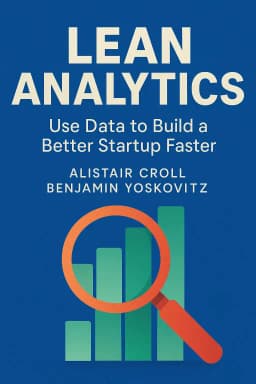
Nova: That's where "Lean Analytics" by Alistair Croll and Benjamin Yoskovitz comes in. This book is brilliant because it highlights a fundamental truth: different business models have different key metrics. What matters for a SaaS company is wildly different from what matters for an e-commerce site or a content platform.
Atlas: That makes sense. A one-size-fits-all approach to metrics sounds like a recipe for disaster. So, how do you figure out one metric?
Nova: The core idea is to identify the 'one metric that matters' for your. It prevents that analysis paralysis by giving you a singular, clear North Star. Let's take a scenario. Imagine a budding social learning platform for professionals—think of it as a place for talent whisperers to grow their skills.
Atlas: I can picture that. A lot of our listeners are probably building or scaling similar platforms. What kind of metrics would they typically be drowning in?
Nova: Exactly. They might be tracking sign-ups, daily active users, content shares, comments, time on site, course completions, message exchanges… the list goes on. Each seems important, but without focus, the team is pulled in a dozen directions. Morale dips because they're chasing too many rabbits.
Atlas: That sounds rough. As a leader, you're trying to inspire your team, but if the goalposts are always shifting, or if there are too many of them, that trust can erode.
Nova: Right. So, for this social learning platform, at an early stage, their "one metric that matters" might be "active engagement rate per unique course completion." It's not just about signing up, or even just finishing a course. It’s about how many of those who complete a course then with the community or apply what they learned.
Atlas: Oh, I like that. It immediately shifts the focus from vanity metrics to real value. It’s not just about consumption, it’s about transformation and community. But how do you, as a leader, sell that to a team that might be attached to, say, "total sign-ups"? How do you persuade them that this one metric is metric?
Nova: That's where the "Persuader" in you comes in. It's about clear communication of the. You explain that while sign-ups are good, they don't tell us if we're truly building a valuable community. The active engagement per course completion directly reflects if our platform is creating lasting impact and fostering a thriving learning culture. It links directly to the mission. It gives the team a single, clear target to rally around, making their efforts feel more purposeful and directed. It's about focusing their energy like a laser.
Atlas: That makes perfect sense. It's not about ignoring other data, but about having a primary compass bearing. It sounds like it simplifies the strategic conversation, allowing you to build trust by providing clarity. But once you have that metric, how do you actually move it? What if your gut tells you one thing, but the data isn't moving?
Cultivating an Experimentation-Driven Culture for Continuous Learning
SECTION
Nova: That’s a brilliant segue, Atlas, because that question leads us directly to our second core idea: cultivating an experimentation-driven culture. This comes from Stefan H. Thomke’s "Experimentation Matters."
Atlas: So, once we know to measure, it's about figuring out to influence it?
Nova: Precisely. Thomke shows how leading companies foster a culture where experimentation isn't just a tactic, but a core strategy for learning and growth. It’s about systematic testing to unlock new insights, rather than just making big, risky bets based on intuition alone.
Atlas: Okay, so it’s not just about having a metric, it’s about having a process to improve it. What does that look like in practice for a company trying to build trust and high-performing structures?
Nova: Let's consider a well-established B2B SaaS platform focused on organizational design—something our architect listeners would be familiar with. Their 'one metric that matters' might be customer retention, or perhaps expansion revenue from existing clients. They want to improve it, but instead of launching a massive, expensive feature redesign based on a hunch, they embrace a culture of small, measurable experiments.
Atlas: So, what kind of small experiments are we talking about? How do you test something like organizational design without upending everything?
Nova: Good question. They might test simple changes to their onboarding flow: does a personalized welcome video improve first-week engagement more than a text-based tutorial? Or they might experiment with different in-app nudges to encourage feature adoption. They could even test new communication strategies for product updates. The key is that each experiment has a clear hypothesis, a defined success metric linked to their OMTP, and a small, controlled scope.
Atlas: I can see how that reduces risk. But wait, couldn't constant experimentation lead to decision fatigue for the team? Or a feeling of instability, especially for a leader trying to build resilient structures and trust? It sounds like it could be exhausting.
Nova: That’s a really important point. This isn't about chaos; it's about learning. For a "Talent Whisperer," the culture around experimentation is everything. It’s about celebrating the, not just the "successful" experiment. You frame every experiment, whether it "wins" or "loses," as a step forward. It builds psychological safety.
Atlas: That’s a great way to put it. So, it's about making sure the team understands the of the experiment—that it's about gaining knowledge and making smarter decisions, not about blaming people if a hypothesis doesn't prove out. It strengthens the culture by showing that learning is valued.
Nova: Exactly. It turns uncertainty into a powerful learning engine. It allows leaders to combine their keen eye for potential—their intuition about what work—with hard evidence. They then have a structured approach to validate those instincts, measure their impact, and learn from every single action. That’s how you build sustainable growth and truly resilient structures.
Synthesis & Takeaways
SECTION
Nova: So, by bringing these two ideas together—the laser focus of the 'one metric that matters' and the continuous learning of an experimentation culture—you create a powerful feedback loop. You're no longer guessing; you're measuring, learning, and adapting with purpose.
Atlas: That's incredibly empowering. It means leaders who prioritize intuition and human connection aren't abandoning those values; they're simply refining and validating them with precision. It's about being strategic, persuasive, and building trust through transparent, data-informed decisions. It sounds like a formula for true impact. If there's one tiny step our listeners could take this week, what would it be?
Nova: My advice is simple, yet profound: Identify one key metric for your current biggest challenge, and then design a simple, measurable experiment to influence it this week. It doesn't have to be a grand gesture; it can be a tiny, focused step.
Atlas: That’s a perfect, actionable challenge. It takes all this big thinking and distills it into something manageable. So, what's one metric you're going to try to influence this week, and what's your experiment? Let us know.
Nova: This is Aibrary. Congratulations on your growth!