Stop Guessing, Start Measuring: The Guide to Data-Driven Growth.
Golden Hook & Introduction
SECTION
Nova: You know, it’s funny how many smart people confidently drive their businesses with the dashboard lights all flashing, but no idea what any of them mean. They’re busy, they’re active, but they often feel like they're just guessing. It’s a recipe for disaster, and frankly, it’s exhausting.
Atlas: Wow, that’s actually a perfect analogy. I can imagine a lot of our listeners nodding along right now, thinking, "Yep, that's me." We're all drowning in data, right? Every platform, every tool, spits out numbers. It's like trying to drink from a firehose.
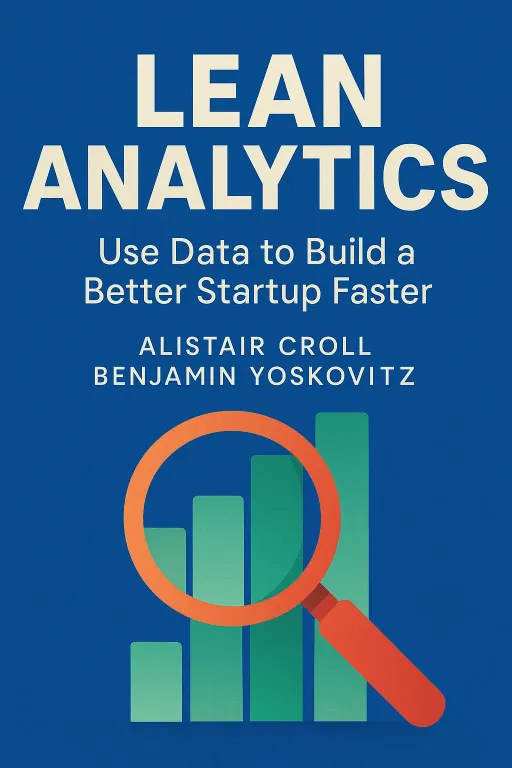
Nova: Exactly! And that's why today, we're dissecting the core ideas from two seminal works: "Lean Analytics" by Alistair Croll and Benjamin Yoskovitz, and John Doerr's "Measure What Matters." What's fascinating about Doerr is his background as an early investor in Google, bringing a truly Silicon Valley perspective to organizational goal-setting that has since influenced countless tech giants. He really saw how this could scale.
Atlas: Right? So, for someone managing a high-stakes team or trying to master current competitive landscapes, who feels swamped by all this data, what's our starting point? Because it sounds like this isn't just about collecting more numbers, it’s about making sense of them.
Nova: Absolutely. And that leads us straight into the heart of the problem: the myth of activity versus progress. Many businesses are incredibly active, generating tons of data, but they mistake that activity for actual progress.
The Myth of Activity vs. Progress: Defining Your 'One Metric That Matters'
SECTION
Nova: Think about an e-commerce startup we'll call "TrendThreads." They were obsessed with social media. Their marketing team would proudly report thousands of new followers, hundreds of likes per post, and a surge in website traffic. The founders were thrilled! They were things, they were. They felt like they were making huge strides.
Atlas: Oh man, I’ve been there. The vanity metrics trap. It feels good, but it doesn't always pay the bills. So, what happened at TrendThreads?
Nova: Well, after six months of relentless activity, their revenue barely budged, and customer retention was abysmal. They had high engagement, yes, but very few actual sales and even fewer repeat customers. Their efforts were educated guesses, not strategic moves. They were drowning in data, but it was the wrong data. That's where "Lean Analytics" comes in, highlighting how different business models, like e-commerce, require unique metrics.
Atlas: Okay, but isn't more data always better? What if you pick the metric? That sounds like you're putting all your eggs in one basket, which could be riskier than having a broad view.
Nova: That's a great point, and it’s a common misconception. "Lean Analytics" isn't saying ignore all other data. It's about identifying your 'One Metric That Matters'. For TrendThreads, their OMTM became "customer lifetime value," or CLTV. Once they focused on CLTV, everything changed. Their marketing shifted from chasing likes to cultivating loyal customers. They started tracking repeat purchases, average order value, and churn rates with daily intensity. This wasn't just a number; it was a compass for every decision. They realized a thousand likes meant nothing if those people never bought anything again.
Atlas: Wow, that’s a perfect example. So, how does someone identify OMTM? Especially if they're in a competitive performance marketing landscape where everything feels like it needs to be measured? Because for our listeners who are constantly optimizing campaigns, it feels like there are a hundred "most important" metrics.
Nova: That’s where the strategic thinking comes in. You have to understand your business model deeply. Is it e-commerce, SaaS, a content platform? Each has a different OMTM. An e-commerce business might focus on CLTV, a SaaS company on churn rate, a content site on daily active users. The book pushes you to ask: what is the single most impactful number that directly correlates to the sustainable growth of? It’s about prioritizing impact over sheer volume of data. It’s about moving from broad data collection to precise, actionable measurement.
From Guesswork to Alignment: The Power of OKRs for Measurable Growth
SECTION
Nova: And once you know to measure – your OMTM – the next challenge is making sure everyone in your organization is measuring the and driving towards ambitious goals. Because having the right metric is one thing; having everyone aligned to achieve it is another entirely.
Atlas: That makes perfect sense. It’s not enough for the CEO to know the OMTM; the entire team needs to be rowing in the same direction. But how do you prevent that from becoming just another top-down mandate that everyone ignores after a week?
Nova: That's where John Doerr's "Measure What Matters" and the Objectives and Key Results, or OKR, framework come into play. Doerr introduces OKRs as a powerful system for setting ambitious objectives with measurable key results. It aligns teams and drives accountability. Think of a mid-sized marketing agency, let's call them "Synergy Campaigns." They were brilliant, creative, but internally, it was chaos. Account managers were chasing different targets, creative teams weren't always in sync with client goals, and project deadlines often slipped.
Atlas: I can totally picture that. Everyone’s busy, everyone’s talented, but the left hand doesn’t always know what the right hand is doing. It’s a common pain point for anyone trying to build something significant.
Nova: Exactly. Implementing OKRs transformed Synergy Campaigns. Their objective might be "Achieve unparalleled client satisfaction and retention." But that's vague, right? The key results make it measurable: "Increase client retention rate by 15%," "Achieve a net promoter score of 8.5," and "Reduce client onboarding time by 20%." Everyone, from the account manager to the graphic designer, could see how their daily tasks contributed to those specific, measurable results.
Atlas: That sounds great on paper, but I can imagine a lot of our listeners thinking, "My team struggles to even agree on lunch, let alone ambitious OKRs! How do you prevent this from becoming just another corporate buzzword bingo that gets rolled out for a month and then forgotten?"
Nova: That’s the brilliance of Doerr’s framework. It's not just about setting goals; it’s about transparency, frequent check-ins, and the cultural shift it fosters. OKRs are meant to be ambitious, even a little uncomfortable, pushing teams to stretch. They're also public. Everyone knows everyone else's OKRs. This creates a powerful sense of shared purpose and accountability. It transforms a group of individuals into a high-performing team because everyone understands their role in the overall output, like a well-oiled machine.
Atlas: So basically you’re saying that the framework itself helps build the culture of accountability, rather than relying on an existing one. That makes me wonder, what's the 'tiny step' someone can take this week to start implementing an OKR mindset, even if it's just for their personal projects or a small team?
Nova: An excellent question. The tiny step is to take your next project – whether it's a new marketing campaign, a product launch, or even a personal goal – and define one clear, ambitious objective. Then, identify 3-5 measurable key results that will tell you if you've truly achieved that objective. Outline how you’ll track those key results daily or weekly. It's about starting small to build the muscle.
Synthesis & Takeaways
SECTION
Nova: So, what we've really explored today is the journey from educated guesses to strategic moves. "Lean Analytics" helps you define your destination by finding your 'One Metric That Matters,' cutting through the data noise to focus your efforts. Then, "Measure What Matters" provides the vehicle and the fuel, the OKR framework, to get you there, aligning everyone in a shared, ambitious pursuit.
Atlas: Right, so it's not just about data, it's about strategic clarity and empowering teams. It reminds me of the desire for mastery our listeners have. To truly stay ahead in competitive landscapes, you can't just work harder; you have to work smarter, with clear targets and a way to measure every step.
Nova: Exactly. Predictable growth doesn't come from hoping for the best or simply being busy. It comes from intentional, measured action. It’s about knowing precisely where you're going and whether you're actually getting there.
Atlas: That's actually really inspiring. It takes the guesswork out of growth and replaces it with a roadmap.
Nova: My challenge to all our listeners is this: for your very next project, identify your single most important metric. Your OMTM. Then, outline how you'll track it daily. Start small, but start measuring what truly matters.
Nova: This is Aibrary. Congratulations on your growth!