The Mind's Mirror: Mastering Your Inner World for Real-World Success
Golden Hook & Introduction
SECTION
Nova: Imagine holding your breath, the crushing pressure of the deep ocean around you, and you have to make a single, perfect decision: turn back now, or push just a little deeper for the prize. One choice leads to glory, the other to blacking out. What separates the champion from the casualty? It's not just lung capacity. It's a finely tuned sense of self-awareness. This ability to perfectly judge your own limits is a skill we all need, whether we're diving for a record or navigating a tough conversation at work.
Dav: That's a powerful image. It really puts into perspective how high-stakes self-judgment can be.
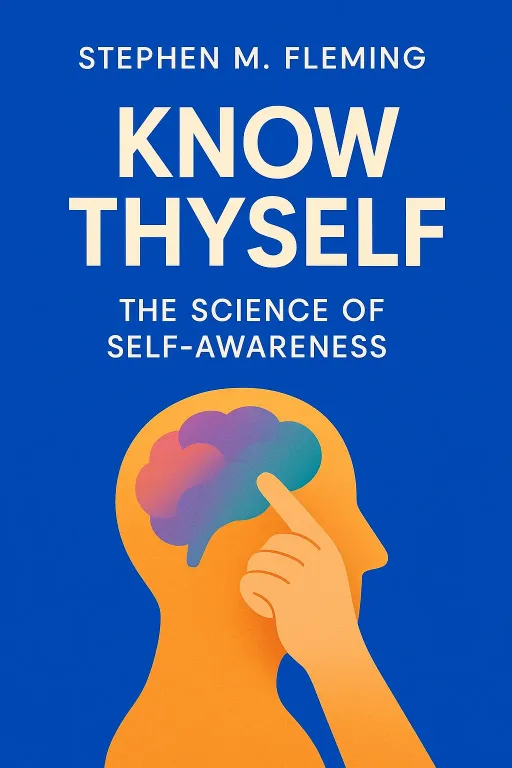
Nova: It really does. And that's the core of what we're exploring today with our guest, Dav, inspired by Stephen Fleming's incredible book, 'Know Thyself: The Science of Self-Awareness.' Dav, you've mentioned you're really focused on growing your skills in leadership and empathy, and this book feels like it was written for you.
Dav: I'm so excited to dive in. The idea that there's a science to this stuff is fascinating to me.
Nova: It's a game-changer. Today we'll dive deep into this from two powerful perspectives. First, we'll explore why accurately calibrating your own confidence is a high-stakes superpower. Then, we'll uncover the surprising science of how looking inward helps us build stronger connections outward, boosting our empathy.
Deep Dive into Core Topic 1: The Confidence Calibration
SECTION
Nova: So let's start with that first idea, Dav: calibrating our confidence. The book calls this 'metacognition'—which is just a fancy word for our ability to think about our own thinking. To illustrate how critical this is, the author tells a story about the writer James Nestor, who was reporting on free-diving tournaments.
Dav: The sport where they dive hundreds of feet on a single breath?
Nova: Exactly. The goal is to dive down a single rope, grab a tag to prove your depth, and come back up. Now, Nestor is watching these elite athletes, and he notices something. The training isn't just about holding their breath longer. A huge part of it is psychological. They spend hours on land, exploring their own minds, trying to get an exact, perfect sense of their own limits.
Dav: So they're building a mental map of their own physical capacity.
Nova: Precisely. Because in the deep, dark water, if you're overconfident—if you think you can go just five feet deeper than you actually can—you don't just fail. You can suffer a shallow-water blackout and drown. But if you're underconfident, you'll turn back too early and lose the competition. Success, and survival, depends entirely on one thing: an accurate self-assessment in that exact moment.
Dav: That's terrifyingly clear. It's the ultimate risk-reward calculation, and the only data you have is your own internal feeling. It's not like you have a dashboard telling you 'Oxygen at 15%'.
Nova: You have nothing but your own self-awareness. And when I read that, I immediately thought of you and the world of customer support.
Dav: It's funny you say that, because it makes me think of my job. When a customer is really upset, I have to make a judgment call in seconds. Do I have the knowledge and authority to solve this right now, or do I need to escalate it to a manager? The stakes aren't life and death, but they feel huge in the moment.
Nova: Tell me more about that. What's the 'blackout' in your world?
Dav: The 'blackout' is losing the customer's trust completely. If I'm overconfident and I promise something I can't deliver, or I give them wrong information because I I knew the answer, I make the situation a thousand times worse. The trust is gone, and it's almost impossible to get back. That customer is lost.
Nova: Exactly! You're performing metacognition in real-time. The book argues that this skill is what separates experts from novices in any field. The expert knows the boundaries of their own knowledge.
Dav: So it's not about just 'being more confident,' which is the advice we always hear, right? 'Be more confident!' 'Believe in yourself!' This sounds different. It sounds like the key is to be more in our confidence.
Nova: You've hit the nail on the head. That's the revolutionary idea here. It's not about blind self-belief. It's about having a well-calibrated, honest sense of your abilities. It's about knowing when to be confident and when to be humble and say, 'I need to check on that,' or 'I need to ask for help.' That accuracy the real superpower.
Dav: That feels so much more achievable, and frankly, more useful. It takes the pressure off of having to 'feel' confident all the time and reframes it as a skill of accurate assessment. I love that.
Deep Dive into Core Topic 2: The Empathy Engine
SECTION
Nova: And what's so fascinating, and this is our second big idea for today, is that the same part of our brain that's doing that internal self-check is also what allows us to understand other people. Looking inward literally helps us look outward.
Dav: Okay, you have my full attention. That sounds like the holy grail for anyone in a people-facing role. How does that work?
Nova: Well, the book shares a powerful story that illustrates this perfectly. It's about a promising young surgeon, let's call her Dr. Carter. She's technically brilliant, but she sometimes struggles with really complex cases. In 2018, she performs a difficult surgery on a patient with a lot of other health problems. And despite her doing everything by the book, the patient develops post-op complications.
Dav: Oh, that's every professional's nightmare. The feeling of doing your best and it still not being enough.
Nova: Exactly. Dr. Carter is frustrated, she's full of self-doubt. But her mentor, a senior surgeon named Dr. Lee, doesn't just say 'don't worry about it.' He suggests she engage in what he calls 'structured reflection.' He has her document the entire case from start to finish: every decision she made, every assumption she held, what she was thinking at each step.
Dav: So he's making her create a log of her own thought process.
Nova: Yes, and it's transformative. As she writes it all out, Dr. Carter has a breakthrough. She realizes she was so focused on the primary surgical task that she didn't give enough weight to the patient's other underlying conditions. She sees that she could have consulted with other specialists earlier in the process. It wasn't a failure of her surgical skill, but a failure to see the bigger picture.
Dav: Wow. That's huge. She's not just improving her surgical technique; she's improving her ability to see the whole system, which includes the patient as a person and her colleagues as a resource. That's empathy in action.
Nova: That's the connection! The book suggests that by reflecting on her own thought process—asking 'Why did I make that decision? What was I assuming?'—she's practicing the exact same mental muscles she needs to think, 'What is my patient feeling right now? What is my colleague thinking?' The hardware for self-reflection is the same hardware for 'other-reflection,' or what scientists call 'theory of mind.'
Dav: That is a lightbulb moment for me. Seriously. I'm thinking about so many difficult customer calls. Often, my first instinct is to solve the problem. But when I'm trying to understand a frustrated customer, maybe the best starting point is to understand my own reactions first. Am I feeling defensive? Am I rushing to a solution because I'm uncomfortable with their anger?
Nova: Go on, this is brilliant.
Dav: By checking in with myself first, I can clear all that mental noise. I can set aside my own defensiveness and actually what they're saying underneath the anger. I'm not just reacting to them; I'm responding to their need because I've already managed my own internal state.
Nova: That is the perfect application, Dav. That's turning self-awareness from a solo activity into a tool for connection. It's not selfish to look inward; the book argues it's the absolute foundation of genuine empathy. You can't put yourself in someone else's shoes if you don't first know the shape of your own feet.
Dav: I'm going to be thinking about that for a long time. It reframes self-care and reflection not just as something for me, but as a professional responsibility to the people I serve.
Synthesis & Takeaways
SECTION
Nova: This has been so insightful. As we wrap up, it feels like we've seen how self-awareness is this powerful, two-sided coin. On one side, it's about accurately calibrating our own abilities to make better, safer decisions, just like that free diver at the edge of their limit.
Dav: And on the other, it's about using that exact same reflective muscle to understand the minds of others and build real, meaningful empathy, like the surgeon who transformed her entire practice by looking inward.
Nova: So for everyone listening, especially if you're in a role like Dav's where you're constantly interacting with people and making judgment calls, here is a simple, actionable takeaway from the book. It's called 'reflective practice.'
Dav: I'm ready, pen in hand.
Nova: After your next challenging interaction—a tough meeting, a difficult conversation, a project that didn't go as planned—take just 60 seconds. Don't ruminate, just reflect. Ask yourself three simple questions: One, what was my primary goal? Two, what did I assume was true? And three, what's one thing I learned that I can use next time?
Dav: I love that. It's so simple and forward-looking. It's not about dwelling on mistakes or beating yourself up. It's about mining them for gold. It turns every single challenge into a practical lesson in getting to know yourself, and by extension, others, just a little bit better.
Nova: That's it exactly. It's building the muscle.
Dav: That feels like a skill worth building. Not just for my career, but for my life. Thank you, Nova. This was incredible.
Nova: Thank you, Dav. It was a pleasure.