Strategies for Handling Workplace Friction
Golden Hook & Introduction
SECTION
Nova: Most professionals believe the biggest threat to their career is a lack of skill or a missed opportunity. The reality is that the most dangerous obstacle on your path is often someone else’s ego.
Atlas: That is a brutal truth, but looking around at the modern office landscape, it feels accurate. We spend more time navigating personalities than we do actually building the product or the strategy. It is like being an expert navigator who is constantly forced to steer around icebergs that aren't on the map.
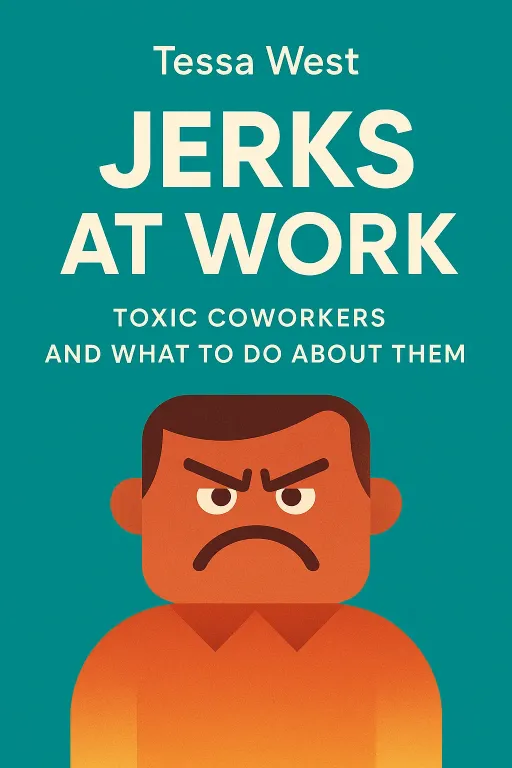
Nova: That is the perfect analogy. We are going to talk about how to map those icebergs. Today, we are pulling insights from two heavy hitters in organizational psychology. First, there is Jerks at Work by Tessa West. She is a behavioral scientist at NYU, and she brings a truly surgical precision to diagnosing exactly why people act like saboteurs.
Atlas: I have heard her work described as a diagnostic manual for human behavior. It is fascinating because most advice on this topic is just venting. She actually breaks down the mechanics of the behavior.
Nova: Exactly. And we are pairing that with The Asshole Survival Guide by Robert I. Sutton. He is a professor at Stanford, and he has spent decades documenting the psychological toll of toxic colleagues. His approach is less about fixing the other person and more about building a defensive fortress for your own sanity.
Atlas: I love that pairing. One gives you the diagnostic lens to see what is happening, and the other gives you the armor to survive it. It is the perfect toolkit for anyone trying to lead with empathy while being surrounded by, well, difficult people.
The Behavioral Diagnostic
SECTION
Nova: Let us start with Tessa West’s perspective. She argues that we often mislabel toxic behavior. We call someone a jerk, we vent about them, and then we wait for them to change. West suggests that this is a losing game because it relies on the other person having self-awareness.
Atlas: That makes perfect sense. I see this all the time. Someone gets passed over for a promotion, and they immediately label their manager as a villain. But what if the manager isn't a villain? What if they are just operating under a different incentive structure?
Nova: That is the breakthrough moment. West identifies specific archetypes. For example, the Kiss-Up/Kick-Downer. This is the person who is charming and sycophantic to leadership but treats their peers or direct reports with absolute contempt.
Atlas: I have worked with that person. It is incredibly disorienting because if you go to leadership, they look at you like you are crazy. They say, but that person is so helpful and enthusiastic.
Nova: Precisely. And that is why the behavioral diagnostic is so important. You have to stop looking at the behavior in a vacuum and start looking at the of the behavior. If you are the target, you need to document the specific instances where the behavior changes based on who is in the room. This isn't about being petty; it is about creating an objective record.
Atlas: That feels like a massive shift in mindset. Instead of internalizing the conflict, you are externalizing it into data. What is the most common mistake people make when they are in the crosshairs of someone like that?
Nova: The biggest mistake is trying to confront them directly without preparation. When you confront a saboteur, they often double down. They turn the narrative against you. They frame you as the difficult one, or the person who cannot handle constructive feedback.
Atlas: That feels dangerous. If you confront them, you are playing their game on their home turf.
Nova: Exactly. You are playing a game of emotions and optics, and they are already winning that game. West suggests that you need to shift your focus to what she calls the "feedback loop." You need to isolate the behavior. If someone is a credit-stealer, for instance, you don't call them out in a meeting. You start adding your name to documents, you send follow-up emails summarizing your contributions, and you make sure your work is visible to others before it even reaches them. You are essentially building a firewall.
Atlas: I can see how that would work. It is not about confrontation; it is about creating visibility. It is about making it harder for them to hide their behavior. But what about the mental toll? Even if you are documenting everything, being around that kind of energy is exhausting. That is where Sutton’s work comes in, right?
The Defensive Fortress
SECTION
Nova: That is exactly where Robert I. Sutton enters the conversation. His approach in The Asshole Survival Guide is fundamentally about psychological safety. He posits that you cannot always change the culture, and you certainly cannot change the person. Therefore, you must change your interaction.
Atlas: That is a tough pill to swallow for high-achieving leaders who want to fix everything. We are conditioned to believe that if we just communicate better, or if we just set better boundaries, the other person will see the light.
Nova: Sutton would argue that is a fundamental misunderstanding of the toxic personality. He uses the term "Asshole" not as a personality trait, but as a behavior. It is a set of actions that demeans, belittles, or humiliates others. And the most important thing he teaches is the concept of "The Filter."
Atlas: What does he mean by that?
Nova: Imagine you have a mental filter. When you interact with a toxic person, you have to decide what information gets through to your core self. If you take their behavior personally, you are letting their toxicity bypass your filter. You are letting them define your worth.
Atlas: That is such a vital distinction. It is the difference between saying, "This person is acting like a jerk because they are insecure," versus "This person is acting like a jerk because I am not good enough."
Nova: Right. Sutton suggests specific tactical withdrawals. If you are in a meeting and someone starts to demean you, you don't have to engage. You can physically remove yourself. You can go to the bathroom, you can get water, you can ask for a break. You are breaking the pattern of the interaction.
Atlas: That sounds simple, but in a high-pressure environment, it feels impossible. What if it is your boss? What if it is a client?
Nova: That is the beauty of the strategy. It is about creating distance, not necessarily physical distance, but psychological distance. Sutton talks about "emotional detachment." You treat the interaction like a clinical study. You observe them, you take notes, you minimize the emotional connection. You become an anthropologist in your own office.
Atlas: I love that. You are observing the "jerk" as if they are a specimen in a lab. It removes the sting. Instead of feeling hurt, you feel curious. You ask yourself, "Wow, why would they feel the need to say that right now? What are they trying to achieve?"
Nova: Exactly. You are reclaiming your agency. You are no longer a victim of their behavior; you are a student of it. This allows you to maintain your focus on your goals, on your team, and on your own growth, rather than getting sucked into their vacuum of negativity.
The Systemic Solution
SECTION
Atlas: We have covered the individual defense, but what about the team? If I am a leader, I cannot just teach my team to be anthropologists. I have to change the environment. How do we prevent this behavior from becoming the norm?
Nova: This leads us to the most practical takeaway from both authors. You have to create a "Solution-First Protocol." I call it the "no-complaining without a solution" rule.
Atlas: That sounds like a classic management trope, but I suspect you mean something deeper.
Nova: It is much deeper. Most of the time, workplace friction starts with venting. Someone comes to you, they complain about a project, they complain about a teammate, they complain about the process. If you listen, you validate the toxicity. You are essentially pouring gasoline on the fire.
Atlas: I see where you are going. By listening, you are signaling that this is the currency of your team—complaining.
Nova: Exactly. You are inadvertently creating a culture where problems are discussed, but never solved. The rule is simple: If you have a complaint, you must pair it with a proposed solution. It does not have to be the right solution. It just has to be a thoughtful attempt at fixing the issue.
Atlas: What happens when they don't have a solution?
Nova: Then the conversation stops. You say, "I hear that this is frustrating. Take some time to think about a potential solution, and let’s come back and discuss it when you have a plan." You are training your team to move from a "problem-focused" mindset to a "solution-focused" mindset.
Atlas: That is brilliant. It immediately shifts the energy. It stops the vent session before it starts. And it forces people to think critically about the issues they are facing.
Nova: And there is a second layer to this. You should be mapping your team’s dynamics. You need to look at who is talking to whom, who is withholding information, and where the bottlenecks are. West suggests that conflict often happens in the "blind spots" of a team.
Atlas: How do you map that? It sounds like you need to be a fly on the wall.
Nova: You don't need to be a spy. You just need to observe the flow of information. Who is the person who always seems to be left out of the loop? Who is the person who is always the bottleneck for approvals? Who is the person who is always complaining to you, but never to the person they have an issue with?
Atlas: That is so true. The "triangulation" is the biggest killer of team morale. Person A complains to you about Person B, but never talks to Person B.
Nova: That is the definition of toxic friction. Your job as a leader is to break that triangle. When someone comes to you to complain about a peer, your response should be, "Have you talked to them about this?" If the answer is no, your next sentence is, "Go have that conversation, and if you still need help, come back to me."
Atlas: That is uncomfortable, but it is necessary. It forces the accountability back onto the individuals where it belongs. It stops you from being the arbiter of petty disputes.
Nova: Exactly. You are not a referee; you are a leader. You are building a system where people are empowered to solve their own conflicts. That is the only way to build a sustainable, high-performing culture.
Synthesis & Takeaways
SECTION
Atlas: This has been a masterclass in shifting from reactive to proactive. We started by diagnosing the behavior using West’s lens, moved to protecting our own peace using Sutton’s armor, and finished by building a system that prevents the friction from taking root.
Nova: It really comes down to this: conflict is inevitable in any high-functioning team. Friction is actually a sign that people care, that they are pushing for results, and that they are passionate about their work. The goal is not to eliminate friction; the goal is to channel it into something productive.
Atlas: I love that reframe. Friction is energy. You can use it to create heat, or you can use it to create light.
Nova: That is a perfect way to put it. The "no-complaining without a solution" rule is the channel for that energy. It turns the friction of a problem into the light of a solution.
Atlas: I am going to challenge our listeners today. For the next week, I want you to try this. When you feel that urge to vent about a colleague or a process, stop. Ask yourself, "What is the solution I am proposing?" If you don't have one, don't complain. Sit with the problem until you have a path forward.
Nova: It will be uncomfortable at first. You will feel like you are suppressing your feelings. But what you are actually doing is sharpening your mind. You are training yourself to be an architect of solutions, not a victim of circumstances.
Atlas: That is a powerful shift. It is the difference between being a passenger in your career and being the driver.
Nova: And remember, if you find yourself dealing with someone who is truly toxic, someone who is undermining you, remember Sutton’s advice. You don't have to engage. You have the power to create distance. You have the power to protect your peace.
Atlas: It is about being a conscious leader. It is about balancing professional excellence with personal peace. We have the tools. Now we just have to use them.
Nova: Exactly. This is Aibrary. Congratulations on your growth!