Reclaiming Attention in a Hyper-Connected World
Golden Hook & Introduction
SECTION
Nova: Tech companies spend more time designing the specific pitch of the notification sound on your phone than most people spend planning their entire career. That notification is engineered to bypass your logic and hit your dopamine centers directly.
Atlas: That is a terrifying thought, but it explains why I reach for my phone before my feet even touch the floor in the morning. It feels less like a choice and more like a reflex.
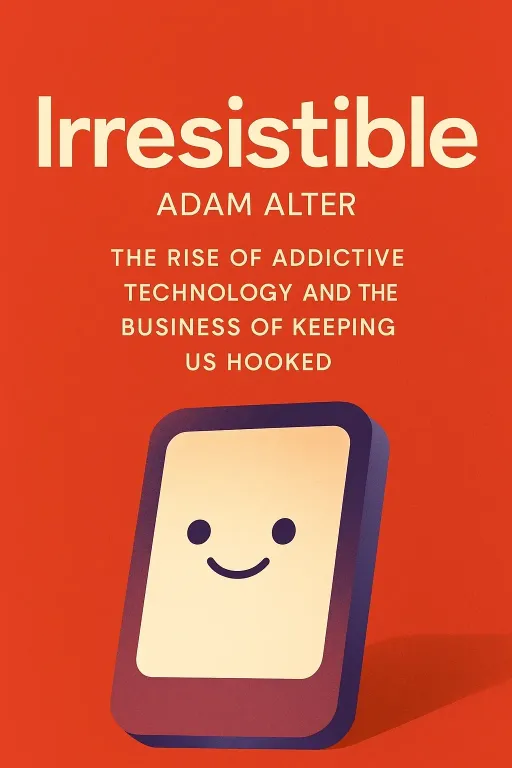
Nova: That reflex is exactly what Adam Alter explores in his book, Irresistible. He is a professor at NYU who spent years analyzing how technology companies use behavioral loops and variable rewards to hijack our attention. He effectively maps out how we have been turned into lab rats in a massive, global experiment.
Atlas: I have heard that term, variable rewards, thrown around, but it always felt a bit abstract. How does it actually work in the wild?
Nova: Think of it like a slot machine. If you pulled a lever and the machine paid out the exact same amount every time, you would get bored quickly. The magic, for the company, is in the unpredictability. You do not know if the next notification is a work email, a like on a photo, or a news headline. That uncertainty keeps your brain locked in a loop, constantly checking.
Atlas: That makes sense. It is the curiosity gap. But if the problem is that deep, is willpower even enough to fight it?
Nova: Alter argues that willpower is vastly overrated when you are up against an army of engineers and psychologists. To combat that, we need a different kind of framework. This is where we bring in Thich Nhat Hanh and his classic work, The Miracle of Mindfulness. Hanh was a Vietnamese Zen master and peace activist who introduced mindfulness to the West in a way that stripped away the esoteric mystery and focused on the practical mechanics of awareness.
Atlas: I know his name, but I usually associate him with meditation retreats and silence. How does a Zen master from the mid-twentieth century help me survive my inbox in the twenty-first century?
Nova: Because the core of his teaching is about reclaiming your presence during the mundane routines of life. He teaches that you do not need a mountain retreat to find peace. You can find it while washing dishes or walking to your car. He provides the cognitive architecture to stop the frantic, reactive mode that tech companies want us to live in.
The Mechanism of Hijacking
SECTION
Atlas: I want to dig into the tech side first. If my brain is being hijacked by these variable rewards, how do I even identify when it is happening? Because right now, it just feels like being busy.
Nova: The key is distinguishing between productivity and reactivity. When you are being productive, you are driving the ship. You have a goal, you execute, you finish. When you are being reactive, you are responding to a constant stream of external stimuli. Alter highlights that we often confuse the two. We feel a hit of dopamine every time we clear a notification, which makes us feel productive, but it is actually the opposite. It is cognitive fragmentation.
Atlas: I have definitely felt that. I call it the tab-switching syndrome. I have twenty tabs open, three apps running, and I am jumping between them every thirty seconds. It feels like I am accomplishing a lot, but by the end of the day, I have nothing tangible to show for it.
Nova: That is the perfect example of the loop. Alter points out that these platforms are designed without a natural stopping cue. In the past, if you read a magazine, you eventually reached the end. There was a natural pause. With a social media feed or an email inbox, there is no end. You scroll, and more content appears. You clear an email, and two more arrive. The system is designed to be infinite.
Atlas: That is the part that gets me. It is the infinite nature of it. I used to think I just lacked discipline. But what you are describing suggests the deck is stacked against us.
Nova: It absolutely is. You are fighting a billion-dollar algorithm with your prefrontal cortex, which is a resource that gets depleted throughout the day. Alter suggests that we need to stop relying on willpower and start relying on structural barriers. We have to design our environment to protect our attention.
Atlas: Okay, so if the environment is the problem, what is the fix? Do I just delete every app? Because that feels like a non-starter for anyone working in a modern office.
Nova: Deleting everything is a nice fantasy, but it is rarely practical for most of us. The better approach is to change the terms of engagement. This is where we pivot to the philosophy of Thich Nhat Hanh. He argues that the only way to reclaim your mind is to cultivate a practice of return. You must constantly return to the present moment.
The Practice of Presence
SECTION
Atlas: How does that apply to a high-pressure workday? I understand the concept of being present, but does that mean I should be mindfully answering a slack message?
Nova: It means you should be fully aware of the action you are taking, rather than being dragged along by the impulse to react. Hanh suggests that we can use our breath as an anchor. When you feel that twitch to check your phone, that is the moment to pause. You take one conscious breath. That single breath creates a gap.
Atlas: A gap between the stimulus and the response.
Nova: Exactly. In that gap, you regain agency. You can ask yourself, do I need to check this right now, or am I just looking for a distraction from the difficult task I am currently working on? Most of the time, we are not checking for information. We are checking to escape the discomfort of deep, focused work.
Atlas: That is a harsh truth. I do that constantly. I get stuck on a difficult paragraph or a complex spreadsheet, and suddenly I am checking the news. It is a defense mechanism.
Nova: It is a coping mechanism. We are using digital distraction to numb the discomfort of effort. Hanh’s work teaches us that discomfort is not something to be escaped; it is something to be observed. When you feel that urge to switch tasks, acknowledge it. Name it. Say, I am feeling an urge to distract myself. That act of naming it brings you back to the present.
Atlas: I like that. It turns the urge into an object of study rather than a command to act. But how do we bridge this with the tech environment? How do we build that digital sanctuary?
Nova: We combine the two. We use Alter’s insights to identify the triggers—the notifications, the infinite scrolls—and we use Hanh’s framework to build the barrier. The strategy is to create a digital sanctuary. This starts with a very specific, actionable rule: turn off every non-human notification.
Atlas: Every single one? Even the ones that seem important?
Nova: If it is a human trying to reach you, that is one thing. But if it is an app telling you that someone liked your post, or a news site telling you about a headline, or a game telling you it is time to play, that is non-human. Those are the ones designed to hijack your attention. You turn them off. You take the power back.
Atlas: I have done this with my phone, and it changed my life. I only allow calls and texts from actual people. Everything else is silent. It stopped the constant phantom vibrations in my pocket.
Nova: That is the first layer of the sanctuary. The second layer is the thirty-minute rule. This is the hardest part, but the most rewarding. Dedicate the first thirty minutes of your workday to deep, offline thinking. No email, no messaging apps, no browser. Just you and your work.
Implementing the Sanctuary
SECTION
Atlas: The first thirty minutes. That is when I usually scan my inbox to see if the world is on fire. What happens if I wait thirty minutes?
Nova: What happens is that you prioritize your agenda over everyone else's. When you start your day by checking email, you are essentially telling the world that their priorities are more important than yours. You are starting in a reactive state. By protecting those first thirty minutes, you are setting the tone of the day. You are the architect of your morning, not the janitor cleaning up the digital debris.
Atlas: I can see the logic, but I also hear the objection. People will say, what if there is an emergency? What if my boss needs me?
Nova: We have to be honest about what constitutes an emergency. Most things that land in an inbox are not emergencies. They are requests. If there is a true emergency, people have ways of reaching you. But we have conditioned ourselves to treat every notification as a high-priority event. We have lost the ability to distinguish between urgent and important.
Atlas: It is a cultural conditioning. We value speed over quality. We think that responding in five seconds makes us valuable.
Nova: And that is exactly what the tech companies want us to believe. They want us to stay in that loop. But consider the long-term cost. If you never have thirty minutes of uninterrupted time, you never reach the state of deep work where real breakthroughs happen. You are essentially capping your own potential by staying in the shallows of reactive communication.
Atlas: I think I am ready to try this. But I need to know how to handle the withdrawal. Because when I turn off those notifications and try to sit with my work for thirty minutes, I know I am going to feel itchy.
Nova: That itch is the proof that the system was working. It is the proof that you were being conditioned. When you feel it, use Hanh’s practice. Breathe. Acknowledge the itch. Do not fight it, but do not feed it either. Just sit with it. Over time, that itch will fade. Your attention span will recover, and you will find that you can focus for longer and longer periods.
Atlas: It sounds like building a muscle. You do not go to the gym and lift the heaviest weight on day one. You start with a set, you rest, you build up.
Nova: That is a perfect analogy. You are training the muscle of your attention. You are moving from a passive consumer of digital content to an active curator of your own cognitive space. You are deciding what gets in and what stays out.
Synthesis & Takeaways
SECTION
Atlas: We have covered a lot of ground here, moving from the psychological design of tech to the ancient practice of mindfulness. If I were to boil this down to a single takeaway for someone listening who feels overwhelmed, what would it be?
Nova: The takeaway is that your attention is your most valuable asset. It is the currency of your life. When you give it away to an algorithm for free, you are losing more than just time; you are losing your agency. The digital sanctuary is not about rejecting technology; it is about reclaiming the right to decide where your mind goes.
Atlas: I really like that framing. It is not about being a Luddite; it is about being a sovereign individual.
Nova: Exactly. You can still use the tools, but you use them on your terms. You check the email when you are ready, not when the notification pings. You scroll when you choose, not when the algorithm prompts. You are the one driving the ship.
Atlas: That feels like a much more sustainable way to work and live. It shifts the power dynamic.
Nova: It does. And the beauty is that it starts with something as simple as one breath and one thirty-minute block of time. You do not need to overhaul your entire life overnight. You just need to reclaim the next thirty minutes.
Atlas: I am going to try the thirty-minute block tomorrow morning. No phone, no email, just a notepad and a pen.
Nova: That is the best way to start. Remember, the goal is not perfection; it is presence. Every time you catch yourself drifting back into the loop, just breathe and return. That is the practice.
Atlas: This has been a great reminder that we have more control than we think. We just have to be willing to exercise it.
Nova: We do. And as we continue to build these foundations, we find that the world becomes a little less noisy and a little more manageable.
Atlas: Thank you for breaking this down. It makes the digital world feel a lot less like a trap and a lot more like a tool.
Nova: My pleasure. It is always a good time to sharpen our focus. This is Aibrary. Congratulations on your growth!