Decoding Irrationality: From Boardrooms to Battlefields
Golden Hook & Introduction
SECTION
Nova: What do the 1941 attack on Pearl Harbor and a failing multi-million dollar corporate project have in common? They are both catastrophic failures fueled by the same predictable, human irrationality. We think of ourselves as rational, especially in high-stakes jobs. But what if the very structure of our teams and the wiring of our brains sets us up to fail?
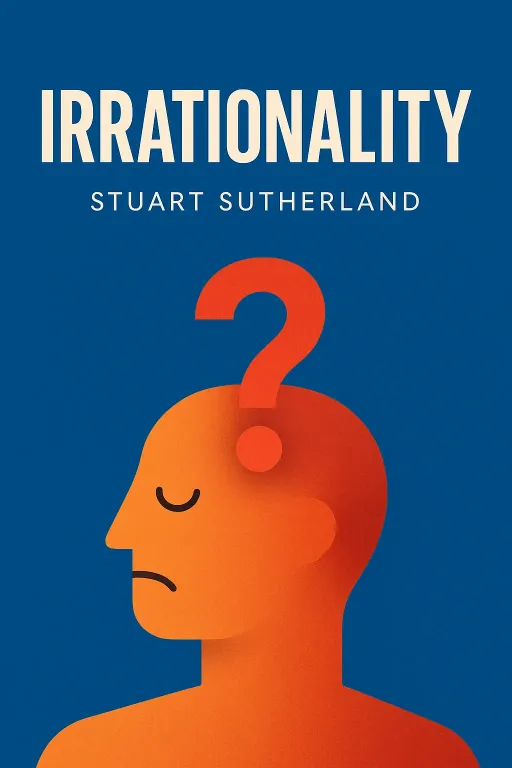
Nova: Welcome to the show. Today we're diving into a fascinating and frankly, slightly terrifying book: "Irrationality" by Stuart Sutherland. It’s a classic exploration of the many ways our thinking goes off the rails. And I'm so thrilled to have sikons18373 here to discuss it. With a background as a product manager in finance and a deep interest in history and politics, he's the perfect person to help us connect these psychological ideas to the real world. Welcome, sikons18373.
sikons18373: Thanks for having me, Nova. This book is a goldmine. It’s unsettling to see how many of these irrational patterns show up in places where you'd expect pure logic to rule.
Nova: Exactly. And that's our mission today. In our conversation, inspired by Sutherland's work, we're going to tackle this from two powerful perspectives. First, we'll explore the 'Situational Trap,' looking at how authority and group pressure can lead to historic blunders. Then, we'll turn inward to discuss the 'Self-Imposed Trap,' uncovering why the sunk cost fallacy keeps us chained to bad decisions, from the battlefield to the boardroom.
Deep Dive into Core Topic 1: The Situational Trap
SECTION
Nova: So let's start with that situational trap. It's one thing to make a mistake on your own, but Sutherland argues that some of the biggest irrationalities happen when we're following orders or conforming to a group. He points to one of the most famous and unsettling experiments in psychology: the Milgram experiment.
sikons18373: I've heard of this one. It's chilling.
Nova: It really is. So, for our listeners, imagine this: in the 1960s, psychologist Stanley Milgram invites ordinary people to a lab at Yale. They're told it's a study on learning. They're assigned the role of "teacher," and in the next room is a "learner," who is actually an actor. The teacher's job is to administer an electric shock to the learner for every wrong answer.
sikons18373: And the shocks aren't real, but the teacher doesn't know that.
Nova: Precisely. In front of the teacher is a big, intimidating shock generator with switches starting at 'Slight Shock' and going all the way up to 450 volts, marked 'Danger: Severe Shock.' As the test goes on, the learner starts groaning, then shouting, then screaming that he has a heart condition and wants to stop. Eventually, he just falls silent, as if he's unconscious or worse.
sikons18373: And the whole time, there's an authority figure in a lab coat in the room with the teacher.
Nova: Yes, an experimenter who calmly says things like, "The experiment requires that you continue," or "You have no other choice, you must go on." The shocking result? In the original experiment, about two-thirds of these normal, everyday people went all the way to the 450-volt shock. They obeyed.
Nova: sikons18373, hearing that, it's easy for us to think, 'Oh, I would never do that.' But as a product manager in a structured corporate environment, does that dynamic of deferring to an 'expert' or an authority figure, even with nagging doubts, feel familiar?
sikons18373: Absolutely. It's less dramatic, of course, but you see a version of it in meetings all the time. A senior VP, the 'person in the lab coat,' states a strong opinion on a product feature. Even if the user data or the engineers' feedback suggests otherwise, you can feel the room's momentum shift to align with that authority. It's not malicious; it's a deep-seated instinct to trust the expert, to not rock the boat. The cost of being wrong by obeying is often perceived as lower than the social cost of being right by disobeying.
Nova: That's a perfect bridge to how this plays out on a massive scale. Let's look at Pearl Harbor in 1941, an example the book details. Admiral Kimmel, the Commander in Chief of the Pacific Fleet, received multiple, increasingly urgent warnings from Washington about a potential surprise Japanese attack.
sikons18373: So he had the data, the signals were there.
Nova: The signals were absolutely there. But Kimmel and his staff were locked into a group belief system. The book describes how on November 24th, a warning came of a 'surprise aggressive movement in any direction.' Kimmel's staff met and essentially reassured each other that Pearl Harbor wasn't at risk because it wasn't specifically mentioned. They twisted the evidence to fit their belief.
sikons18373: That's classic groupthink. The desire for harmony and consensus in the group overrides a realistic appraisal of alternatives.
Nova: It gets worse. They decoded a Japanese message ordering embassies to destroy their codes—a clear sign of impending war. But Kimmel's staff focused on the word 'most,' arguing it meant Japan wasn't planning a full-scale war. The final, most damning piece of evidence came just an hour before the attack. An American ship sank a Japanese submarine right at the entrance to the harbor. The message reached Kimmel. His response? To wait for confirmation.
sikons18373: Wow. That's a catastrophic failure of data interpretation. They had all these signals, but they were filtered through a powerful, pre-existing belief: 'An attack here is impossible.' In product management, we see this constantly. We call it confirmation bias. You have user feedback or analytics data pointing to a serious flaw in your product, but the team dismisses it because it doesn't fit the 'story' of the product we're building. The outcome is obviously less tragic, but the psychological mechanism is identical. You find reasons to ignore the data that contradicts your plan.
Deep Dive into Core Topic 2: The Self-Imposed Trap
SECTION
Nova: Exactly! And that tendency to stick to our story, to our initial decision, leads us directly to our second trap: the self-imposed one. This is the irrational need for consistency, which gives rise to one of the most famous biases in business and finance: the sunk cost fallacy.
sikons18373: The bane of every product manager's existence.
Nova: I can only imagine! Sutherland uses a brutal historical example: General Haig at the Battle of the Somme in World War I. On the very first day, the British army suffered 57,000 casualties for almost no strategic gain. The evidence was immediate and overwhelming: the strategy was a slaughter.
sikons18373: So the rational decision would be to stop, to pivot, to completely rethink the approach.
Nova: You'd think so. But having invested so much—so many lives, so many resources, so much national prestige—Haig couldn't bring himself to admit the initial decision was a catastrophic failure. He continued the same frontal attacks for months. By the end, there were over a million casualties on all sides. He was irrationally trying to 'get his money's worth' from the initial, horrific investment of lives.
Nova: It's a horrifying example, but sikons18373, this idea of 'we've come too far to turn back now' must be a constant battle in product development and finance.
sikons18373: It's the single biggest challenge. You have a project that's six months in, millions of dollars spent. The market has shifted, or a competitor has launched something better, or user testing shows people just don't want the feature. The rational decision is to cut your losses and pivot the team to something more valuable.
Nova: But the irrational force is immense.
sikons18373: Immense. You have to justify the past six months of work to leadership. Your team's morale is tied to shipping. So you pour more resources in, hoping to salvage the initial investment. It's the 'one more feature' syndrome, or the 'it will get better with the next update' excuse. It's all born from the sunk cost fallacy. We're not making a decision based on future potential; we're making it to validate a past decision.
Nova: The book has a much simpler, more relatable example of this too.
sikons18373: Yes, the bad movie! I loved that one. You pay fifteen dollars for a movie ticket, and thirty minutes in, you realize it's terrible. The rational choice is to leave. You've already lost the fifteen dollars—that's the sunk cost. By staying, you're now also losing two hours of your life. You're choosing to suffer a double loss. But we feel we have to 'get our money's worth,' so we sit there, miserable, compounding the irrationality. It's the same logic as General Haig, just with popcorn instead of artillery.
Synthesis & Takeaways
SECTION
Nova: So we have these two powerful forces pushing us toward irrationality. On one hand, the external pressure of the group and authority, making us doubt our own judgment. And on the other, the internal pressure to justify our past selves and our past investments.
sikons18373: And what's so striking from the book is that these traps aren't about being unintelligent or a bad person. Kimmel and Haig were considered brilliant men. The people in the Milgram experiment were ordinary, good people. It's about the flaws in the of thinking that can catch anyone.
Nova: It's a humbling thought, isn't it? That we're all susceptible. So, sikons18373, for our listeners who are in these decision-making roles every day, what's one practical way to start fighting back against these traps?
sikons18373: I think it's about building safeguards into your process, because you can't trust yourself to be rational in the moment. For groupthink and obedience, a powerful tool is to formally assign a 'devil's advocate' in important meetings. This is someone whose only job is to argue against the consensus, to poke holes in the plan. It gives social permission for dissent and forces the group to confront contradictory evidence.
Nova: I love that. It institutionalizes skepticism. What about for the sunk cost trap?
sikons18373: For sunk costs, the key is to reframe the decision. Don't ask, 'Should we continue to invest in this project?' That question is loaded with all the baggage of past investment. Instead, ask the team: 'If we were a new company starting from scratch today, with zero dollars invested, and we were given this project's current assets and market position, would we choose to fund it?' That question mentally erases the sunk costs and lets you make a purely forward-looking, rational decision.
Nova: That is a brilliant mental switch. Don't ask 'Should we continue?', ask 'Should we start?'. That might be the most valuable takeaway from this entire conversation. sikons18373, thank you so much for sharing your insights. This was fantastic.
sikons18373: My pleasure, Nova. It was a great discussion.